This article contains affiliate links. We may earn a commission if you make a purchase through our links, at no extra cost to you.
Key Takeaways
- Noise sensitivity is a brain difference, not an ear problem. Autistic children usually have normal hearing tests; what differs is how the nervous system reacts to sound and habituates to it.
- It is very common. A 2021 review found 50 to 70 percent of autistic people show decreased sound tolerance at some point in their lives.
- Ear defenders and filtering earplugs do different jobs. Earmuffs block bluntly, filtering earplugs lower volume while keeping speech intelligible, and active noise cancellation is not rated hearing protection.
- All-day ear protection is genuinely contested. Several NHS audiology services advise against routine use; other clinicians support targeted use. The published evidence does not settle it.
- Not every auditory sensory need is about avoiding sound. Humming, shouting and banging are often regulation strategies that need outlets, not suppression.
- Precision matters. Hyperacusis, misophonia, phonophobia and general noise sensitivity are four different pictures, and they respond to different support.
Autism noise sensitivity is a difference in how the brain processes sound, not a fault in the ears. A child can pass a standard hearing test in the morning and still need to leave the school assembly by ten. The sound arrives at the ear normally. What the nervous system does with it next is what differs.
That difference is not rare. According to a 2021 review in Neuroscience and Biobehavioral Reviews, 50 to 70 percent of autistic people exhibit decreased sound tolerance at some point in their lives, and the review describes it as a source of significant distress across the lifespan, linked to anxiety, reduced community participation and difficulties at school and work. In a survey of 161 parents of autistic children aged 4 to 12 in Brazil, published in European Psychiatry, 67.1 percent reported auditory hypersensitivity in their child. The behaviours parents most often linked to it were difficulty sleeping (79.8 percent), difficulty concentrating (76.8 percent) and covering the ears (74.8 percent).
If you have ever abandoned a supermarket trolley mid-aisle, you already know the practical version of those numbers.
This guide is the hub of our auditory sensory series: the mechanism, the tools worth owning, the strategies that cost nothing, the honest argument about whether ear protection helps or hurts long term, and the half of the picture that gets ignored — children who chase sound rather than flee it. Where the evidence is thin, we say so.
Table of Contents
- Why Sound Feels Different: The Auditory Sense in Autism
- Noise-Cancelling Headphones and Ear Defenders
- Filtering Earplugs: Loop-Style and Beyond
- Strategies That Need No Equipment
- Headphones or Earplugs: Choosing Between Them
- Auditory Support in the Classroom
- Auditory Seekers: The Other Half of the Picture
- Hyperacusis, Misophonia and Sensory Overload
- Noise Sensitivity in Teens and Adults
- Planning Outings: Fireworks, Haircuts and Crowds
- Calming Sound: Using Auditory Input on Purpose
- Toddlers and Babies: Starting Early
- Frequently Asked Questions
- Conclusion
Why Sound Feels Different: The Auditory Sense in Autism
The ears are usually fine. The difference sits upstream, in how the brain weighs sound and gets used to it. According to SPARK for Autism, a Simons Foundation research initiative, studies have found no difference in the hearing of children with and without autism, at least on tests that do not require a behavioural response, but autistic children showed stronger autonomic reactions to noise, greater activity in brain regions including the amygdala, and were less likely to get used to repeated sounds.
That last point is the one worth carrying around. Most nervous systems habituate: the fridge hum disappears after a minute, the classroom fan stops existing. When habituation does not happen reliably, the fridge stays loud all afternoon, and the twentieth hand dryer of the week is still the first one.
Sensory reactivity is written into the diagnostic criteria. The DSM-5 lists hyper- or hyporeactivity to sensory input among the restricted and repetitive behaviour features, giving "adverse response to specific sounds" as an explicit example, as summarised by the Children's Hospital of Philadelphia Center for Autism Research.
Understanding why sound sensitivity happens changes how you respond, because a processing difference asks for a different answer than a behaviour problem does. You are not managing defiance. You are managing input load.
It is also not exclusive to autism. Research using the Sensory Processing Three Dimensions assessment found auditory over-responsivity, tactile over-responsivity or both in 54 percent of a broad cohort of children with neurodevelopmental concerns, with auditory over-responsivity more than twice as prevalent as tactile, per the study in the Journal of Autism and Developmental Disorders.
What it tends to look like day to day
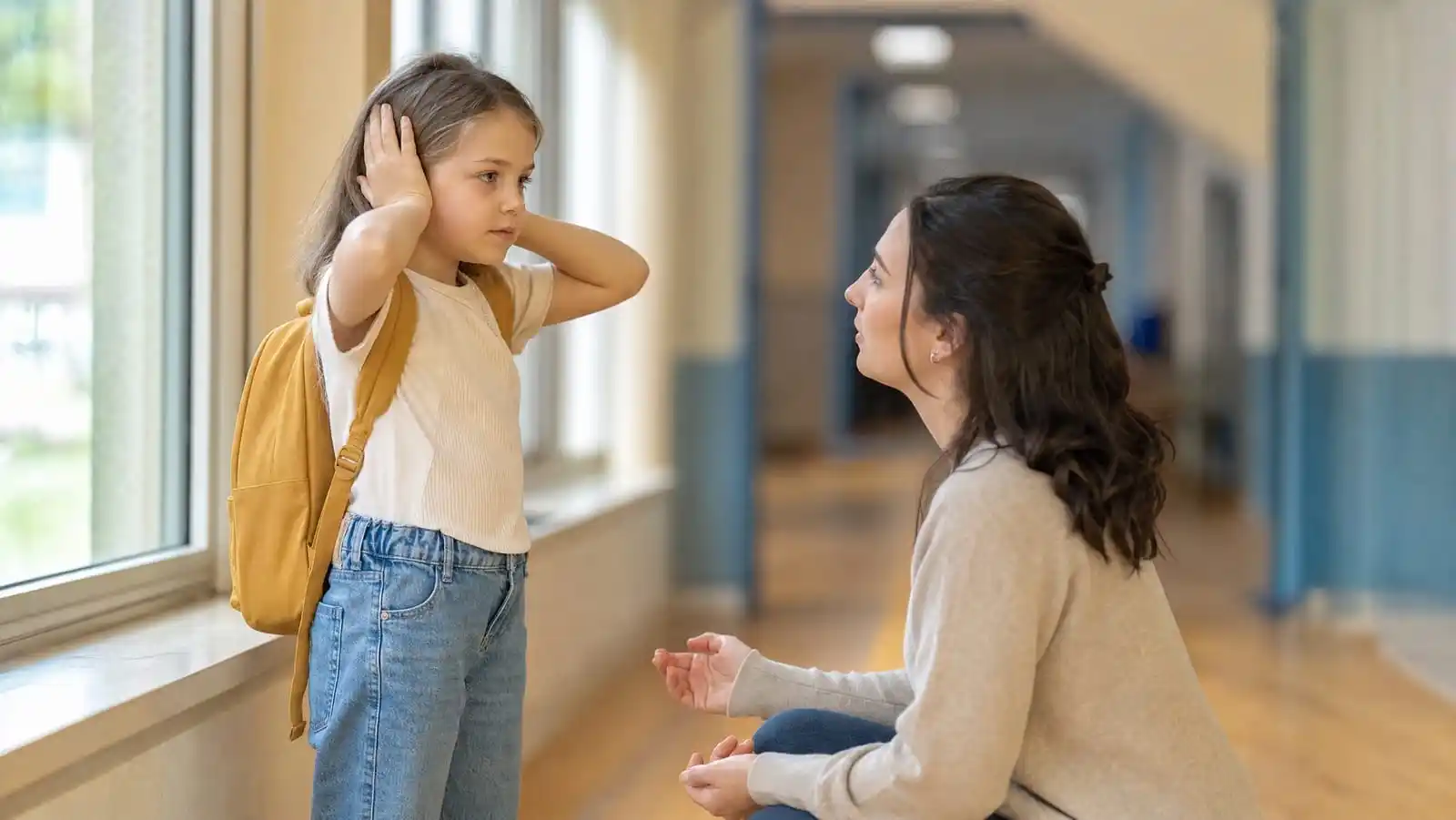
- Hands clamped over ears, or one ear pressed into a shoulder
- Bolting from bathrooms, assemblies, restaurants or birthday parties
- Escalation that seems to come from nowhere in a busy room
- Flat refusal of specific appliances: blender, vacuum, hand dryer, toilet flush
- Exhaustion and meltdown after school rather than during it
- Constant humming, which can be a way of covering other sound
Noise-Cancelling Headphones and Ear Defenders
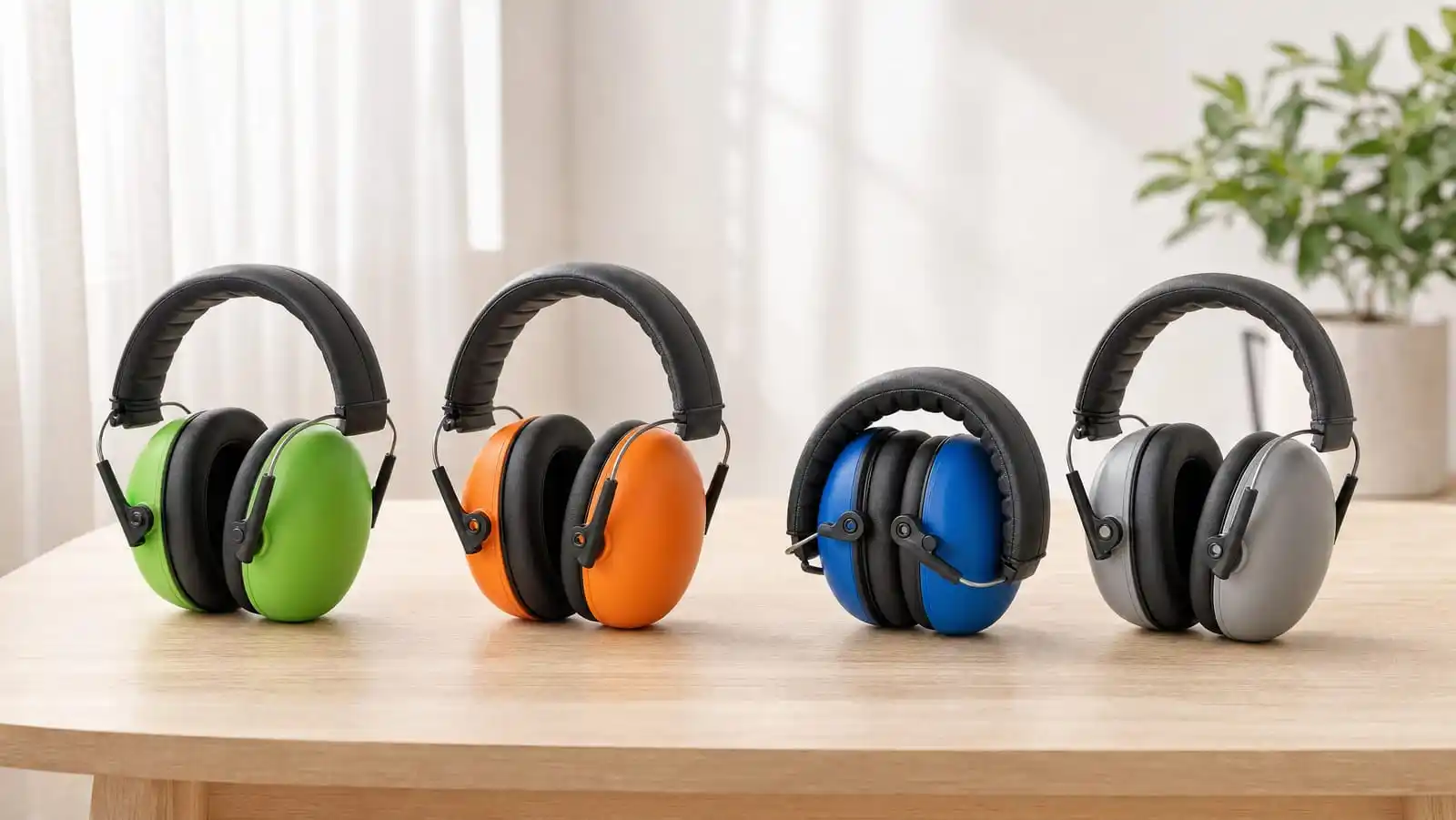
Three different technologies get lumped under one name. Passive ear defenders are sealed earmuffs that physically block sound. Active noise-cancelling headphones generate an opposing wave to reduce steady, low-frequency noise such as engine hum. Many children need one and not the other.
Passive ear defenders carry a Noise Reduction Rating, which the US Environmental Protection Agency requires on hearing protector packaging under 40 CFR Part 211. Treat it as optimistic. OSHA's mandatory Appendix B to 29 CFR 1910.95 requires subtracting 7 dB from the NRR when exposure is measured in A-weighted decibels, and cautions that "calculated attenuation values reflect realistic values only to the extent that the protectors are properly fitted and worn"; OSHA's hearing conservation enforcement guidance goes further and recommends halving the labelled NRR, which is where the common field formula of subtracting 7 and dividing by two comes from. An NRR of 25 dB does not mean 25 dB quieter on a wriggling six-year-old.
Active noise cancellation is a comfort tool, not hearing protection. Cory Portnuff, AuD, PhD, an audiologist at the University of Colorado School of Medicine, told CU Anschutz News that noise-cancelling headphones "are not good enough to be protective from damaging your hearing around loud sounds like a lawnmower."
There is some direct evidence for the calming effect. In a single-subject study of six autistic children aged 8 to 16, published in Frontiers in Integrative Neuroscience, noise-attenuating headphones produced a significant difference in skin conductance between baseline and intervention, with arousal staying stable even as environmental noise rose. The authors list the limitations themselves: six participants, a 50 percent dropout rate from the original twelve, and a quasi-experimental design. A promising signal, not proof.
Comparing the best noise-cancelling headphones for autism is less about brand than about whether a child keeps them on: clamp force, ear cup depth, weight, heat, and whether they come off independently. The trade-off nobody mentions is social — visible earmuffs in a school corridor invite comment, and some children choose the noise over the attention.
The honest argument about all-day use
Several NHS audiology services advise against routine ear protection for sound-sensitive children. The leaflet from Hull University Teaching Hospitals NHS Trust states plainly: "try to avoid giving your child earplugs or ear defenders. These can actually cause your child's ears to become more sensitive." The proposed mechanism is that the auditory system turns up its own internal gain to compensate. Other clinicians, and many autistic adults, argue the opposite: without protection, some environments are simply inaccessible. The published evidence does not settle this. The middle path many occupational therapists use is targeted use for known-loud events rather than default use all day, reviewed with an audiologist if sensitivity seems to be growing.
Filtering Earplugs: Loop-Style and Beyond
Filtering earplugs aim to turn the world down rather than off. Where foam plugs and sealed earmuffs block broadly, filtered or attenuating earplugs pass sound through a small acoustic channel or membrane, lowering the level while keeping speech comparatively intelligible. That matters for a child who wants to stay at the party rather than sit outside it.
The category grew out of musicians' products, and neurodivergent adults adopted it early. The appeal: nearly invisible, light enough to forget about, and a child can still hear you say their name.
The trade-offs are real. Small ear canals come first: many filtering plugs ship with several tip sizes, but a child's canal may still be too small for a reliable seal, and a poor seal means the stated attenuation does not happen. Insertion is a fine-motor task some children cannot manage alone. Children with tactile defensiveness often find anything inside the ear intolerable, in which case earmuffs win by default. And earplugs are easy to lose, which is a budget question as much as a practical one.
Choosing the best earplugs for sensory-sensitive kids usually comes down to whether a child can insert and remove them independently, whether they tolerate the in-ear sensation at all, and whether the attenuation actually matches the environment you are buying them for. A plug designed to take the edge off a restaurant is not the plug for a firework display.
Small parts, small ears
Earplugs and their interchangeable tips are small detachable parts and present a choking and ingestion risk for young children and for any child who mouths objects. They can also be pushed too far into the ear canal. Do not use earplugs with toddlers, do not leave them within reach of younger siblings, and speak to a GP or audiologist before using in-ear devices with a child who has grommets, ear tubes, an ear infection or a history of impacted wax.
Strategies That Need No Equipment
The cheapest interventions give a child control back, and control is what loud environments take away. A sound you can predict, start, stop or escape is processed very differently from a sound that ambushes you.
Start with warning. Telling a child that the hand dryer is about to go, or that the fire alarm test is at 11am on Tuesday, removes the startle component even when the volume is unchanged. Then add agency: let them press the blender button, hold the vacuum, flush the toilet themselves. Being the source of a noise is more tolerable than being the target.
Build a reliable exit. A child who knows they can leave will usually stay longer than one who does not. Agree the signal in advance — a card, a word, a hand on your arm — and honour it the first time, every time, so it stays trustworthy.
You can also change the room rather than the child. Rugs, curtains, cushions and felt pads on chair legs reduce reverberation, which is what makes a hard-surfaced kitchen or hall so punishing. The leaflet from Hull University Teaching Hospitals suggests gentle background sounds so that sudden loud noises are less shocking, alongside comforting the child, preparing them before loud sounds occur, and gradually re-introducing distressing sounds at increasing volumes.
The noise sensitivity strategies that need no equipment are often the ones families rely on most, because they travel, cost nothing and cannot be left on the bus.
A starter list
- Warn before every predictable loud event, including ones you find trivial
- Hand over the button on appliances wherever it is safe to do so
- Agree an exit signal and respond to it immediately
- Cut reverberation with rugs, curtains and felt pads before buying anything
- Shorten the exposure rather than removing the activity entirely
- Protect the hour after school, when accumulated load usually surfaces
Headphones or Earplugs: Choosing Between Them
Pick by environment and by the child's tolerance for things touching them, not by which product is better. Both categories work. They fail in different places.
Framing the decision as ear defenders versus earplugs helps, because the two solve nearly opposite problems. Earmuffs give strong, blunt attenuation and go on in two seconds. Earplugs give gentler, more selective attenuation and disappear socially. A child who needs to survive a stadium needs the first. A child who needs to stay in a noisy classroom and still hear the teacher usually needs the second.
| Consideration | Passive ear defenders | Filtering earplugs | Active noise-cancelling headphones | |---|---|---|---| | Best for | Fireworks, alarms, crowds, motor events | Classrooms, restaurants, shops, gatherings | Cars, planes, trains, steady mechanical hum | | Speech intelligibility | Reduced | Largely preserved | Varies by device and mode | | Visibility to peers | High | Very low | Moderate to high | | Independence for a young child | Easy on and off | Harder, fine-motor task | Easy on and off | | Tactile tolerance needed | Pressure on head and ears | Sensation inside the ear canal | Pressure on head and ears | | Rated hearing protection | Yes, carries an NRR | Only if the pack states an NRR or SNR | No, per audiology guidance | | Main failure mode | Heat, clamp force, refusal | Poor seal, loss, small canals | Battery, cost, no impact protection |
Most families who use these long term end up owning two: one blunt instrument for the genuinely loud, one discreet option for everyday overwhelm. That is not over-buying. It is the difference between a tool that works in a stadium and one that works in a maths lesson.
Whichever you choose, watch how often it is reached for. A steady increase in demand is worth raising with an audiologist or occupational therapist, both because sensitivity may be changing and because an environmental change may do the job better.
Auditory Support in the Classroom
Classrooms are acoustically hostile before anyone adds a child with sensitive hearing, and the standards that exist are widely missed. Research published in Ear and Hearing notes that the American Speech-Language-Hearing Association recommends a signal-to-noise ratio of at least plus 15 dB in classrooms, and that the ANSI/ASA S12.60 standard sets maximum unoccupied background noise at 35 dBA with reverberation time capped at 0.6 seconds for classrooms under 283 cubic metres.
Translated: the teacher's voice should sit roughly fifteen decibels above the background, the empty room should be about as quiet as a library, and sound should stop bouncing quickly. Most real classrooms miss at least one, and when they do, a sound-sensitive child spends their cognitive budget on decoding before the learning starts.
Choosing auditory sensory tools for the classroom therefore means fixing the room first and equipping the child second, because a child in ear defenders in a reverberant room is still in a reverberant room.
Room-level changes worth requesting
- Felt pads or split tennis balls on every chair and table leg
- Soft surfaces: display boards, rugs, curtains, fabric wall hangings
- Seating away from the door, corridor, projector fan and air conditioning unit
- Advance warning of fire drills given to the child, not just to staff
- A designated quiet exit the child can use without asking each time
Child-level supports to write down
Ask that access to ear defenders or earplugs is recorded in the IEP, 504 plan or equivalent, with the conditions spelled out: which lessons, who stores them, what happens if they are forgotten. Written access prevents the common scenario where one supply teacher decides the headphones are a distraction. Include a plan for assemblies, fire drills and the dining hall, usually the three worst points of the day.
Auditory Seekers: The Other Half of the Picture
Not every auditory sensory difference points away from sound. Plenty of children chase it. The DSM-5 criterion covers hyper- and hyporeactivity, and the same child can be both, on different days and with different sounds.
An auditory seeker hums continuously, shouts rather than speaks, bangs objects to hear them ring, replays the same six seconds of a video, or stands under the speaker at a party. It reads as disruptive. It is usually regulation.
The National Autistic Society describes stimming as self-stimulating or self-regulating behaviour, and notes that autistic people use repeated behaviours such as saying a word or listening to a song on repeat for sensory input and enjoyment, and to stay calm. Its position is that stimming is generally beneficial and that support should focus on accommodation rather than elimination.
So the work with children who seek sound and make noise is not suppression. It is routing: give the input somewhere to go, and give the child language for where it is welcome.
Outlets that usually help
- A loud place and a loud time that is sanctioned rather than stolen
- Instruments and sound toys kept accessible: drums, shakers, kazoos, rainmakers
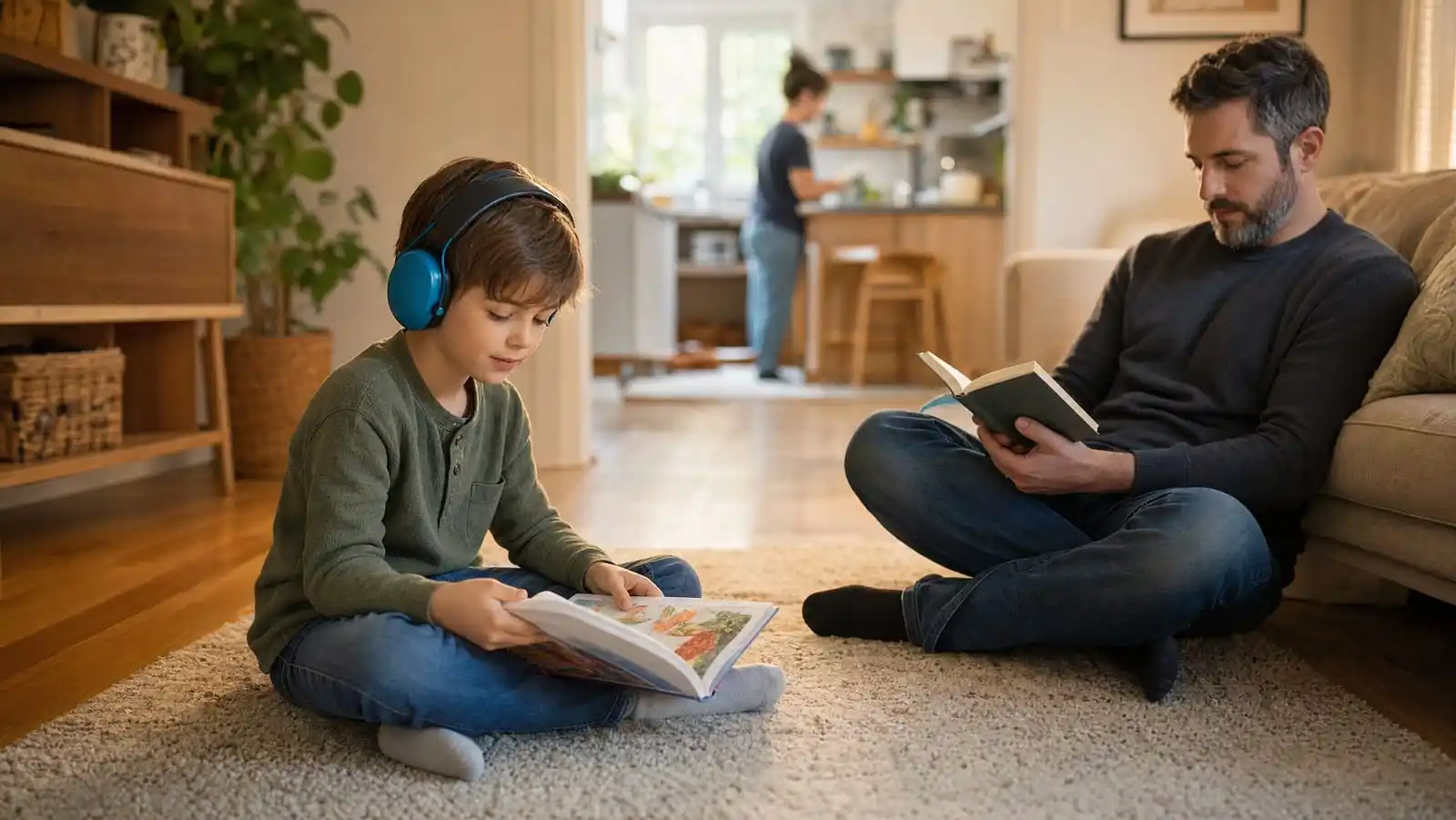
- Headphones with the child's own music, dense predictable input that does not flood the room
- Echo play: singing into a tube, a stairwell, an empty bucket
- Vocal games with a volume arc — loud round, medium, whisper — so volume becomes something they steer
Two cautions. Watch total volume, because seeking behaviour can push a child toward genuinely damaging levels through headphones. And a sudden increase in ear-directed behaviour such as poking, slapping or persistent noise-making close to the ear deserves a medical check, since ear pain and infection can look like seeking.
Hyperacusis, Misophonia and Sensory Overload
These words are not interchangeable, and using the right one changes what helps. Audiology groups them under decreased sound tolerance, then separates them by mechanism.
Drawing on definitions set out in the American Journal of Audiology and ASHA's practice portal on tinnitus and hyperacusis:
- Hyperacusis is physical discomfort or pain when any sound reaches a loudness most people tolerate comfortably. It tracks volume.
- Misophonia is an intense emotional reaction to specific sounds, often body sounds such as chewing or sniffing, and is not driven by how loud they are.
- Phonophobia is anticipatory fear of sound — the anxiety and avoidance that builds around a sound that might happen.
- Noise sensitivity is increased reactivity to a noisy environment in general, including feeling overwhelmed, regardless of absolute loudness.
Telling hyperacusis and misophonia apart is the most useful step a parent can take, because turning the volume down helps the first and does almost nothing for the second. A child who cannot bear their sibling chewing will not be rescued by ear defenders at a firework display.
A systematic review of misophonia in autism, published in Research in Developmental Disabilities, reports prevalence estimates ranging from 12.8 to 35.5 percent across studies, with high rates of co-occurring anxiety, OCD and depression among those affected.
Sensory overload is different again: cumulative rather than sound-specific, where noise is one input among many and the system runs out of capacity. It is why a child copes at 9am and collapses at 3pm over something trivial, and why reducing total daily load often helps more than any single auditory tool.
When to see a professional
Book an audiology appointment if sound sensitivity appears suddenly, worsens quickly, affects one ear, comes with ear pain, tinnitus or dizziness, or if hearing has never been tested. Ask for a pediatric occupational therapist when it is limiting daily life. Nothing here is a diagnosis or a treatment plan, and no tool substitutes for an individual assessment.
Noise Sensitivity in Teens and Adults
It does not reliably grow out. It changes shape. The large parent-report analysis in the Journal of Autism and Developmental Disorders, covering 4,104 people with autism aged 2 to 54 in the US National Institute of Mental Health Data Archive, found that 60.1 percent had auditory sensory over-responsivity currently and 71.1 percent had experienced it at some point. Prevalence and severity varied with age, with no association with sex.
Adult data suggests it persists rather than resolving. Research comparing autistic and non-autistic adults who report decreased sound tolerance, published in Autism in Adulthood, found clinically significant hyperacusis symptoms in 56 percent of the autistic group against 17 percent of the non-autistic group. The kinds of sounds that troubled people, and the reactions to them, were broadly similar across both groups.
What changes with age is the cost of coping. In practice, noise sensitivity in teens and adults is usually less visible than it was at six, because the person has learned to mask it — and masking burns energy that is then unavailable for the lesson, the shift or the conversation. The ear-covering stops. The exhaustion does not.
What tends to help from adolescence onwards
- Discreet tools rather than conspicuous ones, which is where filtering earplugs earn their place
- Self-advocacy language practised in advance: one sentence they can say to a manager or tutor
- Recovery time built into the timetable, not squeezed in after collapse
- Formal accommodations at college or work: a quieter exam room, a desk away from the kitchen, permission to wear earplugs on shift
- Naming the pattern, so the 3pm crash reads as accumulated load rather than personal failure
The thing to hand over is ownership. A teenager who chooses their own tools, and decides when they are needed, keeps using them. One who has tools imposed usually stops the moment nobody is watching.
Planning Outings: Fireworks, Haircuts and Crowds
Most outings fail at the same three points: the entrance, the hand dryer and the way out. Most of the work of planning noisy outings is deciding those three things before you leave the house.
The volume numbers justify the effort. According to the National Institute on Deafness and Other Communication Disorders, any sound of 85 decibels or higher can cause hearing loss or other hearing problems such as tinnitus, and the louder the sound, the shorter the safe exposure. NIOSH's recommended exposure limit is 85 dBA averaged over eight hours, with the safe duration halving for every 3 dBA increase.
Fireworks are a hearing-protection event, not a comfort event
Fireworks reach 140 to 160 decibels, and any sound of 85 decibels or higher can cause hearing loss, per NIDCD hearing protection guidance, which warns that if a firecracker explodes near your ear you could lose all of your hearing. Active noise cancellation is not designed for impulse noise of this kind. For displays, motor sport and similar events, use passive hearing protection with a stated Noise Reduction Rating, fitted properly, on every member of the family including adults, and keep your distance from the source.
A workable outing plan
- Scout the sound. Call ahead about music volume, hand dryers and announcements. A growing number of venues run sensory-friendly sessions.
- Pick the quiet slot. First showing, opening hour, weekday morning. The same venue can be two different acoustic environments four hours apart.
- Pack paper towels so the hand dryer never has to run, and go in with ear protection already on.
- Agree the exit before you walk in: the signal, the meeting point, who takes the child out.
- Shorten the visit deliberately. Twenty successful minutes builds more tolerance than ninety that end badly.
- Rehearse it. A photo walkthrough or short social story reduces the anticipatory fear that often does more damage than the noise.
Haircuts deserve a note, because the distress is frequently about the clippers rather than the cutting. Ask for scissors instead, book the first appointment of the day, and accept a partial cut as a win. Several short, successful visits work better than one long one.
Calming Sound: Using Auditory Input on Purpose
Sound is not only something to remove. Used deliberately, it is one of the most portable regulation tools you own. Using calming sounds and auditory input on purpose works two ways: it masks unpredictable noise, and it gives the auditory system something steady to settle against.
Masking is the more practical of the two. Sudden noise is harder to process than continuous noise, so a low-level background — a fan, a sound machine, instrumental music — can flatten the peaks. The leaflet from Hull University Teaching Hospitals suggests gentle background sounds so that sudden loud noises are less shocking.
Beyond masking, many families find predictable, self-chosen audio helps their child settle: the same playlist at bedtime, an audiobook in the car, rain sounds during homework. The evidence base for specific sound-based therapies is far weaker than the marketing suggests, so treat all of this as a low-risk comfort strategy rather than a treatment. Two rules keep it safe: keep the volume low, and put distance between the source and the child's head.
Options to try
- A fan or air purifier you already own
- A sound machine across the room, never on the cot rail, headboard or pillow
- Low-volume instrumental music during homework, where lyrics compete with reading
- Audiobooks and familiar podcasts for car journeys and waiting rooms
- The child's own playlist through headphones in crowds: predictable input instead of unpredictable
- Humming or singing by the child themselves, which is fully predictable
Check the volume on sleep machines
A study of 14 infant sleep machines published in Pediatrics found that at maximum volume, measured 30 cm away, all exceeded 50 A-weighted decibels — the recommended noise limit for infants in hospital nurseries — and three produced levels above 85 dBA. The authors note that at those levels the output risks noise-induced hearing loss if played for more than eight hours, and that continuous white noise may disrupt normal auditory development. So run it well below maximum, place it across the room, and do not leave it on all night at high volume.
Toddlers and Babies: Starting Early
The youngest children are the hardest group to equip, and the group where caution is most warranted. Their heads are small, their ear canals are small, they cannot tell you what hurts, and their auditory systems are still building the language machinery they will use for life.
Fit is the first obstacle. Adult earmuffs do not seal on a toddler head, and a poor seal means the rating on the box is fiction. Infant-specific ear defenders exist, usually with soft, low-clamp headbands, but low clamp force also means lower real-world attenuation. Choosing ear defenders for toddlers and babies is therefore a balance between something that seals and something a small child will tolerate for more than ninety seconds. Filtering earplugs are not appropriate here at all: the small parts are a choking hazard and a young child cannot manage insertion or removal.
The overprotection concern carries more weight here than at any other age, because early childhood is when speech sounds are being mapped. NHS audiology guidance, including the leaflet from Hull University Teaching Hospitals NHS Trust, advises avoiding routine ear defenders and earplugs for sound-sensitive children and favours gradual, supported re-exposure instead. That is about routine use, not a firework display — but for a toddler, more of the day is routine.
Practical rules for under-threes
- Use ear protection for events, not for the day: the concert, the display, the airport
- Supervise every minute they are worn, and never for sleep
- Check for pressure marks behind the ears and on the temples after removal
- Take them off the moment the child objects; forcing it tends to make future refusal more likely
- Change the environment first: leave earlier, sit further back, choose the quiet session
- Ask for a hearing test as the first step if sensitivity is shaping daily life
Frequently Asked Questions
Is noise sensitivity a sign of autism?
It can be one feature among several, but on its own it is not diagnostic. The DSM-5 includes hyper- or hyporeactivity to sensory input, with "adverse response to specific sounds" as an example, within the restricted and repetitive behaviour domain, as summarised by CHOP's Center for Autism Research. Diagnosis requires the full criteria to be met, assessed by a qualified clinician.
Does noise sensitivity always mean autism?
No. Sound sensitivity occurs in ADHD, anxiety, SPD, migraine, certain ear conditions and in children with no diagnosis at all — the Sensory Processing Three Dimensions research cited above was drawn from a broad neurodevelopmental-concern cohort, not an autism-specific one. A hearing test is a sensible first step regardless.
Can noise sensitivity be reduced?
Sometimes, and there is no guaranteed outcome. NHS audiology guidance for children favours gradual, supported re-exposure to distressing sounds at increasing volumes alongside preparation and reassurance, per Hull University Teaching Hospitals, which also notes that sound sensitivity in children commonly improves with age. Set up any desensitisation approach with an audiologist or therapist rather than improvising it.
Do noise-cancelling headphones damage hearing?
The technology itself is not the risk. Audiologist Cory Portnuff, AuD, PhD, of the University of Colorado School of Medicine told CU Anschutz News that the concern is "the sound level at your ear in your headphones," and said of reports linking noise-cancelling headphones to rising rates of auditory processing disorder that "while that's an interesting theory, there's no evidence that this is happening" — CU Anschutz News characterises the claim as speculation not backed up by the data. He also cautions that noise cancellation is not adequate protection from genuinely loud sounds. Volume and duration are what damage hearing; NIOSH sets its recommended exposure limit at 85 dBA over eight hours, per CDC guidance.
Is sound sensitivity ADHD or autism?
It occurs in both, and it is not a reliable way to tell them apart. Sensory over-responsivity turns up across neurodevelopmental presentations rather than tracking one diagnosis — the Sensory Processing Three Dimensions study found high rates of auditory over-responsivity in a cohort recruited for broad neurodevelopmental concerns, not for autism alone. A sensory profile on its own cannot distinguish the two. That needs a full developmental assessment covering attention, social communication, repetitive behaviour and developmental history.
Why do autistic kids make noises?
Usually because it regulates them. The National Autistic Society describes stimming as self-stimulating or self-regulating behaviour used for sensory input and enjoyment and to stay calm. Vocal noise can also mask an unpredictable environment with predictable self-made sound. The usual advice is to support and redirect rather than suppress, unless the behaviour is unsafe.
How long can my child wear ear defenders each day?
There is no evidence-based number, and anyone who gives you one is guessing. NHS audiology services advise against routine daily use on the grounds that it may increase sensitivity; other clinicians support targeted use for known-loud environments. A practical approach many occupational therapists use is event-based rather than clock-based: on for the assembly, the dining hall, the journey, off in between. If usage is climbing steadily, talk to an audiologist.
Conclusion
Noise sensitivity is one of the most common and least visible parts of autism, ADHD and sensory processing differences. The research is clear that it is widespread, that it is a processing difference rather than an ear problem, and that it persists into adulthood for many people. It is much less clear about what to do — which is why so much of the advice online is confidently wrong in both directions.
Our position: fix the environment first, because a quieter room helps every child in it. Use ear protection for the events that genuinely need it, with a rating on the box for the loud ones. Prefer discreet tools as children get older, and hand over the decision about when to use them. Watch for creeping all-day use and raise it with an audiologist. And do not forget the children chasing sound instead of fleeing it, because they need routing, not silencing.
The first step is the smallest one. Book the hearing test, keep a two-week log of what actually sets your child off, and change one thing about the room they spend the most time in. Everything else here can wait until you know what you are working with.
Explore the full series
- Why Sound Feels Louder: Noise Sensitivity in Autism, ADHD & SPD Explained — What is actually happening in the nervous system when everyday sound becomes unbearable.
- Best Noise-Cancelling Headphones & Ear Defenders for Autism (2026) — How to choose ear defenders by NRR, fit and age, with in-stock picks compared.