Safe Sensory Bin Fillers: What Changed Under the 2026 Water-Bead Rule
Safe sensory bin fillers are the ones that cannot expand inside a body, cannot fit whole into a small mouth, and match where your child actually is with mouthing objects. For most families that means foam, moldable sand, or dry rice and pasta. Water beads are now federally regulated as toys, but the rule is narrower than the headlines suggest.
We earn a commission from qualifying purchases made through links on this page, at no extra cost to you.
That last point is the reason this guide exists. The new standard does real work, but it does not reach into your cupboard or cover the decorative beads sold at the garden centre. Below: the rule, then the practical decision.
Our broader overview of sensory play activities for autism covers setup, clean-up and activity ideas; this article is the narrower one, about safety and selection. For a product-by-product roundup, see the Best Sensory Bins and Water Beads.
Start With One Question: Does Your Child Still Mouth Objects?
Everything else is secondary. If your child still explores with their mouth, no amount of supervision makes a small-object filler a good idea, and that holds at three years old as much as at eighteen months.
The American Academy of Pediatrics, writing on healthychildren.org, says choking is a leading cause of death in infants and children, that most children who die from choking are under age 5, and that two-thirds of those are babies under a year old. Its list of things to keep away from young children includes small balls and toys with small parts.
So we sort fillers into three groups:
- Still mouths things: large single-piece items only. A shallow tray of plain water with one or two big bath toys, or a damp sponge. No granular filler, no beads, no small objects.
- Occasionally mouths things, or you are not sure: moldable sand or foam, in short sessions, in a bin you sit beside.
- Past the mouthing stage: rice, pasta, foam, sand, chunky sorting objects.
If you are unsure which group your child is in, ask their occupational therapist or paediatrician before you buy anything. Persistent oral-seeking can be a sensory need in its own right, with different solutions.
What the 2026 Water-Bead Rule Actually Says
According to the U.S. Consumer Product Safety Commission's water-bead toy business guidance, a new mandatory federal standard for water-bead toys took effect on March 12, 2026. The final rule was published in the Federal Register on December 12, 2025.
The CPSC concluded in the rulemaking that the existing toy standard, ASTM F963-23, was insufficient to address all known water-bead toy hazards, because staff testing found toys that passed F963-23 and could still pose a hazard.
The requirements, per the CPSC guidance, include:
- An expansion limit. Water beads in a toy that fit entirely inside the small-parts cylinder must, once fully expanded, still pass through a 5.0 mm test gauge. Beads are measured in the dehydrated state.
- An acrylamide limit. No more than 325 micrograms of extractable acrylamide from 100 small beads or one large bead. The CPSC defines small beads as under 4.0 mm in all dimensions when dehydrated.
- Mandatory warnings. Water-bead toys, their packaging and their containers must carry a warning label, and that includes toys with beads sealed inside them.
- Certification. Makers and importers must issue a Children's Product Certificate citing 16 C.F.R. section 1250.4.
That 5.0 mm ceiling is a real change: reporting by MedicalXpress on a 2026 Academic Pediatrics study describes it as a reduction from a 20 mm maximum hydrated diameter.
Are Water Beads Banned? No, and the Gap Is the Part Parents Need
Water beads are not banned. Three things about the rule's scope matter more than the limits.
It covers toys, not all water beads. The law firm Keller and Heckman, summarising the rule, describes covered products as water-bead toys designed, manufactured or marketed for children younger than 14, and notes the rule does not apply to water beads sold for non-toy purposes such as decorative or agricultural uses, air fresheners, cat-litter deodorisers and cold packs. Keller and Heckman adds that acrylamide limits apply only to toys, though non-toy products exceeding them may require warnings under the Federal Hazardous Substances Act. In plain terms: vase filler and floral or garden water beads are not toy-standard beads, however much they look like the ones in a sensory kit.
It is keyed to manufacture date. Keller and Heckman notes that covered water-bead toys manufactured after March 12, 2026 must meet the new requirements. The rule is not a recall. It does nothing about the jar of beads already in your house.
The hazard is well documented. A 2025 case report in Pediatrics explains that water beads absorb liquid and can increase in volume by more than a hundredfold, so intestinal obstruction can follow ingestion. Announcing that report, the American Academy of Pediatrics cited Consumer Product Safety Commission data showing more than 7,800 water-bead ingestion injuries treated in U.S. emergency departments from 2016 through 2022. In a statement dated September 13, 2023, CPSC Commissioner Richard Trumka said the agency knew of at least one child who died after swallowing a water bead and a second who was forced to undergo months of surgeries to clear an intestinal obstruction. The recall that followed covered about 52,000 Chuckle and Roar activity kits from Buffalo Games; per the CPSC recall notice, one infant death was reported, a 10-month-old in Wisconsin, alongside a 9-month-old in Maine who needed surgery.
MedicalXpress, reporting the Academic Pediatrics study, describes a 6,532% rise in reported ingestions among U.S. children under 6 between 2019 and 2023, followed by a 24% drop from 2023 to 2024, with most cases involving children under 3 at home. Separately, as Fortune and other outlets reported in December 2023, Amazon, Walmart and Target each said they would stop selling water beads marketed to children, with each retailer setting its own age cut-off.
Our position: if you have beads that predate March 2026, or that came from a non-toy bag, we would get rid of them rather than audit them. If you want beads and your child is well past mouthing, buy a product certified under the new standard and treat spills as a floor-level hazard for younger siblings.
Water Bead Alternatives for Sensory Play
Water beads got popular because they feel extraordinary: cool, slippery, weighty, visually loud. Two filler types get most of the way there without anything that expands.
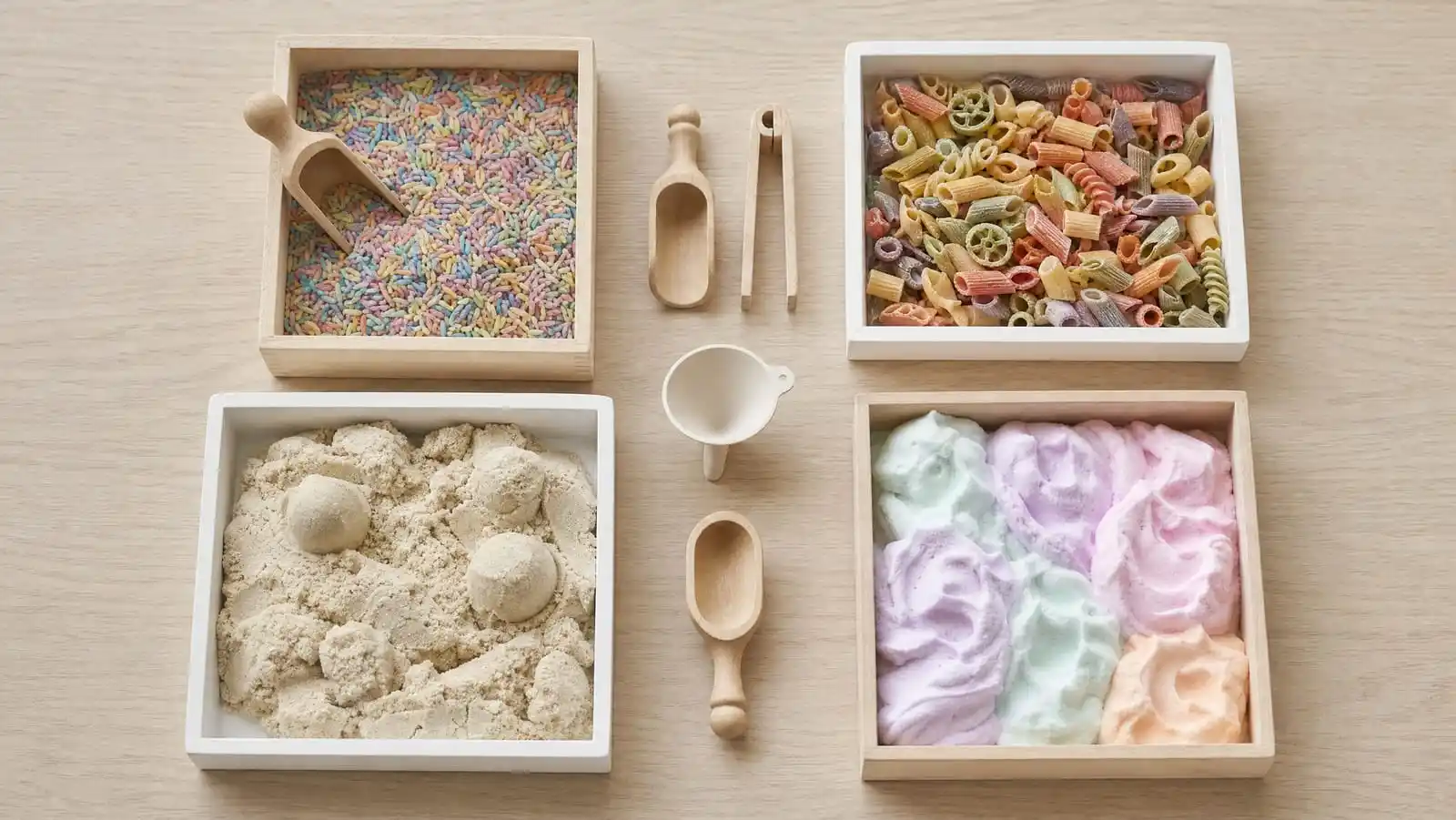
Foam filler is the closest sensory match. The Educational Insights Pluffle Mini 8-pack is $19.99 as of November 2026, against a $34.99 list price, and gives you eight mini tubes in eight colours. Educational Insights states that Pluffle is non-toxic and free of major allergens including nuts, gluten and latex, that it vacuums off surfaces, and that it never dries out or hardens. It is labelled ages 3 and up. That vacuum claim is the maker's, not our measurement.
Moldable sand gives resistance and heft rather than flow. Kinetic Sand 3.25lb Beach Sand is $16.99 as of November 2026 in a resealable bag, labelled ages 3 and up. The maker states it is made with natural sand, is reusable and does not dry out. Because it sticks to itself it scatters less than loose grain, which is why we suggest it first for carpeted rooms.
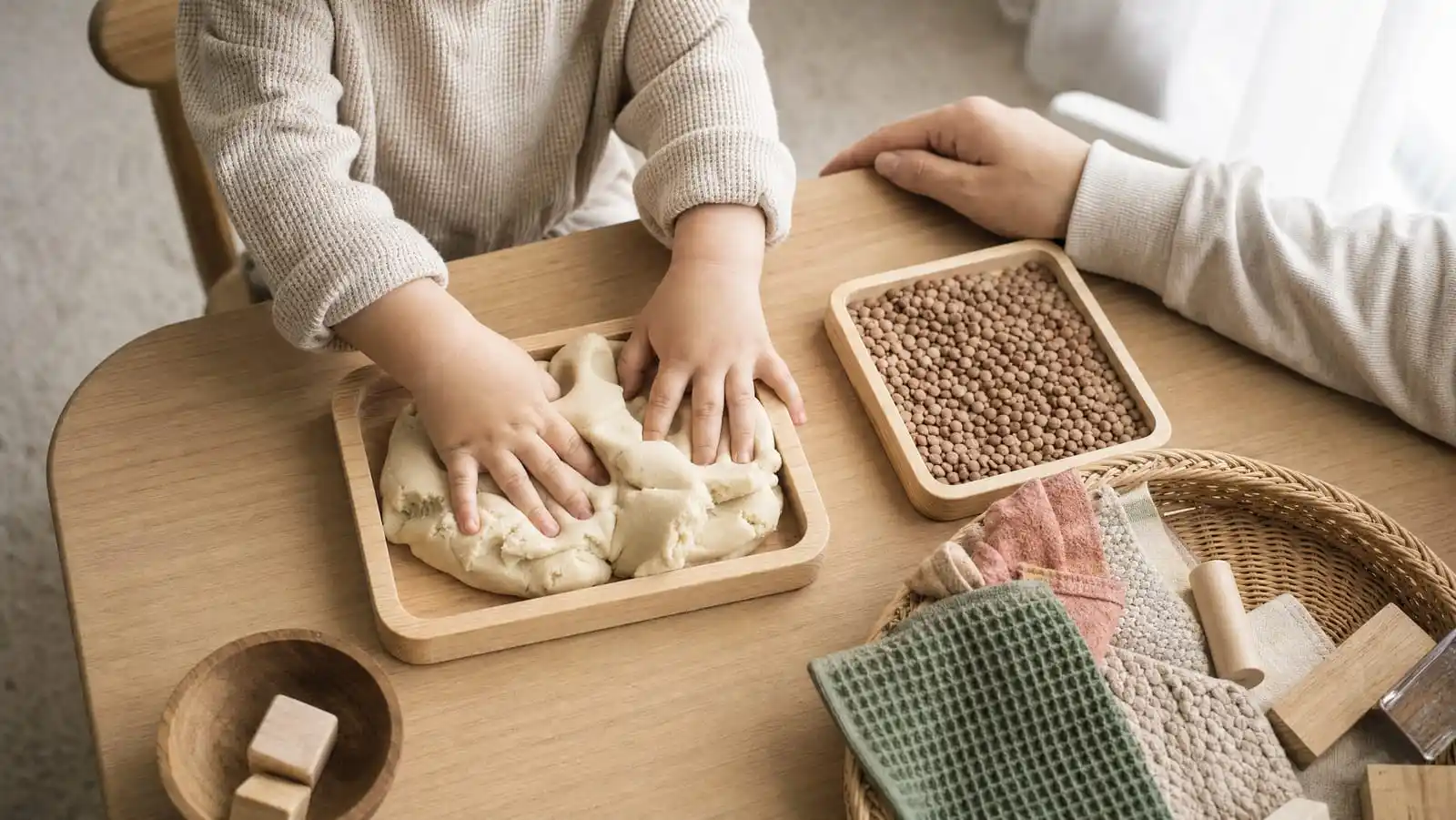
If your child wants squeeze and resistance more than pour and scoop, a dough or putty may serve better than any bin; we compare those in the Best Therapy Putty and Sensory Dough.
Food-Based Sensory Bin Filler Ideas: Rice and Pasta, Done Properly
Dry food fillers are cheap, easy to replace, and the usual starting point for children past the mouthing stage. The trade-off is scatter and storage.
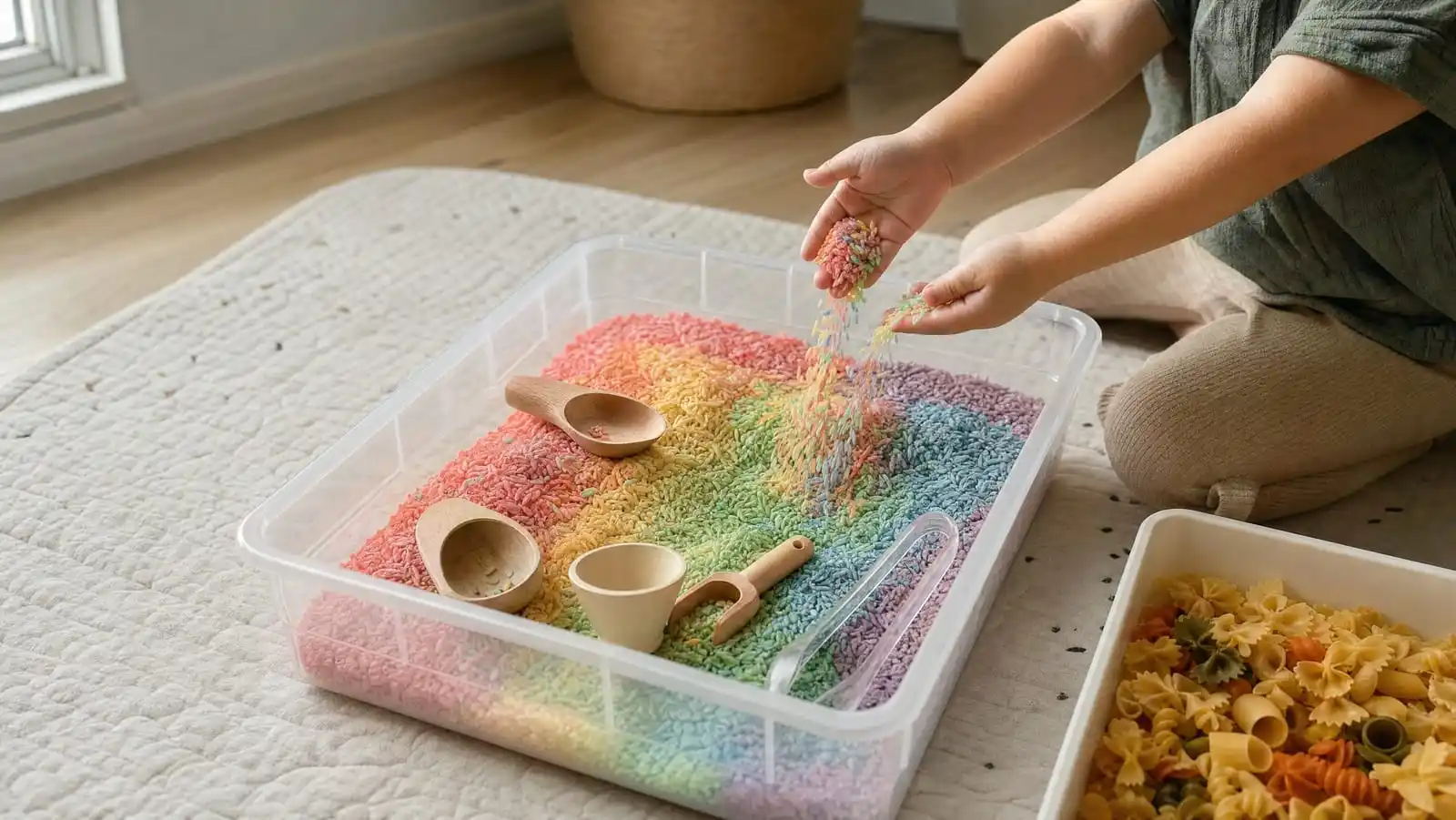
E & A Play Rainbow Sensory Rice is $20.99 as of November 2026 for 5 cups (2.25 lbs) across five colours. The maker states the rice is hand-dyed with non-toxic, food-grade colouring on white rice, and that it is independently tested to the ASTM F963 toy safety standard with per-batch lot numbers. That documentation claim is unusual for a dyed-food filler, which is why we flag this one.
Lattooland Rainbow Elbow Pasta is $19.99 as of November 2026 for 4 cups (1 lb) of dyed elbow pasta. The manufacturer states non-toxic ingredients. The elbow shape scoops and pours cleanly, and the listing notes it is reusable if stored dry in an airtight container.
Two practical notes. Keep food fillers genuinely dry: a sealed container, away from wet bins and wet hands, and replaced rather than rescued if moisture gets in. And wheat pasta is not a free choice for a child with coeliac disease. A 2020 study in the Journal of Pediatric Gastroenterology and Nutrition, covered by News-Medical, had 30 healthy children handle gluten-containing craft materials and reported a very low or negligible risk of gluten exposure from Play-Doh or dried pasta, while papier-mâché, cooked pasta and cookie dough transferred more than 20 parts per million. Dry pasta is the lower-risk end of that range, not a cleared one. For a coeliac child we would use rice, foam or sand and skip the question.
Sensory Bin Fillers Non Food: Chunky Objects and the Choking-Size Line
Chunky non-food objects are excellent for sorting, counting and tong work with school-age children, and they are exactly where the size question bites.
The Leitee 71-Piece Sensory Bin Sorting Set is $21.99 as of November 2026, down from a $24.99 list price, and includes 60 hedge balls averaging about 3 cm (1.18 in) in diameter plus 5 cups, 2 scissors clips and 4 tweezers. The listing carries an explicit choking-hazard warning and says to always supervise play. We would take that at face value.
Here is why 3 cm is the number to notice. Under 16 C.F.R. part 1501, the CPSC uses a small-parts cylinder roughly 1.25 inches (about 3.17 cm) across, intended to approximate the fully expanded throat of a child under three; an object that fits entirely inside it, in any orientation, fails, and such objects are banned in products intended for under-3s. A 3 cm ball sits just under that diameter. That makes this size class a good fit for a six-year-old doing tong work and a poor one for any child who still mouths objects or has a younger sibling crawling nearby.
For children who find textured objects aversive rather than interesting, our guides to Tactile Toys for Tactile Defensiveness and Tactile Sensory Toys: The Complete Guide cover building tolerance slowly instead of forcing a bin.
Matching the Filler to Your Mess Tolerance
Mess tolerance is a real constraint, not a character flaw. A bin you dread setting up never comes out.
| Filler | Scatter | Clean-up | Best for | |---|---|---|---| | Foam filler | Moderate | Maker says it vacuums off surfaces | Water-bead replacement, bright visual play | | Moldable sand | Low | Sweeps, sticks to itself | Carpeted rooms, building and cutting | | Dry rice | High | Sweep or vacuum | Cheap pouring and scooping volume | | Dry pasta | High, but large pieces | Easy to pick up by hand | Fast scoop-and-pour, easy to find on the floor | | Chunky sorting objects | Low | Hand-collected | Sorting, counting, tong and tweezer work, once mouthing has stopped |
Two setup habits beat any product choice. Set the bin on an old sheet or shower curtain liner, so clean-up is a shake-out rather than a vacuum, and use a shallow under-bed box rather than a deep tub, because depth encourages scooping over the edge. For something more permanent, a dedicated table helps: see the Best Sand Table Sensory Toys for Toddlers.
The Safety Check We Run Before Any Bin Goes on the Floor
It takes two minutes.
- Size. If a child under 3 can reach the bin, nothing in it fits entirely inside a 3.17 cm cylinder. Without the CPSC test cylinder, a cardboard toilet-roll tube is the household approximation, not an official test.
- Expansion. Nothing in the bin grows when wet. This is the whole lesson of the water-bead story.
- Supervision. Within arm's reach for the whole session, not just in the room. The AAP also notes that many incidents happen when an older sibling hands a younger child something unsafe, which matters in a shared playroom.
- Allergens. Check wheat, nuts and latex against your child's needs, and treat allergen statements as the maker's claim. Educational Insights states Pluffle is free of major allergens; still read the current label.
- Storage. Dry fillers go into a sealed, labelled container, out of reach. Damp food filler gets binned, not dried out and reused.
- Clean hands after. Soap and water, which that 2020 study found consistently the most effective way to remove transferred gluten, and a sensible default for any food-based play.
Tools Change the Activity More Than the Filler Does
Swap the filler and you change the texture; add tweezers and a dropper and you change the skill.
The GCTWFYK 11-Piece Sensory Bin Tool Set is $16.95 as of November 2026 against a $17.95 list price, with 5 scoops, a scissors clip, tweezers, a silicone tong, a shovel, a funnel and a dropper. The maker states the pieces have smooth rounded edges and work in bins, sensory tables, sandboxes and water tables. Pincer-grip tools are a common occupational-therapy suggestion for fine-motor practice, and in our experience they slow a child down, which many parents find extends how long a bin holds attention.
Be honest about the evidence, though. Sensory play is play, and play is worth doing on its own terms. It is not a treatment for autism. A 2025 systematic review of sensory-based interventions in Frontiers in Pediatrics, by Piller and colleagues, covering studies from 2015 to 2024, found the evidence for techniques targeting a single sensory system limited and mixed, and concluded that continued research is needed to clarify the benefits of sensory-based interventions. That is the right level of confidence to hold. If your child has specific sensory goals, an occupational therapist should set them. Our explainer What Is Sensory Play? How It Works in Autism, ADHD & SPD goes deeper into what the research does and does not support, and Proprioception and Body Awareness Explained covers the heavy-work side of the same picture.
What We Would Buy First
If your child is past mouthing and you want one purchase, we would start with the foam filler, for the water-bead feel without the water-bead risk, and add the tool set once you see which actions your child gravitates to. On carpet, start with moldable sand. On a tight budget, dyed rice does most of the same work.
The 2026 standard is good news, and it is narrow news. It makes newly manufactured water-bead toys safer. It does not make every bead in circulation safe, and it says nothing about the decorative beads two aisles over. Choose on the three questions that actually predict risk in your house: mouthing, size, and whether the thing expands.
For activity ideas, setup routines and the rest of the bin playbook, head back to our full sensory play and sensory bin guide, or browse Tactile Activities That Need No Equipment for the days when no bin is coming out at all.