This article contains affiliate links. We may earn a commission if you make a purchase through our links, at no extra cost to you.
Key Takeaways
- Control, not loudness, is the variable. A sound the child starts and can stop is a different object from one that happens to them.
- White, pink and brown are spectra, not moods. White noise is flat across frequencies; pink and brown sit lower.
- The comparative claims are marketing. A 2024 meta-analysis of 13 studies found no brown noise research to compare.
- Distance helps, but not on its own. All 14 infant sleep machines measured in Pediatrics in 2014 exceeded 50 A-weighted decibels at 30 cm, and all but one at 200 cm.
- Measure, do not guess. NIOSH found only four of 192 smartphone sound apps came within 2 dB of a reference microphone.
- Added sound is a support, not a treatment. Keep it the child's choice, and stop when behaviour says to.
Calming sounds for autistic children are set by predictability before they are set by volume. A sound the child picks, starts and can switch off sits in a different category from one that arrives without warning. Choose for control first, set the level second, then let behaviour decide.
Almost everything written about autism and ears is subtraction: fewer bangs, softer rooms, ear defenders. This is the inverse — sound added on purpose, a normal part of auditory sensory processing rather than a contradiction of it.
Predictability, Not Volume, Is the Real Variable
The same decibel reading lands as comfort or as an assault depending on whether the child saw it coming. Jiang, Dai and Mo, writing in Frontiers in Public Health in 2026, note that "noise-annoyance research also shows that judgments about whether a source is predictable, avoidable, or controllable can shape reactions to the same acoustic stimulus." The honest limit: that is adults rating community noise, not autistic children.
Who holds the switch matters: a sound the child can stop is an input they are using, and a sound only you can stop is one more thing happening to them. A sensitive child can still want sound. In a meta-analysis of 67 articles covering 13,093 autistic individuals by Williams, Suzman and Woynaroski in Ear and Hearing in 2021, hyperacusis prevalence was 41.42 percent by questionnaire or interview and 27.30 percent on objective measures — estimates the authors call "extremely heterogeneous." Flinching at a hand dryer and asking for rain sounds are not in conflict: see children who seek sound and make noise.
White, Pink and Brown Noise, Described Honestly
These describe how energy is spread across frequencies, and the marketing has run far ahead of the evidence. In Nigg and colleagues' 2024 meta-analysis in the Journal of the American Academy of Child and Adolescent Psychiatry, white noise is "equal intensity of different frequencies (i.e., a flat power spectrum)," while pink and brown show "decreasing spectral power density as frequency increases" — pink following a 1/f pattern, brown falling away faster still. Child and adolescent psychiatrist Shivnaveen Bains tells Cleveland Clinic that with brown noise "the deeper and lower frequencies are played at a louder level and the higher frequencies are much softer."
What the attention research actually found
Nigg and colleagues pooled 13 studies: 12 on white noise, one on pink. For participants with ADHD or high ADHD symptoms (N equals 335) the benefit on laboratory attention tasks was small but statistically significant, Hedges g of 0.249. For non-ADHD participants (N equals 335) the effect was negative, g of minus 0.206. The caveats: "no studies of brown noise were identified," and "only brief interventions were employed (several minutes)." No study was in autistic children.
Preference is real and worth following; superiority is not. Dr Bains is blunt: the brown noise research "is minimal and there are no significant studies to compare brown noise to white or pink noise for ADHD."
The BrownNoise Sound Machine is $17.58 as of October 2026, and its listing separates 3 brown noise tracks from white and pink noise, 8 lullabies and 15 nature sounds — listing claims, not our measurements. Two honest limits: it is AC powered, and its 12 night-light colours add a second sensory channel just as you were trying to reduce input.
How Loud Is Defensible
No sound machine we could verify publishes an output level in decibels, so the level in the room is yours to measure. Hugh and colleagues, publishing in Pediatrics in April 2014, measured 14 infant sleep machines at maximum volume at 30, 100 and 200 cm. At 30 cm, roughly cot-rail distance, all 14 exceeded 50 A-weighted decibels — their stated recommended limit for infants in hospital nurseries — and three exceeded 85 dBA. All but one still exceeded 50 dBA at 200 cm, as ENT Today reported. Its limit: a 2014 bench measurement at maximum volume, not a study of children.
The WHO-ITU global standard for safe listening devices sets 80 dB for 40 hours a week for adults and 75 dB for 40 hours a week for children.
A level routine you can actually run
Put the machine across the room, never on the cot rail, and start at the lowest setting audible from the pillow. Then check the level with a phone app where the child's head goes, treating the number as approximate: in NIOSH's evaluation of 192 smartphone sound-measurement apps, only four came within 2 dB of a reference microphone.
A machine running all night is an exposure, not a neutral background
Nigg and colleagues warn that "sustained exposure to even moderate decibel levels can harm hearing or hearing development," and the 2014 Pediatrics authors judged the levels they measured capable of damaging infant hearing. No machine here publishes an output level, so none can be called safe at a given setting. Keep the source far from the head, the level low and the hours short. If your child reports ear pain or ringing, speak to a GP or audiologist. For the under-threes, see noise sensitivity in toddlers and babies.
What to Play, by Purpose
Decide what job the sound is doing first: the three jobs want different things.
Masking an unpredictable environment. A steady broadband sound raises the background level so individual bangs stand less far above it — what acoustics manufacturer Armstrong calls sound masking.
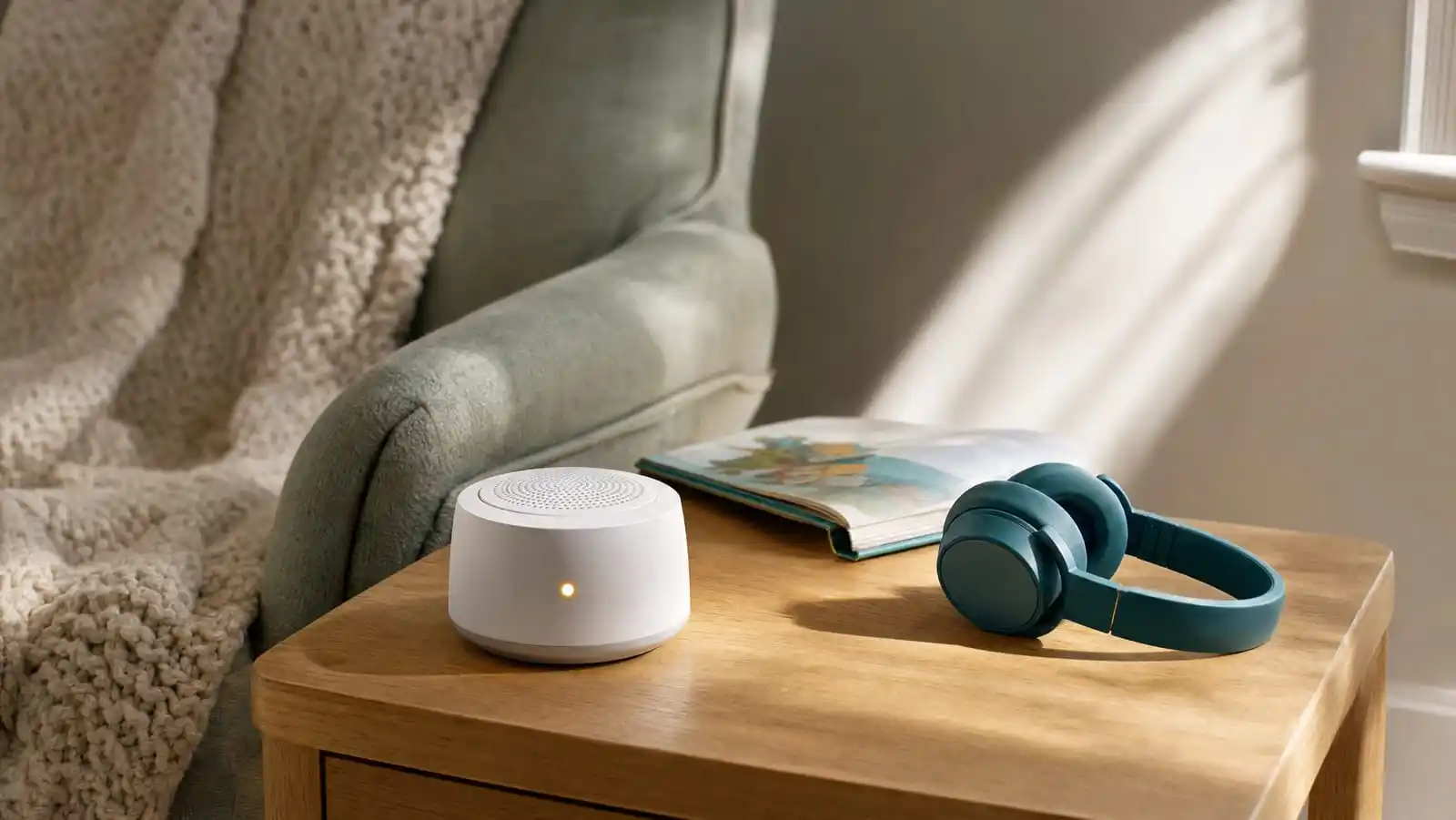
The spec worth paying for is a track with no seam: a pattern-noticer may hear where a loop restarts. The Magicteam Sound White Noise Machine is $18.39 as of October 2026, down from a $22.99 list price, and its listing states 20 non-looping sounds — white, brown, pink and blue noise alongside fan, rain and ocean — plus 32 volume levels. The honest limits: it has no battery and must stay plugged in, and with no published output level you cannot assume a setting is safe without measuring. It is not a sleep aid.
Sound the child chooses. A child who picks the track and knows the rule — off whenever you like — is regulating. The same track imposed is a stressor.
Sound as a transition cue. One short, fixed sound for the last five minutes before a change gives notice without requiring the child to process speech. Trade-off: it works only while it stays predictable, so reusing it for three transitions a day dissolves it.
Music, Carefully
Preferred, familiar, repeated music is a reasonable thing to offer, and it is not a therapy.
The music therapy evidence is genuinely split
The 2022 Cochrane review by Geretsegger and colleagues pooled 26 studies with 1,165 participants and found music therapy "more likely to positively effect global improvement" than placebo therapy or standard care, on moderate-certainty evidence — but "no clear evidence of a difference" for social interaction or communication, on low- to very-low-certainty evidence. The TIME-A randomised trial of 364 children aged four to seven, published by Bieleninik and colleagues in JAMA in 2017, found that five months of one-to-one improvisational music therapy added to enhanced standard care produced no significant difference in ADOS social affect scores (mean difference 0.06, P equals .88). Both studied trained music therapists, not a parent pressing play.
So play the music, including the song requested for the two-hundredth time. Just do not file it as treatment.
The practical risk is level. The EarFun K1 Kids Headphones are $9.99 as of October 2026, and EarFun's listing states a volume limit switchable between 85 dB and 94 dB and a wired 3.5mm connection.
That 94 dB position is the catch: a headphone switched to 94 dB is not meaningfully volume limited, and it sits well above the WHO-ITU 75 dB reference for children. Advertised caps are not verified protection either — Stone and colleagues, testing consumer children's headphones for Trends in Hearing in 2019, found some "still capable of producing output levels well in excess of 'safe-listening' levels of 85 dB(A)." Set the switch to 85 dB, measure it yourself, and for hardware see children who seek sound and make noise.
When Added Sound Backfires
Added sound has a failure mode, and it is not subtle once you know what to look for.
- A sound the child cannot stop is a stressor. An off switch out of reach, or behind a parent's permission, makes the input uncontrollable.
- It stacks rather than replaces. Rain over a loud kitchen gives the child the kitchen and the rain. Subtract first; many of our noise sensitivity strategies that need no equipment remove rather than add.
- Masking can become a requirement. A child who settles only with their own machine has fewer workable environments — a reason to keep other conditions in play.
- Sound is not uniformly helpful. Nigg and colleagues found a negative effect in non-ADHD participants, and the sleep evidence is weak: a systematic review of 38 studies led by Mathias Basner's group at the University of Pennsylvania in Sleep Medicine Reviews rated the evidence quality "extremely poor," with at least one study suggesting noise increased sleep disruption.
For a child who cannot yet tell you, watch rather than ask. Hands to ears, leaving the room, a jump in stimming, going flat, or taking longer to settle — any of those is reason to switch it off for a few days.
Building It Into the Day
The daytime placements are the ones nobody sets up, and they are often where this earns its keep. A car journey — engine, road noise, a sibling and no exit — is the obvious one, and a familiar sound the child controls is one predictable thing inside it. The five minutes before a transition is the other: same cue, same length, every time.
Portability makes those real. The Dreamegg D11 Max Portable Sound Machine is $16.98 as of October 2026, down from a $32.99 list price, and Dreamegg's listing states a 1800mAh rechargeable battery charged over USB-C, a child lock and a lanyard for a stroller or car seat. One correction: it masks noise, it does not cancel it, whatever a product title implies. The child lock suits a fiddler, though it also means the child cannot switch the sound off.
Sleep stays one sentence here, because it is covered elsewhere: see the best white noise machines for sensory-sensitive children for hardware and bedtime routine strategies for sensory seekers for the routine the sound sits inside.
When to Ask a Professional
Three professions answer three different questions, and none answers all three. A paediatric audiologist establishes what the child can hear and assesses decreased sound tolerance — worth doing first, since the signs overlap: the US Centers for Disease Control and Prevention lists turning the volume up excessively and unclear or delayed speech among the signs of hearing loss in children and advises asking the child's doctor for a screening "as soon as possible." Our guide to the difference between hyperacusis and misophonia covers what gets assessed.
An occupational therapist reads the pattern across a day and can separate "sensitive to sound" from "needs added sound," which often coexist. A music therapist is the right call if music looks like more than a preference, because Cochrane and TIME-A describe trained delivery, not a playlist.
Frequently Asked Questions
What is the best calming sound for an autistic child? There is no evidence-based answer: the pooled attention research covered white and pink noise only, and none of it was in autistic children. Offer two or three options and keep what they return to.
Is brown noise better than white noise for autism or ADHD? No study we can find supports it. Cleveland Clinic's Dr Bains says brown noise research is minimal, with no significant studies comparing it to white or pink noise for ADHD. Preference is legitimate; superiority is not.
How loud should a sound machine be in a child's room? Low enough that you can only just hear it from the pillow, and across the room rather than on the cot. All 14 machines in the 2014 Pediatrics measurements exceeded 50 dBA at 30 cm at maximum volume, and none publishes an output level — so measure yours.
Can calming music at home replace music therapy? No, and it should not be called therapy. The Cochrane review and the TIME-A trial both examined structured work by trained music therapists, and they disagree. A favourite album is a different activity.
Is it safe to use a sound machine for a baby? Treat it cautiously and ask your paediatrician. The 2014 Pediatrics study found close-range levels its authors judged capable of damaging infant hearing. Keep it far from the cot and keep it brief; see noise sensitivity in toddlers and babies.
Bringing It Together
Pick the sound for the job, hand the child the switch, put the speaker across the room, and measure the level once instead of guessing forever. Then watch for a fortnight: if the child reaches for it you have found something; if they leave the room you have learned something too.
What will not hold up is treating added sound as treatment. The evidence base is small, mostly brief, mostly in adults or on laboratory tasks, and silent on brown noise — which argues for modest claims, not for doing nothing. Sound you add and sound you take away are two halves of one plan, and the full picture sits in our pillar guide to autism noise sensitivity.