This article contains affiliate links. We may earn a commission if you make a purchase through our links, at no extra cost to you.
Key Takeaways
- Why autistic kids make noises: the sound is doing a job. It is regulation, communication, pleasure or predictability — not behaviour to extinguish.
- Sensory features are the norm. 74 percent of 25,627 autistic four- and eight-year-olds in US surveillance data had them documented.
- Seekers and avoiders are not two types of child. Many show several sensory response patterns at once.
- Suppression has a measured cost. Of 340 adults surveyed, 84 percent of autistic respondents had been told to stop stimming.
- Put a ceiling on the volume. The WHO's safe-listening reference is 80 decibels for 40 hours a week, 75 dB for children.
- Get the hearing tested. The yield is low, which is why guessing does not work.
Why do autistic kids make noises? In most cases because the sound is doing a job. Humming through dinner, slamming the same cupboard forty times, replaying four seconds of a cartoon until an adult cracks — these serve regulation, communication, pleasure or predictability. Stopping the noise does not remove the need underneath it, which is why auditory sensory processing in autism is a better starting point than a behaviour chart.
Most writing on ears and autism concerns too much sound. This is the other half: the child who wants more of it.
What Auditory Seeking Actually Looks Like
Auditory seeking is easier to recognise from a list than a definition, and the quiet presentations get missed. Most parents arrive having noticed one loud behaviour; the pattern is wider.
- Sound made with the body. Humming, droning, squealing, clicking, throat noises, repeating a line of dialogue long past the point of conversation.
- Sound made with objects. Banging, tapping, scraping a fork on a plate, slamming doors, flushing toilets, switching a fan on and off.
- Sound the child goes to find. An ear pressed to the speaker, the washing machine, the car window; standing beside a hand dryer by choice.
- Sound in the background, constantly. The television on to fall asleep, a fan all night, one album on repeat through homework.
- Volume. Reaching for a level adults find uncomfortable, and reaching again the moment it is turned down.
- One sound, endlessly. A single song, toy or six-word phrase. Repetition is the point, not a failure of imagination.
The honest limit: a list shows what you can see, not what it is for. Two children can hum identically — one to drown out a room, one for pleasure. An occupational therapist or paediatrician is the person to interpret a pattern.
Why Autistic Children Make Noises: What the Evidence Supports
Sensory differences are documented in most autistic children, and seeking is one of three recognised response patterns. In a study of 25,627 four- or eight-year-old autistic children in the US Autism and Developmental Disabilities Monitoring Network, published by Kirby and colleagues in Autism Research in 2022, 74 percent — 95 percent confidence interval 73.5 to 74.5 percent — had documented sensory features, spanning over-responsiveness, diminished responsiveness and "sensory seeking behaviors." It counted what professionals wrote in records, which is its limit.
Autistic adults describe stimming, including the vocal kind, as regulation. In a qualitative study of 31 autistic adults aged 21 to 56 by Kapp and colleagues in Autism in 2019, participants described stimming as "a self-regulatory mechanism, which acted to create a calming feedback loop," managing intense emotion with either a positive valence such as excitement or a negative one such as distress. Thirty-one self-selected adults is not a measurement of children, but it is testimony about function: a child squealing on a trampoline and one droning in a supermarket are doing different things.
Why self-made sound may be easier to take
Part of the appeal may be control. In a study of 28 healthy, normal-hearing adults by Reznik and colleagues in PLOS ONE in 2015, when "the expected intensity is high, perceived loudness of self-generated tones is attenuated" relative to identical tones heard passively — though at near-threshold intensity the same self-generated tones were perceived as louder, so the effect runs with what the listener expects. Suggestive only: that sample was healthy adults aged 22 to 30, not autistic children, and the mechanisms behind auditory seeking are not settled science.
Seeking and Sensitivity in the Same Child
A child can cover their ears at the hand dryer and still hum all day, and nothing about that is contradictory. This dissolves the usual question: is she sensitive, or a seeker.
The Autism Sensory Research Consortium's analysis of 3,866 autistic children aged 3 to 18, pooled from 12 data sources and published by Williams and colleagues in Molecular Autism in 2023, notes that "many individuals express behaviors characteristic of multiple sensory response patterns, even within the same modality." The same analysis reports that "supra-modal HYPO scores as currently operationalized were found to have limited construct validity" — the cross-modality hypo-reactivity measures themselves are contested, while the modality-specific ones held up better.
The practical reading is that the variable is often control, not volume. The hand dryer is unannounced, unstoppable and someone else's decision; the hum is none of those. Removing the sound a child controls to fix distress at sound they do not control is backwards. For that side of the picture, see why sound feels louder for some children.
Vocal Stimming, and Why Suppression Is the Wrong Target
The best evidence on stim suppression comes from autistic adults, and it does not support making suppression the goal. In an online survey of 340 adults — 160 diagnosed autistic, 139 suspected autistic and 41 non-autistic — run by Gabrielle Nwaordu and Dr Rebecca Charlton at Goldsmiths, University of London, 84 percent of autistic respondents said they had been told not to stim or to stop a repetitive movement. Social pressure was a reason given, and suppression "had a negative effect on emotions and cognition." The Kapp interviews name the same from the inside: the "depleting, effortful costs" of holding a stim back.
Repeated speech is often doing communicative work. Xie, Pascual and Oakley, writing in Frontiers in Psychology in 2023, describe echolalia as shown in "75–80% of verbal individuals" with autism — a figure they carry over from much older echolalia research. How common it actually is remains unsettled: a 2024 rapid review by Sutherland, Bryant, Dray and Roberts in Current Developmental Disorders Reports found primary prevalence estimates spanning 25 to 91 percent, largely because studies define echolalia differently. In Xie and colleagues' study of eight Mandarin-speaking preschoolers aged 3 to 6, 120 of 196 echolalic utterances during the task were judged "unequivocally functional," used for naming, description, topic development, conversational maintenance or thinking aloud. Eight children in one language generalises poorly, but it points the same way.
This does not make every sound costless. A child removed from class three times a week is paying a price; so is a sibling who cannot sleep. The target is lowering the cost, not deleting the sound — and a stim that injures a child needs a paediatrician now.
Meeting the Need: Safe Sound Input, With a Ceiling On It
If a child wants sound, the question is not whether to allow it but at what dose. A seeker left with a volume dial finds the top of it, so permission needs a number attached.
The World Health Organization's Make Listening Safe brochure states that "the daily recommended safe volume level is eighty decibels for forty hours a week," that 100 dB — the level it says a subway train produces — "can be safely listened to for only 15 minutes each day," and that volume should stay "to no more than 60% of maximum." Children get a stricter figure: the WHO-ITU standard for safe listening devices sets "Mode 1 for adults: 80 dB for 40 hours per week" and "Mode 2 for children: 75 dB for 40 hours per week."
Volume-limited headphones, and what the limit is worth
The Puro Sound Labs PuroQuiet Plus costs $119.00 as of September 2026. According to the listing it applies an 85 dB volume limit with digital processing, offers active noise cancelling that decreases background sound by up to 22 dB, works over Bluetooth and wired, and runs up to 35 hours on USB-C charging — listing claims, not measurements.
The trade-offs are substantial. An 85 dB ceiling is a maximum output, not a daily dose — six hours a day at 85 dB is well past the WHO allowance — and it sits above the 75 dB reference for children. Nor is limiting guaranteed: Stone, Harrison, Wilbraham and Lough, testing six pairs of children's headphones for Trends in Hearing in 2019, found that driven by a laptop or CD player "some were still capable of producing output levels well in excess of 'safe-listening' levels of 85 dB(A)."
Open-ear audio, for the child who should not lose the room
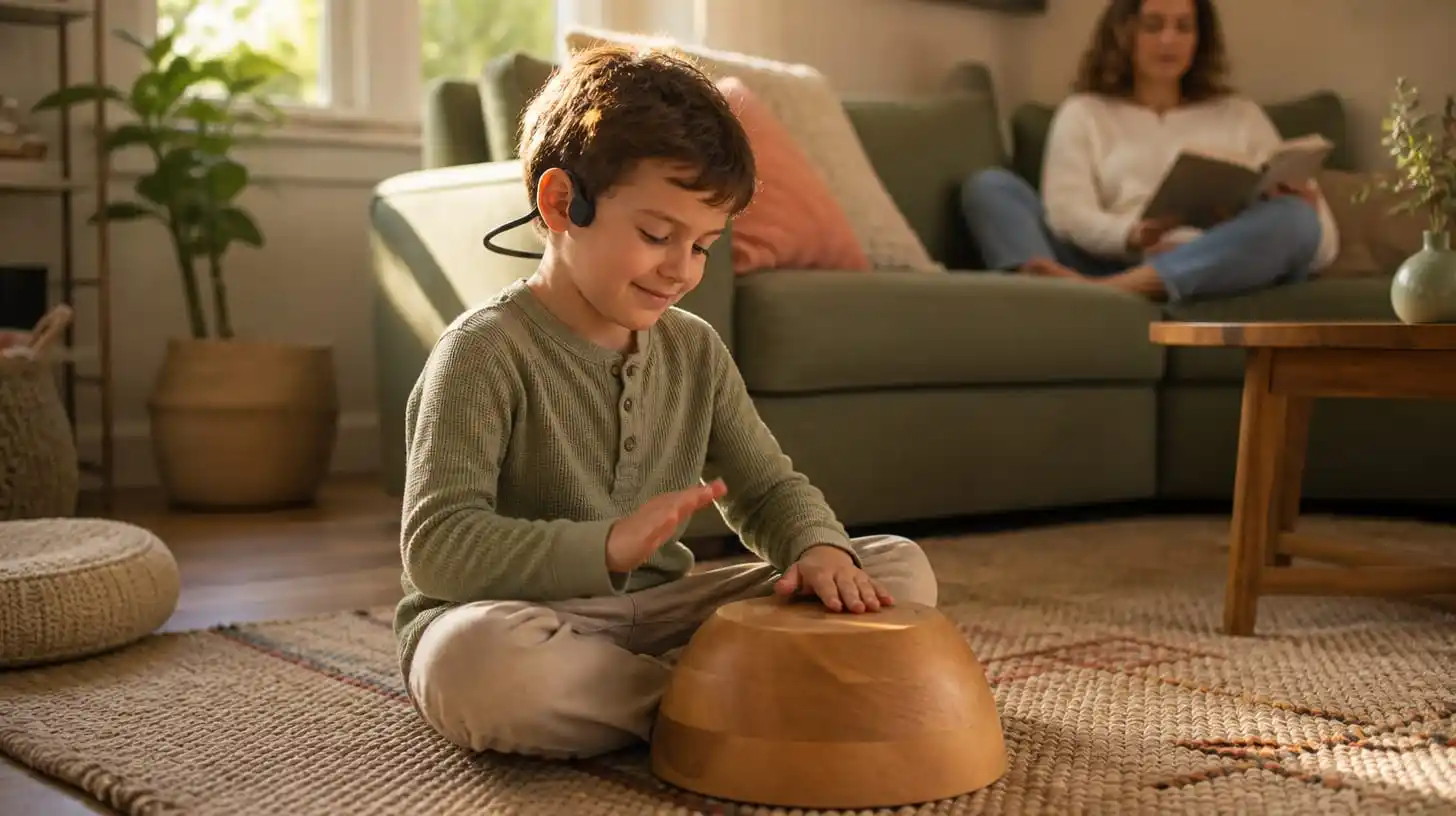
Some seekers need sound added without the room taken away. The Mehomeli Kids Air Conduction Headphones are $18.04 as of September 2026, from an $18.99 list price. The listing states an open-ear air conduction design delivering audio without covering the ears so the child can still hear surrounding sound, an 85 dB volume limitation, about 30 grams on a memory titanium neckband, and Bluetooth 5.2 with up to 20 hours of playtime — listing claims again.
The honest limits: open-ear audio leaks into the room, so the sibling and the classroom still hear it; a child competing with background noise pushes the volume up; and air conduction still delivers a dose. Neither pair is hearing protection. For the overwhelmed end, see auditory sensory tools for the classroom.
A volume limit is not a hearing-safety guarantee
A stated decibel ceiling caps loudness, not exposure time, and published testing has found children's headphones exceeding advertised limits on some source devices. Check the level at the volume your child actually uses, and keep sessions short. If a child reports ear pain or ringing, stops responding to speech they used to hear, or has a history of ear infections, speak to a GP or audiologist first.
Giving the Sound a Time and a Place
Substitution beats suppression, but only when the substitute does the same job — and the child judges that, not the adult.
- Schedule the loud. Ten known minutes of drumming or music at the child's volume, before the quiet thing is asked for. Trade-off: a broken promise costs more than the noise.
- Offer a version the context allows. Humming into a sleeve, headphones during independent work; our guide to using calming sound on purpose covers what to play and at what level. Trade-off: a quieter substitute delivers less input, and a child who finds it thin reverts.
- Move the channel, not the need. The mouth is the neighbouring route for many seekers; our guide to oral sensory tools for sensory seekers covers chewing and blowing. Trade-off: choking and hygiene questions of their own.
- Log two weeks before negotiating. Date, time, activity, the sound, what happened either side. That turns "he is disruptive" into a conversation about function, and several tactics in our list of noise sensitivity strategies that need no equipment work in both directions.
What the evidence does and does not support
Branded sensory programmes have a weaker footing than their marketing suggests. Autism CRC's evidence review of sensory-based interventions records a null effect for sensory diets, from one low-quality systematic review, and null effects for auditory integration therapy — one moderate-quality review for communication, two low-quality reviews more broadly. That argues against buying a programme, not against the child's need.
When to Bring in a Professional
A child who seeks out loud sound should have their hearing tested, even though most such tests come back normal. The US Centers for Disease Control and Prevention lists turning the TV or radio volume up too high among the signs of hearing loss in children, alongside delayed or unclear speech and frequently saying "huh," and advises asking the child's doctor for a screening.
Expect a low yield. Confer, Fosnight, Wheeler and Bonino, writing in Frontiers in Pediatrics in 2026, evaluated a hearing assessment protocol for 608 children aged 18 months to 8 years attending speech-language evaluation: reduced hearing was identified in 2.3 percent, at similar rates in the autistic and comparison groups, and 37 children had middle ear dysfunction requiring medical management. Low rates argue for testing, not against it: you cannot tell by watching, and middle-ear problems that affect hearing may fluctuate and are often treatable.
Three professions handle different parts. A paediatric audiologist establishes what the child can hear. A speech and language therapist handles echolalia, which is communication territory, not behaviour. An occupational therapist looks at the pattern across the day. The honest limit: none can tell you in one appointment which function a sound serves.
Frequently Asked Questions
Will my child grow out of making noises? Some presentations change with age and others continue into adulthood — the adults in the Kapp study describe stimming as an ongoing part of life, not something outgrown. What changes more reliably is where and how it happens, so aim at the route, not the need.
Should I ask my child to stop humming in class? A cost question, not a right-and-wrong one. The Goldsmiths survey found 84 percent of autistic adults had been told to stop stimming, and that suppression under social pressure hurt emotion and cognition, so "stop" is rarely free. If the humming genuinely costs the child, an agreed alternative and a scheduled outlet get further than a prohibition.
How loud is too loud for a child's headphones? The WHO's reference is 80 decibels for 40 hours a week for adults and 75 dB for children, with practical advice of no more than 60 percent of maximum volume. Because the 2019 Trends in Hearing testing found advertised limits were not always honoured, check your child's own setup.
Could the noise-making mean my child has hearing loss? It can. The CDC names turning the volume up too high as a sign of hearing loss in children, and a paediatric audiologist is the only way to rule it out. The Frontiers in Pediatrics evaluation found reduced hearing in 2.3 percent of 608 children — uncommon, but missing it delays everything.
Bringing It Together
Start from the assumption that the sound is doing something, and watch for a fortnight with a pen. Then work out what the noise costs the child — not what it costs you — and spend your effort there: a scheduled outlet, a substitute the child accepts, a volume ceiling you have checked. Get the hearing tested early.
What does not work is making silence the target. A child who stops humming because an adult is watching has not stopped needing to hum; they have learned to pay for the quiet themselves. Children who seek sound and children who flinch from it are not separate populations, and both belong in one plan — for the full range, see our pillar guide to autism noise sensitivity.