This article contains affiliate links. We may earn a commission if you make a purchase through our links, at no extra cost to you.
Key Takeaways
- Nothing here is truly noise-cancelling. These are passive ear defenders — sealed cups and dense foam, no batteries.
- NRR and SNR are not interchangeable. For earmuffs the NRR usually lands 5 to 6 dB below the SNR for the same pair.
- Clamping force decides whether they get worn. A pair rated SNR 29 dB that comes off after four minutes protects nobody.
- Telescopic range, in millimetres per side, decides how long a pair lasts.
- Ear defenders are for loud events, not all day. Audiology guidance warns that continuous use can increase a child's sensitivity.
- Six picks below, $9.99 to $27.99 as of September 2026, each with a stated limitation.
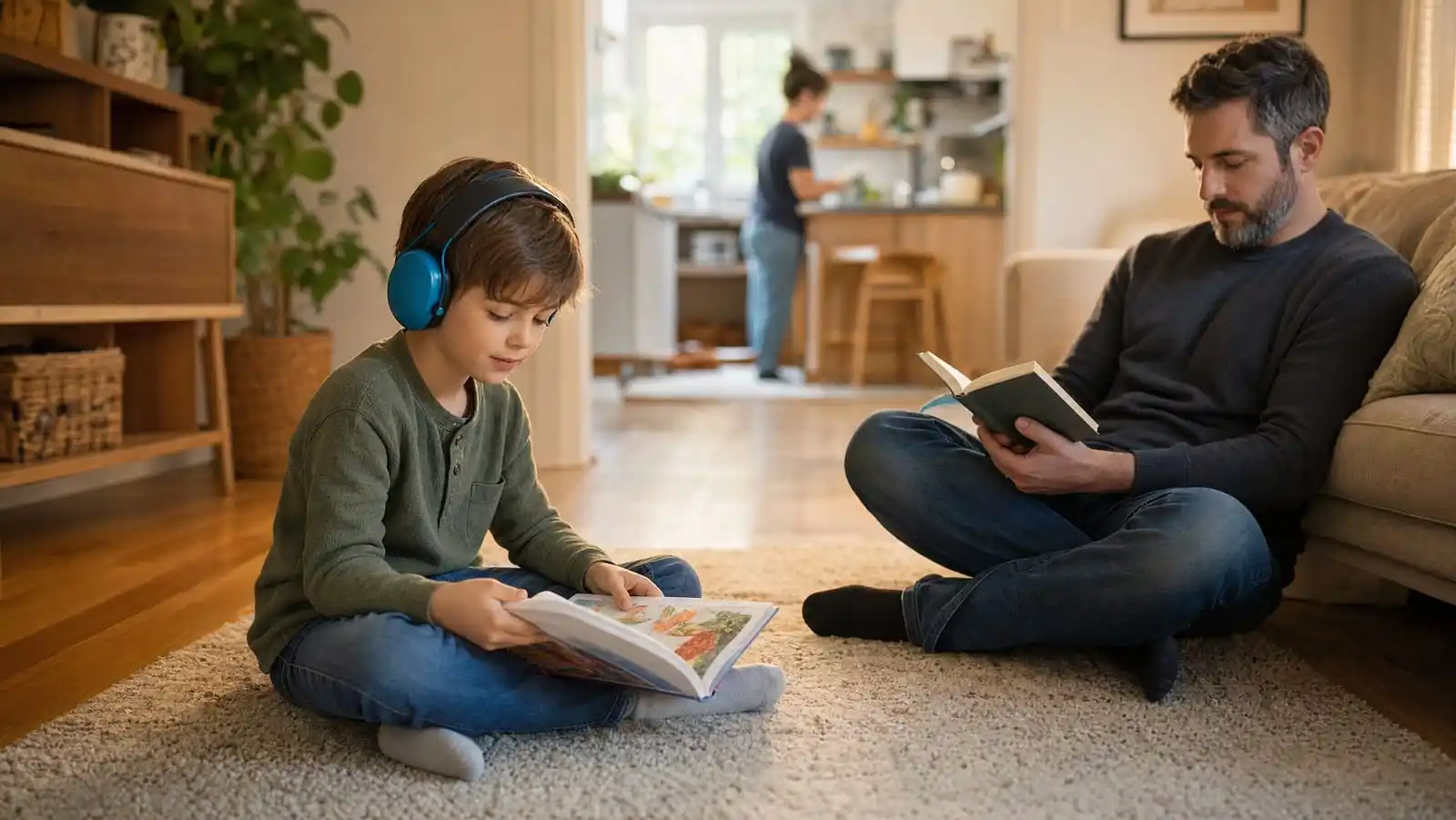
The best noise-cancelling headphones for autism are, for most children, not headphones at all — they are passive ear defenders rated around SNR 27 to 29 dB or NRR 25 dB, chosen for a headband your child will tolerate rather than for the biggest number on the box. Attenuation is the easy part. Fit decides whether a pair gets worn or lives at the bottom of a bag.
This is not a niche problem. According to the 2021 meta-analysis by Williams, Suzman and Woynaroski in Ear and Hearing, indexed on PubMed, pooling 67 studies and over 13,000 autistic participants, estimated current prevalence of hyperacusis — decreased tolerance to sound at levels that do not trouble most people — was 41.42%, with lifetime prevalence of 60.58%; under objective measures the current estimate fell to 27.30%. For the wider picture of autism noise sensitivity, start with our pillar guide.
How to Choose
Four specs and one judgement call — whether your child keeps them on, which no spec predicts. That is why we would rather you spent $9.99 finding out than $28. If you are not yet sure sound is the trigger, read why sound sensitivity happens first.
"Noise-Cancelling" Is a Misnomer — These Are Ear Defenders
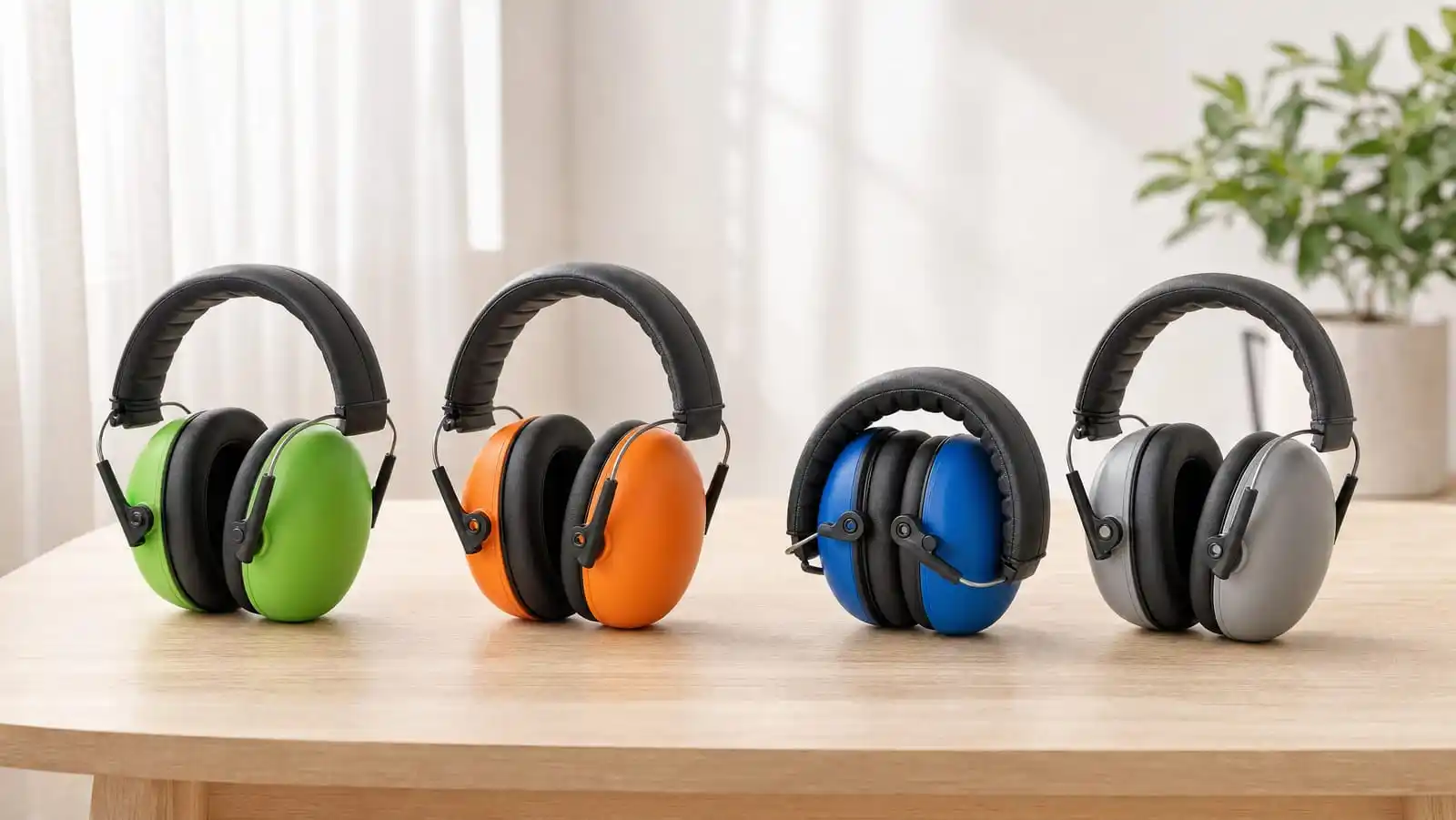
Active noise cancellation is electronic: microphones sample incoming sound and the headphone generates an opposing wave to flatten it, which works best on steady low-frequency noise. None of these products do that. They are passive ear defenders — rigid cup, acoustic foam, headband holding a seal.
Mostly good news — nothing to charge, no battery dying mid-drill — but "cancelling" oversells what these do, and two makers say so. iClever states that "earmuffs cannot 100% eliminate noise"; Dr.meter labels its pair "Reduce only, NOT MUTE".
NRR and SNR: Two Rulers, Two Different Scales
This is where most buying guides go wrong. According to Elliott Berger's E-A-R/3M technical note on hearing protector ratings, the NRR is the US rating mandated by the Environmental Protection Agency, computed from ANSI S3.19 attenuation data with two standard deviations subtracted from the mean plus a flat 3 dB spectral safety factor. The SNR is the international rating in ISO 4869-2, computed from ISO 4869 data with typically one standard deviation subtracted and no spectral safety factor.
Same earmuff, different caution baked in. Berger notes that for a muff the NRR "is in fact lower, by 5 to 6 dB, than the SNR or SLC80". One pick below carries both figures: the Dr.meter EM100 is listed at SNR 27.4 dB / NRR 20 dB — one earmuff, a 7.4 dB gap, nothing changed but the ruler.
So compare NRR with NRR and SNR with SNR, knock roughly 5 dB off an SNR if you must cross over, and treat both as laboratory ceilings — Berger notes the ANSI data behind the NRR is the least representative of real-world performance. Hair, glasses and a half-pushed-off cup all cost decibels.
Clamping Force Is the Number One Reason They Get Refused
An earmuff attenuates by sealing, a seal needs headband force, and more force means more pressure on temples and jaw. For a child already sensitive to touch, you have solved a sound problem by creating a tactile one.
Two of our six ship with break-in instructions — honesty, not defect. ProCase describes its earmuffs as "a little tight before using" and suggests stretching them over a box for one to two days; Dr.meter suggests a box or size 3 soccer ball for four hours. On both makers' own account, the first wearing is likely to be the tightest — the worst possible introduction. Do the stretch before your child sees them, and let the child take them off whenever they want.
Head Size, Growth and How Long a Pair Lasts
Longevity comes down to telescopic range, rarely printed on the box: ProCase gives up to 32 mm per side, iClever up to 38 mm. According to Skanwear's summary of EN 352, the European standard tests adjustability against "the range of head sizes specified by the manufacturer" — the maker's claim, not your child. If the arms sit near the top of their travel on day one, you have bought about a year.
What ANSI S3.19 and EN 352-1 Actually Certify
Both marks appear on five of our six picks. ANSI S3.19-1974 is the US laboratory test method behind the NRR that the EPA requires on the label, per Berger's note. EN 352-1 is the European earmuff standard: per Skanwear it covers adjustability, headband force ("to ensure there is no excessive pressure exerted on the wearer's head"), drop resistance, ignitability and attenuation. Neither certifies that a product suits an autistic child, or that the lab number survives a real six-year-old.
How loud is actually loud?
Most sensory use of ear defenders is about comfort, not hearing conservation. According to the NIDCD, "long or repeated exposure to sounds at or above 85 dBA can cause hearing loss", and it puts sirens at 110 to 129 dBA. Sensory distress and hearing risk are not the same thing, though one does not rule out the other: a study of 44 installed hand dryers in Paediatrics & Child Health (Keegan, 2019) measured many above 100 dBA at children's ear height, the loudest at 121 dBA. The hand dryer that ruins your child's morning can be both.
The Picks
All six were verified in stock on 16 September 2026, and every price is as of September 2026. We have not lab-tested them: specs come from the manufacturer listings, and maker claims are flagged.
1. ProCase Kids Ear Muffs — Best budget pick
Buy the ProCase Noise Cancelling Headphones for Kids first: at $9.99 as of September 2026 (list $18.99) they are an experiment, not a commitment.
- SNR 27 dB, certified to ANSI S3.19 (US) and CE EN352-1 (EU)
- Telescopic arms stretch up to 32 mm (1.3 inch) per side
- Solid ABS shell, thickened sound-absorbing foam, 360-degree rotatable cups, holeless pivot; folds compact
The limitation: ProCase itself calls them "a little tight before using", and 32 mm per side is the shortest telescopic range stated for any pick here, so a bigger head outgrows them soonest. Check the current price on Amazon.
2. iClever EM01 — Highest attenuation
The iClever EM01 ear muffs, $14.99 as of September 2026, carry the highest rating here — the pair for assemblies, fireworks and shopping centres.
- SNR 29 dB, certified to ANSI S3.19-1974 and CE EN 352-1
- Telescopic arms up to 38 mm per side; maker states ages 5 and up
- 22 mm porous sponge plus honeycomb acoustic sponge; 18 mm slow-rebound padding
- BPA-free ABS, silicone-free earcups, 301 stainless steel and 2 mm steel bars; foldable
According to iClever, the headband applies "1/3 less pressure than other average ear muffs". The limitation: that claim comes with no published test method, and the maker's own age floor of 5 rules it out for toddlers. Check the current price on Amazon.
3. ZOHAN Kids Ear Protection 2 Pack — Best for home-and-school pairs
The ZOHAN 2-pack is $23.98 as of September 2026 (list $25.99) for two pairs in blue and green, roughly $12 each.
- 25 dB NRR, certified to ANSI S3.19 and CE EN 352.1
- Metal-free lightweight construction, ultra-soft foam, reinforced ear-cushion bonding (a 2026 upgrade)
- Ships as a 2 pack; ZOHAN states a 1-year warranty on kids' earmuffs
According to ZOHAN, the intent is one pair in the school backpack and one at home — a sensible answer to a real failure mode. The limitation: the listing states no telescopic adjustment range, so for an older child you are buying fit blind, and two pairs costs more up front than any single pair bar the MelonArt.
4. PROHEAR 032 — Best for staying aware of surroundings
The PROHEAR 032 kids ear muffs are $12.99 as of September 2026 (list $15.99), built around a deliberately moderate rating.
- NRR 25 dB, certified to ANSI S3.19-1974 and CE EN 352-1
- Maker states ages 3 to 12
- 360-degree rotatable cups, ultra-soft cushions, fully padded headband
- High-visibility fade-resistant colours; folds compact
According to PROHEAR, the 25 dB NRR cuts harmful noise "without blocking out all sounds" — the point for children who get more anxious when voices vanish. The limitation: that intent is wrong when the trigger is one close-range sound, the stated range stops at 12, and high-visibility orange is conspicuous enough that older children often refuse it.
5. MelonArt Kids Ear Muffs — Most cushioned
At $27.99 as of September 2026 the MelonArt ear muffs are the most expensive pick here, and the case is entirely comfort.
- SNR 27 dB
- High-density acoustic sponge, solid ABS cups
- Memory foam cushions in breathable protein leather
- Padded headband, 360-degree swiveling cups; lightweight and foldable
According to MelonArt, the swiveling cups "automatically adjust to eliminate clamping force". Try these for a child who has rejected cheaper pairs on comfort, or who wears glasses. The limitation: nearly three times the ProCase price for the same SNR 27 figure; the listing data we have states no ANSI or EN certification, unlike the other five; and "eliminate" should read as "reduce", since no earmuff seals without headband force.
6. Dr.meter EM100 — Best size range (toddler to adult)
The Dr.meter EM100 ear muffs are $11.99 as of September 2026 and suit a mixed-age household.
- SNR 27.4 dB / NRR 20 dB — the same device under both standards
- Certified to ANSI S3.19-1974 and CE EN 352-1
- Memory foam cores with PU leather padding, ABS shells, triple-layer sound-dampening foam
- Maker states the headband adjusts from toddlers through to teenagers and adults; folds to palm size
According to Dr.meter these "Reduce only, NOT MUTE". The limitation: NRR 20 dB is the lowest here on a like-for-like comparison — PROHEAR and ZOHAN are both NRR 25 — and a headband spanning toddler to adult means the seal at either extreme is a compromise. Check the current price on Amazon.
What ear defenders cannot do
They reduce awareness as well as noise. A child wearing ear defenders may not hear a car, a shouted warning or an alarm. Supervise directly near traffic, car parks and water.
Ratings are laboratory ceilings. The NIDCD puts a fireworks show at 140 to 160 dBA; subtracting a 25 to 29 dB laboratory figure still leaves a very loud residual. Distance from the source protects more than any earmuff.
Fit is a safety spec. Do not put a child-sized muff on an infant it does not seal on, and we would not leave one on a sleeping, unsupervised child.
Noise-Cancelling Headphones in the Autism Classroom
School noise is predictable — drills, assemblies, the dining hall — so it is plannable. Agree in advance who holds the pair and when it goes on: one locked in a drawer during an unannounced drill does not exist. Write down when it comes off, too. "On for the drill, off back in the room" beats an arrangement that quietly becomes all day.
Professionals are less unanimous than the marketing implies. Neave-DiToro, Fuse and Bergen (2021), in Language, Speech, and Hearing Services in Schools, surveyed 255 speech-language pathologists, audiologists, teachers and graduate students: 66% reported observing individuals with autism using ear protection devices, most commonly headphones (91%), then earmuffs (44%) and earplugs (33%). The authors concluded there is "uncertainty among various stakeholders of the benefits and possible negative effects of EPD use" and a need for "specific guidelines for recommending and monitoring EPD use".
When Ear Defenders Are Not the Answer
The all-day problem. Guidance from an NHS Lothian principal audiologist, published as hyperacusis guidance for schools and nurseries by NAIT (2019), is blunt: "The continued use of ear defenders results in an increase in a child's auditory gain; which means that they become MORE sensitive towards sounds." It calls the practice counterproductive to audiology treatment plans and strongly recommends against ear defender use for a child formally being treated for hyperacusis.
Read that precisely: it is clinical guidance about children under treatment, not a trial of a pair worn at a fireworks display twice a year. The fair conclusion is not "ear defenders are harmful". It is that ear defenders are an event tool, not a default state, and a child who cannot take them off needs an audiologist rather than a higher rating.
Filtered earplugs instead. For an older child who needs volume down but speech intact, filtered earplugs are worth raising with an audiologist, and they are less conspicuous, which matters to teenagers. They are also small parts, ruling them out for young children and anyone who mouths objects.
Change the room, not just the ears. NIOSH says hearing loss from routine noise exposure "is best addressed by creating a quieter workplace", and the logic carries home: soft furnishings, closed doors, a seat away from the hand dryer. At night, masking with one of the white noise machines we have reviewed often beats blocking, and our guide to a sensory-friendly bedroom covers the rest. NAIT also notes hyperacusis "will require a formal diagnosis" — so worsening tolerance is a referral conversation, not a shopping one.
Frequently Asked Questions
Do noise-cancelling headphones for autism actually work?
There is early physiological evidence and not much of it. A 2019 study in Frontiers in Integrative Neuroscience, available via PubMed Central, gave six children aged 8 to 16 with autism and auditory hypersensitivity noise-attenuating headphones and measured electrodermal activity; both in-ear and over-ear versions were associated with reduced skin-conductance markers of sympathetic arousal. Six participants is a pilot, not proof. Many families find ear defenders useful, but no one can promise an outcome.
What NRR or SNR rating does my child need?
Less than you would think for everyday comfort — the deciding factor is which pair stays on. For genuinely loud places, treat the rating as a rough ceiling and add distance. The NIDCD notes that sounds at or below 70 dBA are unlikely to cause hearing loss even after long exposure. NIOSH sets its recommended exposure limit at 85 dBA over eight hours, halving the permitted duration for each 3 dBA increase.
Can wearing ear defenders every day make noise sensitivity worse?
This is genuinely debated. The strongest statement comes from audiology: the NAIT hyperacusis guidance (2019) states that continued use increases a child's auditory gain, making them more sensitive to sound. Against that, the 2021 LSHSS survey found professionals uncertain and the research thin. Our reading: reserve them for identified situations, and seek an audiology opinion if use keeps growing.
Are ear defenders or earplugs better for autistic children?
No evidence base settles it, and no published guidelines exist for recommending or monitoring either — a central conclusion of the LSHSS authors. In practice earmuffs are easier to fit and safer for younger children; filtered earplugs are more discreet and preserve speech better for teenagers.
At what age can a child start wearing ear defenders?
There is no universal age, and makers disagree: PROHEAR states ages 3 to 12, iClever 5 and up, Dr.meter toddlers to adults. EN 352-1 checks adjustability against the range the manufacturer specifies, so certification confirms that claim rather than endorsing an age. For infants and toddlers, fit and supervision matter more than the rating.
Will ear defenders affect speech and language development?
Nobody knows, and that uncertainty is itself a reason for measured use. Neave-DiToro, Fuse and Bergen (2021) framed their study around it, noting that "given the communication deficits often noted in this population and the essential role of hearing in speech and language development, the impact of wearing EPDs to attenuate sound needs to be explored." Part-time use around events is a different proposition from all-day wear. If your child receives speech therapy, raise it with their therapist.
The Bottom Line
Buy the cheapest pair that meets the spec, find out whether your child tolerates a headband, then spend more if you need to. The ProCase at $9.99 as of September 2026 is that experiment. If loud places are still hard, the iClever EM01 at SNR 29 dB is the step up. If the objection is the headband rather than the noise, the MelonArt is the comfort play. For a mixed-age household, the Dr.meter EM100 stretches furthest.
Then put them away between events. They work best as one item in a kit that includes a quieter room, a warning before loud things happen, and a plan for when blocking is not enough. For the rest of that kit, see our guide to auditory sensory tools for autism and ADHD.