This article contains affiliate links. We may earn a commission if you make a purchase through our links, at no extra cost to you.
Key Takeaways
- The device is the easy part. Getting it into a written plan, within the child's reach, and used by a substitute in March is the work.
- The room is usually the problem. ANSI/ASA S12.60 caps unoccupied classroom noise at 35 dBA; in one study of 42 US and Canadian K-2 rooms, every empty room was over it.
- Free changes beat purchases. Seating, chair-leg pads, a closed door at transitions and a warning before the bell help the whole class.
- All-day ear defenders are a warning sign, not a success. Some audiology services advise against continuous use, and the evidence is thin in both directions.
- Specific wording is the whole game. "Ear defenders in the child's desk, staff prompting at assemblies and fire drills" is enforceable. "Sensory supports" is not.
- IDEA and Section 504 are different laws with different eligibility rules, and which applies changes the process you are in.
The most useful noise sensitivity tools for the classroom are the ones a child can reach at the moment they need them, without asking an adult first. Earmuffs locked in the office are not an accommodation. A pair in the child's own desk, named in a plan every adult can see, is.
This is for the parent heading into an IEP or 504 meeting, and the teacher with one child who cannot cope with the room. For the underlying picture of autism noise sensitivity, see our pillar guide. What follows is the school half: the acoustics, the free fixes, the tools and the wording.
What a Classroom Actually Sounds Like
Most classrooms are too loud for speech, by a published standard, before a child walks in. ANSI/ASA S12.60, the American national standard for school acoustics, caps background noise in an unoccupied classroom at 35 dBA and reverberation time at 0.6 seconds for rooms under 10,000 cubic feet, rising to 0.7 seconds between 10,000 and 20,000, as summarised by acoustics instrument maker Larson Davis. Reverberation is how long sound keeps bouncing after its source stops: in a hard room, the end of one word is still in the air when the next starts.
The Acoustical Society of America's classroom acoustics booklet states that "in many classrooms in the United States, the speech intelligibility rating is 75 percent or less" — about one word in four missed, with ordinary hearing.
Measurements bear this out. In K-2 classrooms serving deaf and hard-of-hearing children across the US and Canada, reported in The Volta Review by Gremp and Easterbrooks, the mean unoccupied level across 42 rooms was 48.18 dB and every unoccupied classroom exceeded 35 dB. Occupied, the mean rose to 63.77 dB, and the authors report nine occupied classrooms — 24 percent of the 38 rooms with complete acoustic data — at or above 70 dB, which they describe as the point where speech becomes hard to understand. That sample was deaf and hard-of-hearing provision, not a national average, but a room that fails when empty has no headroom for 28 children.
Why nobody is enforcing this
The standard is not a building code. As the Hands and Voices summary of classroom acoustics standards puts it, "taken by itself, the standard is voluntary unless referenced by a State code, ordinance, or regulation." Most states have not adopted it. The same article notes parents may still use it as a guide to accommodations under IDEA — which moves a meeting from "he finds it loud" to "this room is over a published criterion."
Environment First
Free changes to the room outperform purchases, because they help all 28 children and nobody has to remember to do anything.
- Move the seat, not the child. Away from the door, the corridor, the HVAC vent and the pencil sharpener. ASHA's practice portal on classroom acoustics describes the aim as seating "away from extraneous noise, within the acoustic critical distance."
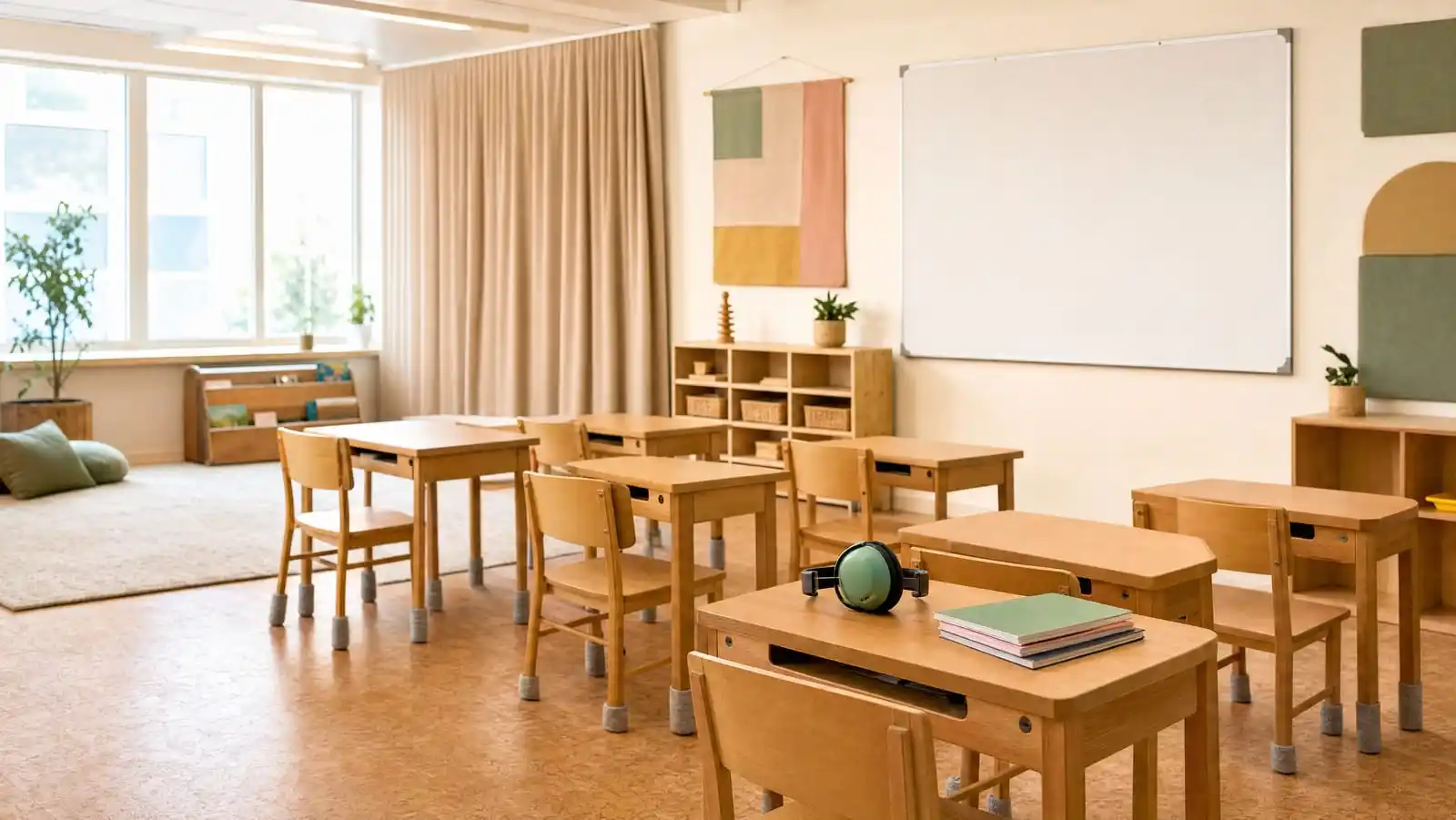
- Kill the chair scrape. Felt pads or slit tennis balls on 30 chair legs remove one of the most constant sounds in a primary room. Trade-off: pads fall off, and tennis balls collect grit that scratches floors, so ask the custodial team first.
- Add soft surfaces. Fabric display boards, a rug, curtains, a bookcase against a bare wall. Trade-off: cleaning, allergen and fire-code questions.
- Close the door during transitions. Corridor noise at changeover is often louder than anything in the room, and arrives with no warning.
- Warn before predictable noise. The bell, the drill, the assembly. A child who knows a sound is coming in two minutes is in a different state from one ambushed by it.
These overlap with our list of noise sensitivity strategies that need no equipment. The honest limit: this work is capped. It takes a room from unbearable to merely loud, and merely loud is still too much for some.
The Tools, and When Each One Fits
Ear defenders: loud, predictable, time-limited events
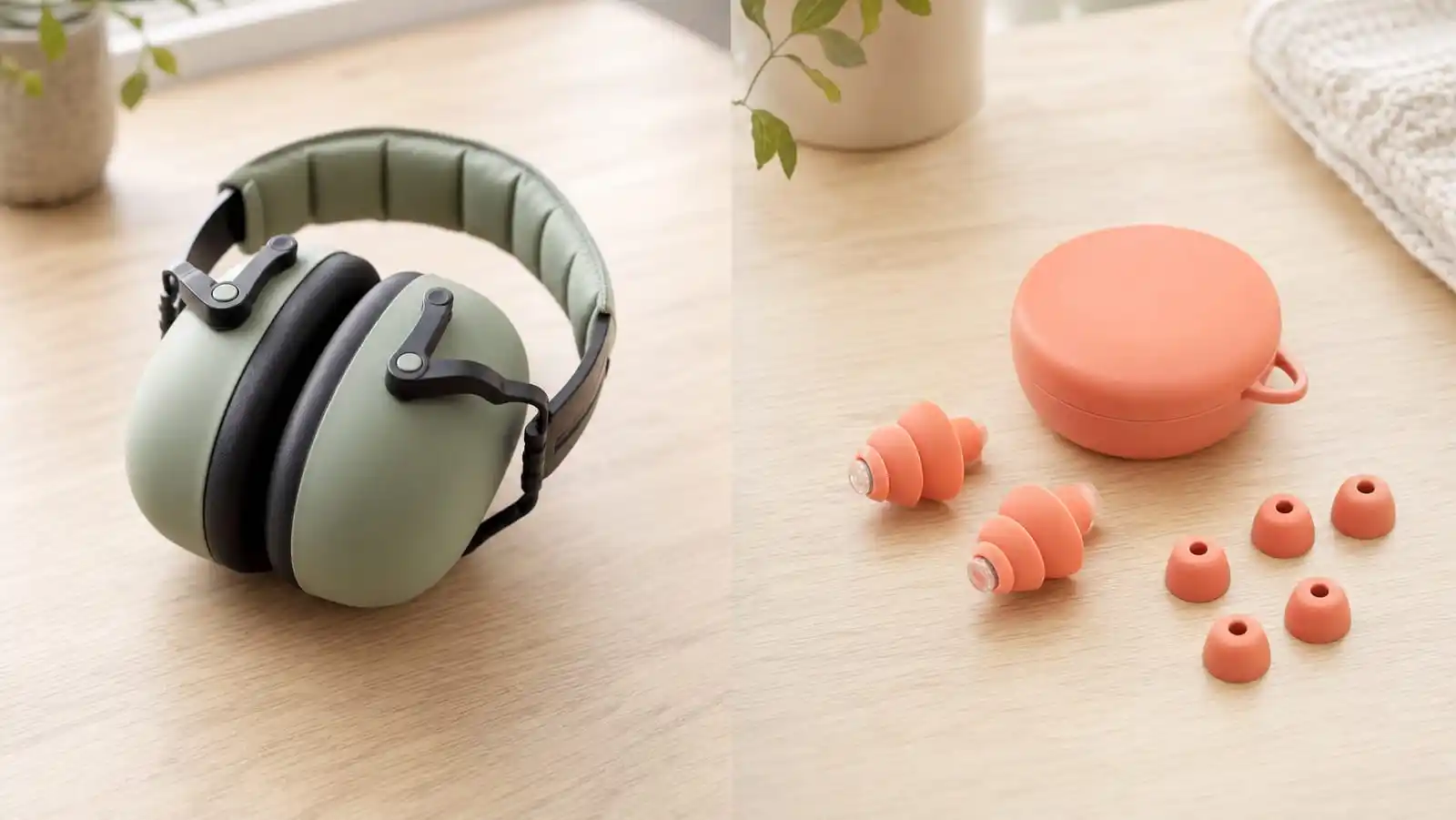
Passive earmuffs suit the assembly, the fire drill, the cafeteria and the gym: on in seconds, no fine-motor skill needed, impossible to lose inside an ear. The ZOHAN Kids Ear Protection 2 Pack is a workable example at $23.98 as of September 2026, the listing stating 25 dB NRR attenuation, certification to ANSI S3.19 and CE EN 352.1, and a metal-free lightweight build. According to ZOHAN, the two-pack is deliberately one for the backpack and one for home — answering the failure teachers report most: the school pair vanishes in week six.
The trade-offs are real. A lab NRR is not what a wriggling seven-year-old gets; attenuation depends on seal. Earmuffs are hot, press on glasses and hearing aids, and are visible across a corridor, which some children mind enormously. Model choice comes down to clamp force, cup depth, weight and independent removal — see the best noise-cancelling headphones for autism.
All-day use is the red flag
A child wearing ear defenders from 8:45 to 3:15 is not a support working: it substitutes for a room nobody fixed, and cuts the child off from instruction and peers. Some clinicians go further. The hyperacusis guidance for schools and nurseries published by Scotland's National Autism Implementation Team in 2019, written with a principal paediatric audiologist, states that "the continued use of ear defenders results in an increase in a child's auditory gain; which means that they become MORE sensitive towards sounds," and advises against use during formal hyperacusis treatment. Other clinicians, and many autistic adults, counter that without protection some environments are inaccessible. The research does not settle it: a survey of 255 professionals and graduate students by Neave-DiToro, Fuse and Bergen, published in Language, Speech, and Hearing Services in Schools in 2021, found about 66 percent had observed ear protection device use by people with autism, and concluded there "appears to be uncertainty among various stakeholders of the benefits and possible negative effects" of it, alongside "a dearth of research in this area." Treat all-day use as a prompt to ask an audiologist or OT.
Filtering earplugs: constant background load, and the child who refuses anything visible
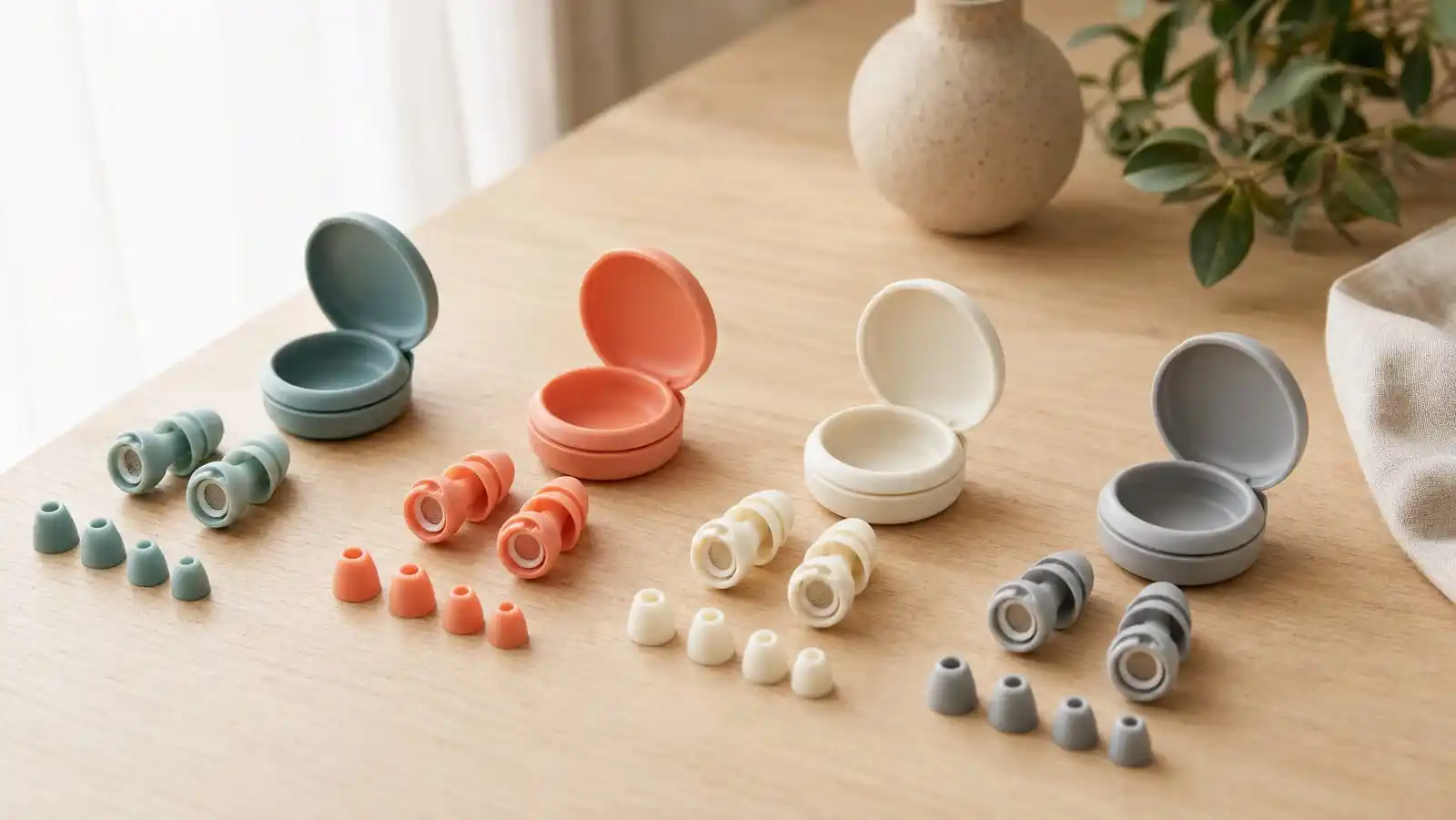
Filtering earplugs lower the level while passing speech through, which suits the steady all-day hum for an older child who wants to stay in the room and stay unremarkable. The Loop Engage Kids 2 costs $34.95 as of September 2026. Loop publishes 16 dB SNR noise reduction for Engage Kids 2 and states ages 6 and up, listed at retail as 6 to 12 years, with four kid-sized silicone tips and a keychain case.
Sixteen decibels is a design choice, not a weakness: enough to take the edge off, not enough to make a teacher unintelligible. It is not protection for a dangerous environment. Trade-offs: easy to lose; insertion is a fine-motor task some children cannot manage alone; tactile defensiveness may make anything in the ear intolerable; and the stated attenuation only happens if the tip seals. Some schools restrict in-ear items, so raise it before day one.
Small parts, small ears
Earplugs and their interchangeable tips are small detachable parts and present a choking and ingestion risk for young children, for any child who mouths objects, and for younger siblings who find them left out. They can also be pushed too far into the ear canal. Do not use them with toddlers or preschoolers, and speak to a GP, paediatrician or audiologist first if a child has ear tubes, an ear infection, or a history of impacted wax.
A quiet space, a noise meter, and the one you cannot buy
A named, always-available place to go is often the highest-value item here, because it lets a child leave without it becoming a discipline event. The NAIT guidance makes the same point clinically: children's anxiety may increase if they are forced to remain in a situation that is causing distress. Trade-off: it becomes exclusion if nobody plans the return, so write down how long, who checks and what re-entry looks like.
A visual noise-level indicator gives a class a shared external measure of volume. Trade-off: tied to class rewards it slides into public shaming, especially when the child with the sensory need is the one who vocalises to regulate.
Remote microphone and sound-field systems are audiological interventions, not purchases. ASHA's practice portal puts responsibility for recommending "classroom systems to improve the classroom listening environment and personal remote microphone hearing assistive technology" with audiologists, noting that where several are in use "the expertise of an educational audiologist is crucial." They are built around listening access, not sound tolerance, so the route is a referral, not a website.
Getting It Into the IEP or 504 Plan
This is the part that decides whether any of the above happens in February. What follows is general information about the US system, not legal advice; rules differ elsewhere. For your child, talk to the school's special education coordinator or a parent advocate. Two federal laws are in play, and they are not interchangeable.
- IDEA produces an IEP. Under 34 CFR 300.8(a)(1), a "child with a disability" must be evaluated as having one of the named categories — autism, hearing impairment and specific learning disability among them — and must need special education and related services because of it. Both halves are required.
- Section 504 of the Rehabilitation Act produces a 504 plan, on a broader definition: 34 CFR 104.3(j) covers a person with "a physical or mental impairment which substantially limits one or more major life activities," with learning and hearing named among them. A child who is not IDEA-eligible may still qualify.
Nobody is entitled to a specific product. Accommodations are determined by the team in a meeting, based on assessed need — so the wording you bring matters more than the brand you researched. "Sensory supports as needed" will not survive the year; this will:
"Access to ear defenders as needed, stored in the child's desk, with staff prompting at assemblies, fire drills and cafeteria periods. Child may leave for the designated quiet corner in Room 4 without requesting permission, for up to 10 minutes, signing out on the door card. Replacement pair held in the school office."
That names the item, the location, the triggers, who prompts, the duration and the backup. Two further details:
- On cost. Where the team determines a support is necessary and writes it into the IEP, it falls under FAPE, which 34 CFR 300.17 defines as "provided at public expense, under public supervision and direction, and without charge". Many families buy a pair anyway because it beats a procurement cycle — but do not let "no budget" close the question of whether it belongs in the plan.
- On substitutes. 34 CFR 300.323(d) requires the IEP to be accessible to each teacher and related services provider responsible for implementing it, and each informed of "the specific accommodations, modifications, and supports that must be provided for the child." Ask how that reaches a substitute; usually it is a one-page summary in the sub folder, so ask to see it.
Bring data, not adjectives: a two-week log of date, time, activity, the sound and what happened next. A phone sound-level app reading is an indication, not a measurement. Finally, ask for a review date in the plan; a short interim review — six weeks or so — is often the easiest thing to get agreed, because it commits nobody to anything but talking again.
Making It Stick
Supports fail in predictable ways.
- The pair in a locked cupboard, or gone by October. If a child must ask an adult to unlock something, the support does not exist in the two minutes it is needed. Name the storage location in the plan, label the pair and keep a spare — the argument for buying two.
- The child who stops after a comment. Around age eight or nine, visibility often starts to outweigh comfort. The answer may be something discreet, a class conversation, or accepting the child's own choice about which cost to pay.
- Staff turnover. A new aide in January knows nothing. The one-page summary is the fix, and it needs its own review date.
- The support that becomes the only support. If ear defenders do all the work, the room never gets fixed. Pair the device with environmental change and self-advocacy practice — saying "this is too loud, I need five minutes" is the accommodation that follows a child into adulthood.
Auditory needs rarely travel alone. Many of the same children benefit from tactile sensory tools for the classroom, and one plan covering both is implemented more consistently than two.
Frequently Asked Questions
Will ear defenders damage my child's hearing or make sensitivity worse? Passive earmuffs reduce sound reaching the ear, so they do not damage hearing. The contested question is routine all-day use. Scotland's National Autism Implementation Team guidance states that continued use increases a child's auditory gain so they become more sensitive to sound, and advises against it during formal hyperacusis treatment. The 2021 survey in Language, Speech, and Hearing Services in Schools found genuine uncertainty among professionals and a lack of research. Targeted use for known-loud events, reviewed with an audiologist, is the middle path.
How loud is too loud? For hearing damage, the reference point is occupational: NIOSH sets a recommended exposure limit of 85 dBA averaged over an eight-hour day, with a 3 dB exchange rate, so every 3 dB increase halves the safe exposure time. Ordinary classroom noise sits well below that. Distress and hearing damage are different problems with different thresholds, and a child can be overwhelmed by a room that is nowhere near damaging.
IEP or 504 plan — which one covers this? Either can carry sensory accommodations. An IEP comes from IDEA and requires both a named disability category and a need for special education and related services. A 504 plan comes from Section 504, which defines disability more broadly. Ask which process you are in before the meeting; the protections differ.
Do we still need an audiologist if there is already an autism diagnosis? Often yes, at least once. A hearing assessment rules out fluctuating hearing loss and middle-ear problems that can look like sound aversion, and an audiologist can assess for hyperacusis and say whether ear protection is helping.
Bringing It Together
Order matters more than the shopping list. Fix what is free — seating, chair pads, soft surfaces, a closed door, a warning before the bell. Add a tool for the situation it is meant for: earmuffs for the assembly and the drill, filtering earplugs for the all-day hum, a quiet corner for when it stops working. Then write it in language a substitute could follow on their first morning, with a review date attached.
A support that exists on paper and not in the room has failed. A support worn for seven hours a day has also failed, more quietly. The target is a child who can access the loud parts of school and still hear their friends during the rest of it. For the background and deeper tool comparisons, see our auditory sensory guide.