This article contains affiliate links. We may earn a commission if you make a purchase through our links, at no extra cost to you.
Key Takeaways
- Measure the head, not the age. Head circumference is the only sizing figure worth trusting.
- Get hearing checked before you buy. Middle-ear fluid is common under five and often silent, per the NIDCD.
- NRR and SNR are different rulers. One earmuff below carries both a 21 and a 27, unchanged.
- The printed rating is a laboratory ceiling, which NIOSH says "often does not reflect the actual protection provided".
- Earmuffs only — nothing in the ear canal under five.
- Supervised loud events, never an unattended sleep. AAP safe-sleep guidance is a bare crib.
Ear defenders for toddlers with autism, ADHD or sensory processing differences should be chosen by head circumference rather than by the age range on the box, and ideally only after a hearing check. Under five, fit decides everything: a soft passive earmuff your child tolerates for twenty minutes beats a higher-rated pair that comes off in the car park.
If your eighteen-month-old screams in the supermarket and goes rigid at the hand dryer, you do not need a diagnosis yet. You need to know whether they can hear properly, and a thing that stays on their head. Our guide to noise sensitivity in autism and ADHD covers the older-child version; under five, almost every decision is a fit decision.
What Auditory Sensitivity Looks Like Before Age Five
Sound distress at this age is acted out rather than announced, which makes it easy to read as temperament.
- Startle that does not settle. MedlinePlus lists a startle reflex to loud noise among reflexes normal in infancy, and says the Moro reflex "normally goes away after 3 or 4 months". What matters is the twenty minutes after.
- Hands to the ears, or a head pressed into a shoulder.
- Specific, repeatable triggers — hand dryers, vacuums, flushing toilets, hair clippers.
- Waking at sounds nobody else notices, like a door latch two rooms away.
- Going still and switching off rather than crying — the one that gets missed, because a quiet child looks like a coping child.
None of this is a diagnosis. Sound sensitivity in a toddler has ordinary explanations: fluctuating hearing from middle-ear fluid, an unremarkable startle response, a cautious temperament, or nothing identifiable. It occurs in autistic children, in children later identified with ADHD or sensory differences, and in children with none of those. A reason to look, not to conclude.
Rule Out Hearing First, Before You Buy Anything
A child who reacts strangely to sound may be hearing it strangely, and that is both common and treatable.
The NIDCD states that five out of six children will have at least one ear infection by their third birthday, and describes otitis media with effusion as fluid that "stays trapped behind the eardrum" after an infection has run its course. A child with that fluid "may have no symptoms", it notes, and chronic effusion "can affect their hearing."
The newborn screen does not close the question. The CDC describes loss that "develops after the baby is born," and advises that children at risk of acquired, progressive or delayed-onset loss have one hearing test by 2 to 2 and a half years of age.
Yes, a baby can be tested
The American Academy of Audiology's guidelines on assessing hearing in infants and young children set out visual reinforcement audiometry for "infants between approximately 5 and 24 months developmental age", plus the auditory brainstem response for children who cannot give a behavioural response. The honest limit: a normal result does not mean nothing is happening. It means the problem, if there is one, sits downstream of the ear — see why sound feels louder for sensory-sensitive children.
Fit Is the Whole Decision: How to Measure a Toddler's Head
Head circumference is the only sizing number a parent can check, and almost no listing publishes it. Measure first: a soft tape around the widest part of the head, above the eyebrows and ears.
The WHO 2006 child growth standards, tabulated by the Merck Manuals, put the median at 12 months at 44.9 cm (17.7 inches) for girls and 46.1 cm (18.1 inches) for boys, reaching 48.3 cm (19.0 inches) for boys by 24 months.
Only one product here publishes a range. The Alpine Muffy Baby Ear Muffs listing, $23.99 as of October 2026 (list $29.99), gives 15.4 to 19.7 inches and states suitability up to 4 years; Alpine publishes 23 dB SNR and states US and EU certification. The trade-off: a median two-year-old boy is already at 19.0 inches, so that range and the "up to 4 years" claim do not agree for a bigger child.
Age bands also contradict themselves inside one listing. The Vanderfields Baby Ear Protection Headphones, $9.99 as of October 2026, are the clearest case: the title says 3 to 24 months while a bullet says the headband adjusts for 3 months to 4 years. The BBTKCARE Baby Ear Protection Earmuffs, $16.99 as of October 2026 (list $20.99), state 3 months to 3 years but give no circumference, so you are sizing blind.
Band tension is the other variable and no listing quantifies it: too loose and the cup leaks, too tight and a touch-sensitive toddler pulls it off. The number that matters is minutes worn — a child who will not wear it gets zero attenuation.
What the Decibel Numbers Mean, and What They Do Not
The rating on the box is a laboratory figure produced on adults, and it is not what your baby's ear receives.
Two rating systems circulate and they are not interchangeable. According to Elliott Berger's E-A-R/3M technical note on hearing protector ratings, the NRR is the US rating mandated by the Environmental Protection Agency and computed from ANSI S3.19 data with two standard deviations and a flat 3 dB spectral safety factor subtracted; the international ISO 4869-2 SNR subtracts typically one standard deviation and no spectral factor. For an earmuff, Berger notes, the NRR "is in fact lower, by 5 to 6 dB, than the SNR". The Vanderfields listing proves it: 21 dB NRR and 27 dB SNR on one earmuff. Compare like with like, and treat a bare figure as unusable — the trouble with BBTKCARE's "minimum of 23 dB" with no scale named.
Both are ceilings, not promises. NIOSH is direct: the rating on packaging "often does not reflect the actual protection provided for each worker," and it now recommends individual fit testing. Its 2025 science policy update notes the 1998 NIOSH criteria document "recommended a variable derating of the labeled Noise Reduction Rating" — an agency subtracting from the printed number for decades.
These are occupational standards written for working adults. We found no attenuation standard written for infant heads. Fit on a small head is the dominant variable, and the unmeasured one.
Earmuffs Only Under Five
Nothing goes inside a toddler's ear canal — not foam plugs, not silicone plugs, not filtered "sensory" earplugs.
Size is the first reason. The U.S. Consumer Product Safety Commission small parts ban covers products for children under 3 presenting "a choking, aspiration, or ingestion hazard" — anything fitting into a cylinder approximating "the fully expanded throat of a child under three."
The canal is the second. In a 2007 review in American Family Physician, Heim and Maughan report that across several large paediatric case series, 75 percent of patients with ear foreign bodies were under eight years old, and that in one series 30 percent needed general anaesthesia for removal.
No in-ear hearing protection for babies and toddlers
Insertion depth is what makes an earplug work, and it cannot be judged on a squirming one-year-old. Given the choking risk the CPSC describes and the retained-object picture Heim and Maughan set out, we would not put anything in a child's ear canal under five. Raise anything beyond an over-ear earmuff with a paediatrician.
Older children have more options once they can report discomfort and remove a device reliably: see the best noise-cancelling headphones and ear defenders for autism and ear defenders versus earplugs.
The marketing language on these listings is misleading. All three are passive earmuffs: sealed cup, dense foam, nothing electronic. No microphones, no opposing waveform, no battery. BBTKCARE's title says "Noise Cancelling Headphones" and it is not one; the quiet is purely a function of the seal.
Supervised Events, Not Unattended Sleep
Ear protection for a baby is something an adult puts on, watches and takes off. Not sleepwear.
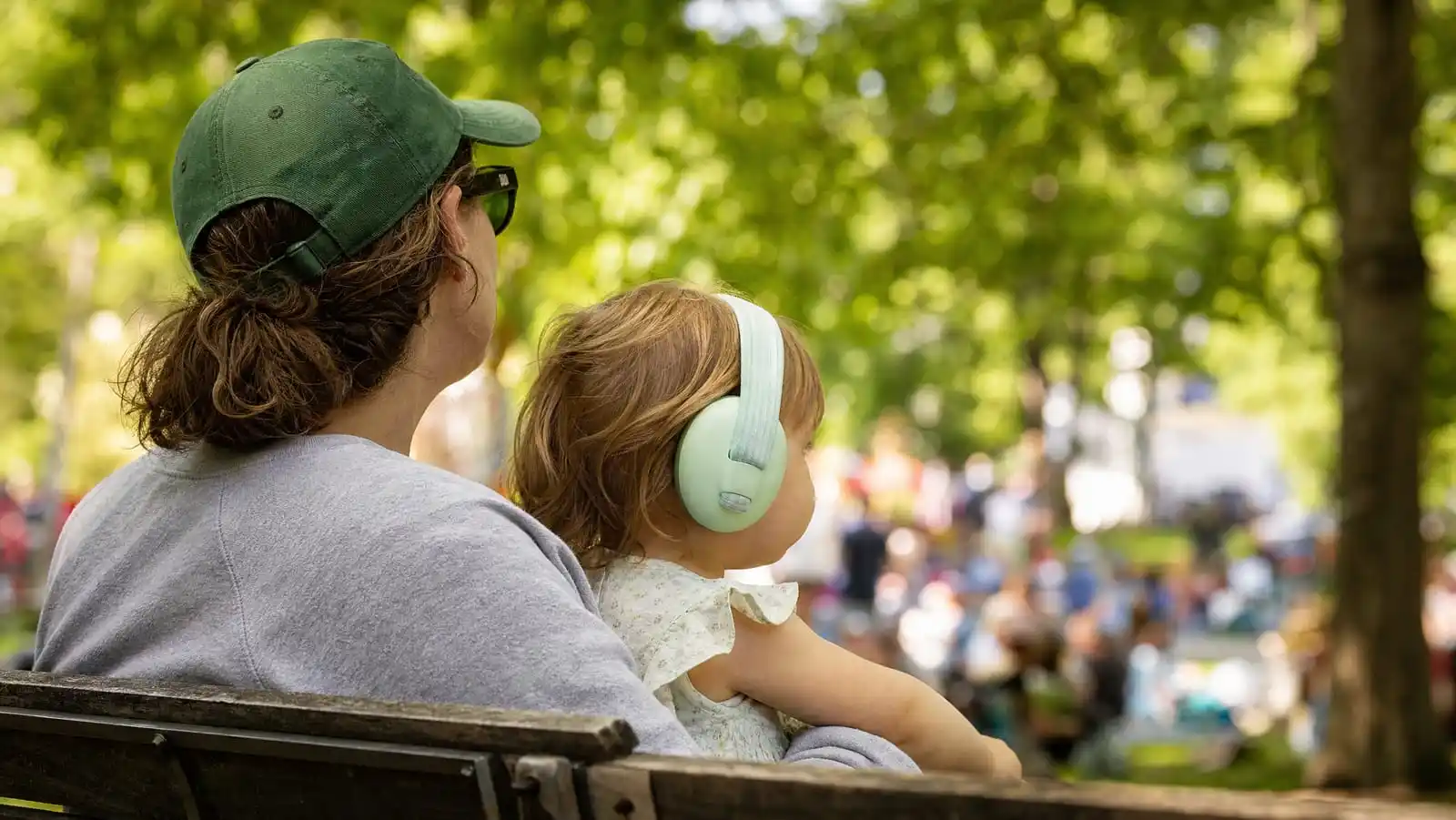
Fireworks, a parade, a sibling's concert, a loud flight — those are the use cases, with an adult in arm's reach. The NIDCD states that "long or repeated exposure to sounds at or above 85 dBA can cause hearing loss," puts a fireworks show at 140 to 160 dBA, and tells readers to "protect the ears of children who are too young to protect their own." Sensory comfort and hearing risk are different problems; both can be true at once.
Do not leave ear protection on a sleeping baby
AAP safe-sleep guidance is built around a bare sleep surface: firm, flat, baby on their back, "a fitted sheet only — nothing else should be in the crib with your baby." The AAP lists soft objects and loose bedding as raising the risk of "entrapment, suffocation or strangulation," and warns against hanging a pacifier around a sleeping baby's neck. A headband-and-cup device on an infant's head is not in the spirit of that. A baby dozing in a carrier at a loud event with an adult watching is supervised use; an unattended nap is not.
The Half of This That Is Not Equipment
Under five these cost nothing, usually outperform the earmuffs, and a calm adult is the main tool on the list.
- Predict and pre-warn. Say what is about to happen, in the simplest words, before it does.
- Time the outing around the loud thing — supermarkets at opening, soft play on a weekday morning, the barber first thing.
- Leave before the meltdown, not after. Ten good minutes on your terms teach something different from forty that end in the car park.
- Use the pushchair or carrier as a buffer. A canopy and a parent's chest may muffle some sound and cut visual load, and a carrier adds steady pressure many toddlers find calming.
- Bring a familiar, predictable sound — a known song or steady hum gives the nervous system something constant to hold: using calming sound on purpose.
- Expect mouthing and chewing. Hands and sleeves in the mouth are a common self-regulating behaviour at this age, not a problem to stop; see oral sensory toys for toddlers.
The honest limit: none of this makes a loud room quiet. It makes one survivable for longer, which at this age is the goal.
Does Constant Use Make Sensitivity Worse?
Genuinely contested, with thin evidence either way. The NHS advises against constantly wearing earplugs because it can make sensitivity worse, and an NHS children's hyperacusis leaflet from Milton Keynes University Hospital states that "the regular use of ear plugs, earmuffs or ear defenders must be avoided." Against that, many occupational therapists argue that ear defenders buy a child tolerable exposure to places they would otherwise refuse. We found no trial evidence in under-fives either way. Both camps agree: event-based use is defensible, all-day default use is not.
When to Ask for Professional Help, and Who
Ask sooner than feels justified — the appointments take months.
- Paediatrician or family doctor first, for the ears and a developmental once-over. The CDC tells parents to ask for a hearing test as soon as possible if they suspect hearing loss.
- Audiologist, urgently if sound seems to cause pain, if tolerance changes suddenly, or after repeated ear infections.
- Early intervention. US state programmes under Part C of the Individuals with Disabilities Education Act serve children under 3, and the CDC notes "a doctor's referral is not necessary" and that they serve eligible children "for free or at reduced cost".
- An occupational therapist with sensory-integration training, when the issue is function: outings, feeding, sleep, bath time.
Access varies by country, state and insurer, and waiting lists are the norm.
Frequently Asked Questions
Can a baby wear ear defenders to sleep? Not unattended, and not overnight. AAP safe-sleep guidance is built around a bare sleep surface — a fitted sheet and nothing else in the crib — and flags soft objects and loose bedding as suffocation risks. Supervised use at a loud event is a different situation.
What age can a toddler wear ear muffs? No authoritative age floor exists and the manufacturers do not agree: Alpine states up to 4 years with a 15.4 to 19.7 inch range, BBTKCARE 3 months to 3 years, and the Vanderfields title 3 to 24 months against its own bullet's 3 months to 4 years. Measure the head.
Is noise sensitivity a sign of autism? It is common in autistic children, but on its own it is not diagnostic. Middle-ear fluid is a much more common explanation to rule out at this age: the NIDCD reports five out of six children have at least one ear infection by their third birthday, and notes that a child left with fluid trapped behind the eardrum afterwards "may have no symptoms". Only a clinician can diagnose autism.
Do baby ear defenders actually block the noise? They reduce it, they do not remove it, and the printed figure is a ceiling. NIOSH states the rating on packaging "often does not reflect the actual protection provided," and those ratings come from laboratory testing on adults. Fit and minutes worn decide the rest.
My toddler pulls them straight off. What now? Treat it as information. Check the fit with a tape measure, try the muffs at home with no event attached, and accept that some children never take to them.
Where This Leaves You
Buy the tape measure before the earmuffs, and book the hearing appointment before either. Under five the printed decibel figure is the least informative number in the decision, and the only measure that predicts anything is minutes worn. Earmuffs for supervised loud events, never an unattended sleep, nothing in the ear canal.
This closes our auditory series, and our complete auditory sensory guide pulls the set together — mechanism, hardware, classroom, bedroom, no-equipment strategies. If you have energy for one thing this week, pick the outing that goes wrong most often.