This article contains affiliate links. We may earn a commission if you make a purchase through our links, at no extra cost to you.
Key Takeaways
- Hyperacusis is about volume. ASHA calls it a disorder that makes sounds most people find normal seem unbearably loud.
- Misophonia is about specific triggers. The 2022 consensus definition says the response comes from a sound's pattern or meaning, not its loudness.
- Sensory overload is about accumulation. Rarely one sound; a day's input in a system that stopped filtering.
- The prevalence numbers disagree wildly. A 2021 meta-analysis put hyperacusis in autism at 41.42 percent by questionnaire or interview and 27.3 percent by observational or objective measures.
- Noise sensitivity is not a test for autism. Among 925 representatively sampled school-age children, 16 percent of parents reported four or more bothersome tactile or auditory sensations.
- The word changes the referral. Hyperacusis to audiology, misophonia usually to a psychological therapy, overload to environmental change.
Hyperacusis is a loudness problem, misophonia is a trigger problem, and sensory overload is an accumulation problem — and the practical difference between hyperacusis and misophonia in autism is that turning the volume down helps the first and does almost nothing for the second. Different mechanisms, different assessors, different routes.
Three professionals can watch the same child cover their ears in a supermarket and hand you three different words for it. They may all be right: the words are not synonyms. This is the definitional layer underneath noise sensitivity in autism: what each term means, who assesses it, and what changes once you have the right one. Nothing here is a diagnosis.
What Hyperacusis Is: A Loudness Problem
Hyperacusis tracks volume. The American Speech-Language-Hearing Association's audiology information series calls it "a rare hearing disorder that causes sounds which would otherwise seem normal to most people to sound unbearably loud," then draws the line parents most often miss: "Hyperacusis is not discomfort around loud sounds." Dishes clanking or rustling paper can be the problem, and ASHA adds that "many people with hyperacusis have normal hearing."
Nor is it recruitment — the "abnormally fast growth of loudness perception of sound intensity" that follows damage to the cochlea's outer hair cells, which a 2022 review by Shi and colleagues in Medical Science Monitor separates from hyperacusis, "an aberrant condition characterized by maladaptation of the central auditory system." Recruitment belongs to hearing loss.
What Misophonia Is: A Trigger Problem, Not a Volume Problem
Misophonia is set off by what a sound is, not by how loud it is. Until 2022 the field had no agreed definition. The consensus definition published by Swedo and colleagues in Frontiers in Neuroscience, built by a 15-member expert committee over four rounds of voting, calls misophonia "a disorder of decreased tolerance to specific sounds or stimuli associated with such sounds."
The load-bearing line, in the same document: "Misophonic responses do not seem to be elicited by the loudness of auditory stimuli, but rather by the specific pattern or meaning to an individual." Triggers cluster around oral and nasal functions — the committee names chewing, slurping, throat clearing, swallowing, breathing and sniffing. The reaction is anger, irritation, disgust and anxiety, with autonomic arousal — faster heart rate, sweating.
A tool chosen for volume is therefore the wrong tool: ear defenders bought for a fireworks display will not rescue a child who cannot stay at the table while a sibling eats toast.
What Sensory Overload Is: An Accumulation Problem
Overload is usually not about any single sound. The research term is sensory over-responsivity, and Ben-Sasson, Carter and Briggs-Gowan in the Journal of Abnormal Child Psychology describe responses "that are rapid in onset, prolonged, and greater in intensity compared to peers," to otherwise non-noxious sensation that a child "may not habituate to."
That habituation clause is the difference. A child may cope with the hand dryer at 9am and come apart over a chair scrape at 2pm, because the capacity was spent elsewhere — the mechanisms are covered in why sound feels louder in autism.
Overload is a state rather than a diagnostic category, but the reactivity does sit inside the autism criteria: a 2023 systematic review by Gonçalves and Monteiro in the Journal of Neural Transmission quotes the DSM-5 wording "hyper- or hypo-reactivity to sensory input or unusual interest in sensory aspects of environment" as one of four restricted and repetitive behaviour features.
One umbrella, four patterns
Audiology gathers sound intolerance under decreased sound tolerance, which a 2022 paper in the American Journal of Audiology defines as a negative reaction to a sound that does not cause a reaction in an average person, and splits into four: hyperacusis, misophonia, noise sensitivity and phonophobia. Writing in ENT and Audiology News, autism researcher Zachary Williams describes phonophobia as "a marked fear or anxiety about specific sounds or situations in which a person might encounter unpleasant sounds." The same article notes "a notable lack of evidence-based options for diagnosis and treatment" for decreased sound tolerance in autism.
Side by Side: Types of Sound Sensitivity Compared
| | Hyperacusis | Misophonia | Sensory overload | |---|---|---|---| | What it is | Ordinary-volume sound heard as unbearably loud | Reaction to specific triggers | Cumulative over-responsivity | | What sets it off | Moderate-intensity sound, many sources | Particular sounds, often from particular people | Total load over time | | The reaction | Discomfort, intolerance, sometimes pain | Anger, disgust, anxiety, autonomic arousal | Shutdown, escape, distress | | Does volume predict it | Broadly, yes | No | Partly; duration and predictability matter too | | Who assesses it | Audiologist, ENT for medical questions | Psychologist or psychiatrist | Occupational therapist | | Typical management route | Graded sound desensitisation | Cognitive behavioural therapy | Environmental change, lower load |
How Often They Overlap, and Why the Numbers Disagree
The spread in the prevalence figures is itself the finding. ASHA's sheet states that "reports estimate that up to 40% of children with autism have hyperacusis." Summarising the 2021 meta-analysis by Williams and colleagues in Ear and Hearing, Danesh and Kaplan in ENT and Audiology News report that "the prevalence of hyperacusis was 41.42% when assessed using an interview or questionnaire and 27.3% when assessed using an observational or objective measure." Ask parents, get one number; observe or test the child, get a lower one.
Outside autism, Kennedy and Benton in ENT and Audiology News wrote in 2019 that "the reported prevalence of hyperacusis in children varies between 3.2% and 17.1%," with higher rates in preschoolers and in children with developmental differences including autism. For misophonia, a systematic review in Research in Developmental Disabilities reports estimates in autism from 12.8 to 35.5 percent.
Does Noise Sensitivity Mean My Child Is Autistic?
No. Noise sensitivity is not always autism: it occurs on its own and alongside many other conditions. Nor is it meaningless, since sensory reactivity is a recognised feature within the autism criteria. Both errors get made. Three findings sketch the picture.
- It is common in children generally. In the Ben-Sasson representative sample of 925 children aged 7 to 11, "sixteen percent of parents reported that at least four tactile or auditory sensations bothered their children."
- It is raised in ADHD too. A 2020 study by Ralli and colleagues in the International Journal of Environmental Research and Public Health diagnosed hyperacusis in 36.7 percent of 30 normal-hearing children with combined-presentation ADHD aged 4 to 12, against 13.3 percent of 30 matched controls, significant at p equals 0.03. The authors flag their own limits: a small sample, and no way to separate hyperacusis from misophonia or phonophobia.
- It turns up with no autism attached. Of 62 children with sound sensitivity in a 329-patient paediatric audiology sample, reported by Jahn, Wiegand-Shahani and Lobarinas in the American Journal of Audiology, only 5 — 8.06 percent — had autism documented. That is a hearing-clinic population, not a population average, and its intake question lumped the patterns together.
Asked seriously, that question is answered by a developmental assessment through a paediatrician or specialist service, not inferred from one symptom.
Who Assesses What, and Why Audiology Comes First
Several causes of sound intolerance are medical. ASHA links hyperacusis to Bell's palsy, chronic fatigue syndrome, Lyme disease, Meniere's disease, post-traumatic stress disorder, depression and autism, plus head trauma, jaw or face surgery and viral inner-ear infection, and names loud noise exposure a major cause. Kennedy and Benton add Williams syndrome, in which children have some degree of sound hypersensitivity.
Hearing is worth checking anyway. In the Jahn sample, 43.55 percent of the sound-sensitive children had a history of ear infections, and about 49 percent had normal hearing in both ears at 25 dB HL or better against 23 percent of those without, so roughly half had something worth knowing about.
How sound tolerance should be measured in children is contested. Danesh and Kaplan list stapedial reflex thresholds, loudness discomfort levels and otoacoustic emissions among objective measures in use; Kennedy and Benton take the opposite view — "We don't recommend uncomfortable loudness levels (ULLs). Asking a child, who has come to the clinic with distress on hearing loud sounds, to sit and listen to loud sounds seems somewhat unfair at best and cruel at worst, when the role of the audiologist should be to build a relationship of trust with that child." A clinic that declines to play loud tones is taking a side, not cutting corners.
When sound intolerance is a same-week question
The NHS advises seeing a GP if everyday noises feel too loud or painful, and says a GP may refer on to a hearing specialist. Its tinnitus guidance is more urgent where tinnitus is present: an urgent GP appointment for "tinnitus that beats in time with your pulse," and A and E or 999 for tinnitus after a head injury, or tinnitus "with sudden hearing loss, weakness in the muscles of your face, or a spinning sensation (vertigo)." Sound sensitivity that starts suddenly, worsens quickly, sits in one ear more than the other, or comes with ear pain is worth raising promptly rather than monitoring at home.
So What Changes: The Route Each Label Puts You On
The routes genuinely diverge.
- Hyperacusis. ASHA describes sound desensitisation — barely audible static noise for a set period each day under a specialist's guidance, tolerance building over "perhaps 6 months to a year or more." Danesh and Kaplan name habituation training, cognitive behavioural therapy and auditory integration training as the three approaches reviewed in autism; one is not endorsed, ASHA's position being that auditory integration therapy "does not meet scientific standards for effectiveness" outside research protocols. The trade-off on the rest: months of adherence for an uncertain return.
- Misophonia. The strongest evidence is cognitive behavioural therapy, and it is thinner than the internet implies. A 2023 systematic review by Mattson and colleagues in Personalized Medicine in Psychiatry found 33 treatment studies, of which exactly one was a randomised controlled trial: 54 adults aged 18 to 70, seven weekly group sessions, a mean drop of 9.7 points on a misophonia severity scale, and 37 percent rated treatment responders on a clinician-rated measure against 0 percent of the waiting list. The reviewers' verdict: "there exists no single frontline treatment for misophonia to date." That trial was in adults, not children.
- Sensory overload. No single established treatment to refer to, so most of the work is environmental: predictability, warning before known noise, recovery time, lower daily load. Our list of noise sensitivity strategies that need no equipment is the practical version, and it costs nothing to start.
Why this matters for ear defenders specifically
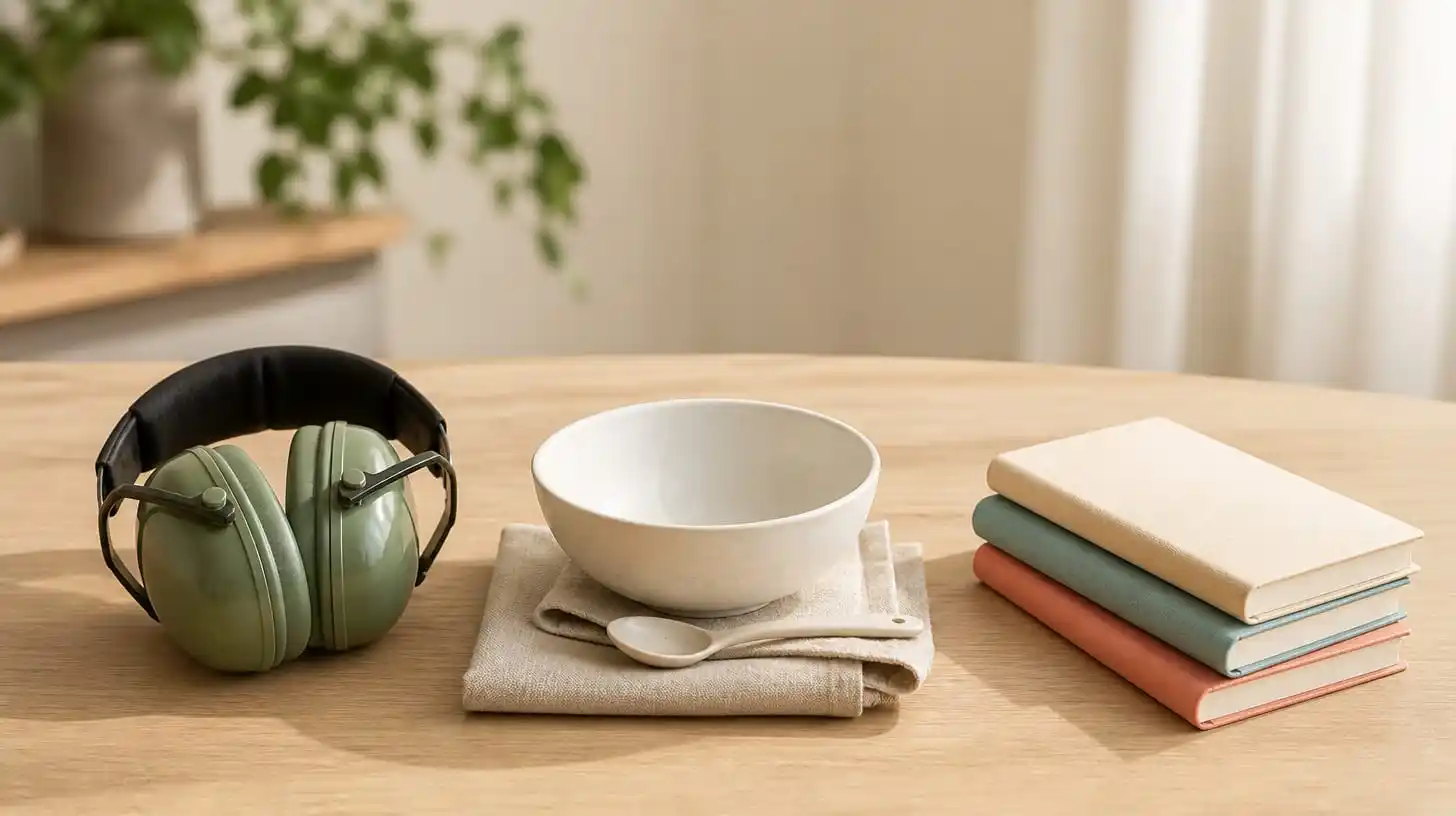
Attenuation is reasonable at a known-loud event, contested as a daily habit, and most contested during hyperacusis treatment. ASHA warns that earmuffs may give immediate relief, but that "when the individual eventually removes the earplugs or muffs, that environment will seem even louder than it might have otherwise." Danesh and Kaplan put it mechanistically: avoiding sound can "enhance the central gain in the brain," worsening intolerance "due to the lack of proper exposure." Against that sits the counter-argument many autistic people make: without protection, some environments are closed to them. The research does not settle it, so targeted use reviewed with an audiologist beats all-day use by default. Device choice: ear defenders and earplugs.
None of that applies to misophonia, because lowering a trigger sound's volume does not change its meaning: seating changes, a family conversation and a therapy referral are more likely to help than a purchase. Patterns can shift with age, too, and self-report in adolescence may not look like what a parent saw at seven — the subject of noise sensitivity in autistic teens and adults.
Frequently Asked Questions
Can my child have more than one of these at once? Yes, and co-occurrence is commonly reported — ASHA notes that people with autism "can have multiple sensory integration issues involving hearing and other senses." Hyperacusis confirmed by an audiologist, a misophonic trigger at the dinner table and an accumulation pattern at school can sit together. They are separated because the routes differ, not because they exclude one another.
Will a hearing test show hyperacusis? Not directly — it is a tolerance problem, not a threshold problem, and ASHA notes many people who have it have normal hearing. The test earns its place by ruling out middle-ear and hearing-loss explanations.
Does sound sensitivity get better on its own? Sometimes. ASHA notes that depending on the cause hyperacusis may improve with time, particularly after trauma to the brain or hearing system, but that where the cause is unclear "relief may not come on its own." That is an argument for assessment, not waiting.
Getting the Word Right
Mixing them up has consequences. Treat a trigger problem as a volume problem and you buy equipment that cannot work. Treat accumulation as hyperacusis and you aim a desensitisation programme at the wrong mechanism. Treat hyperacusis as behaviour and you miss a medical question an audiologist is equipped to investigate.
So write it down: which sounds, at what volume, from whom, for how long, what happened next. Two weeks of that log tells an audiologist, occupational therapist or psychologist more than any label you arrive with. For the sense itself and the day-to-day strategies, see our complete auditory sensory guide.