This article contains affiliate links. We may earn a commission if you make a purchase through our links, at no extra cost to you.
Key Takeaways
- Three levers do most of the work: lower the total sound load, make what remains predictable, hand the child control.
- Self-generated sound is processed differently. The brain's early response to a sound you cause yourself is measurably smaller than to the identical sound from elsewhere.
- Predictability matters as much as volume. Classic research found the aftereffects came from noise being unpredictable and uncontrollable, not simply loud.
- In the moment, do less. Fewer words, no questions, a quieter voice, protected recovery time afterwards.
- Avoidance is not the goal. NHS hyperacusis guidance is blunt that avoiding noise is not the answer; an escape route and a shrinking world are different things.
- Tolerance work belongs with a clinician. Sound-based therapies sold as autism treatments have not met evidence standards.
The most useful autism noise sensitivity strategies do not try to make a child tolerate sound. They lower the total amount of noise the child is carrying, make what is left predictable, and give the child a say in it. All three are free and need nothing you do not already own.
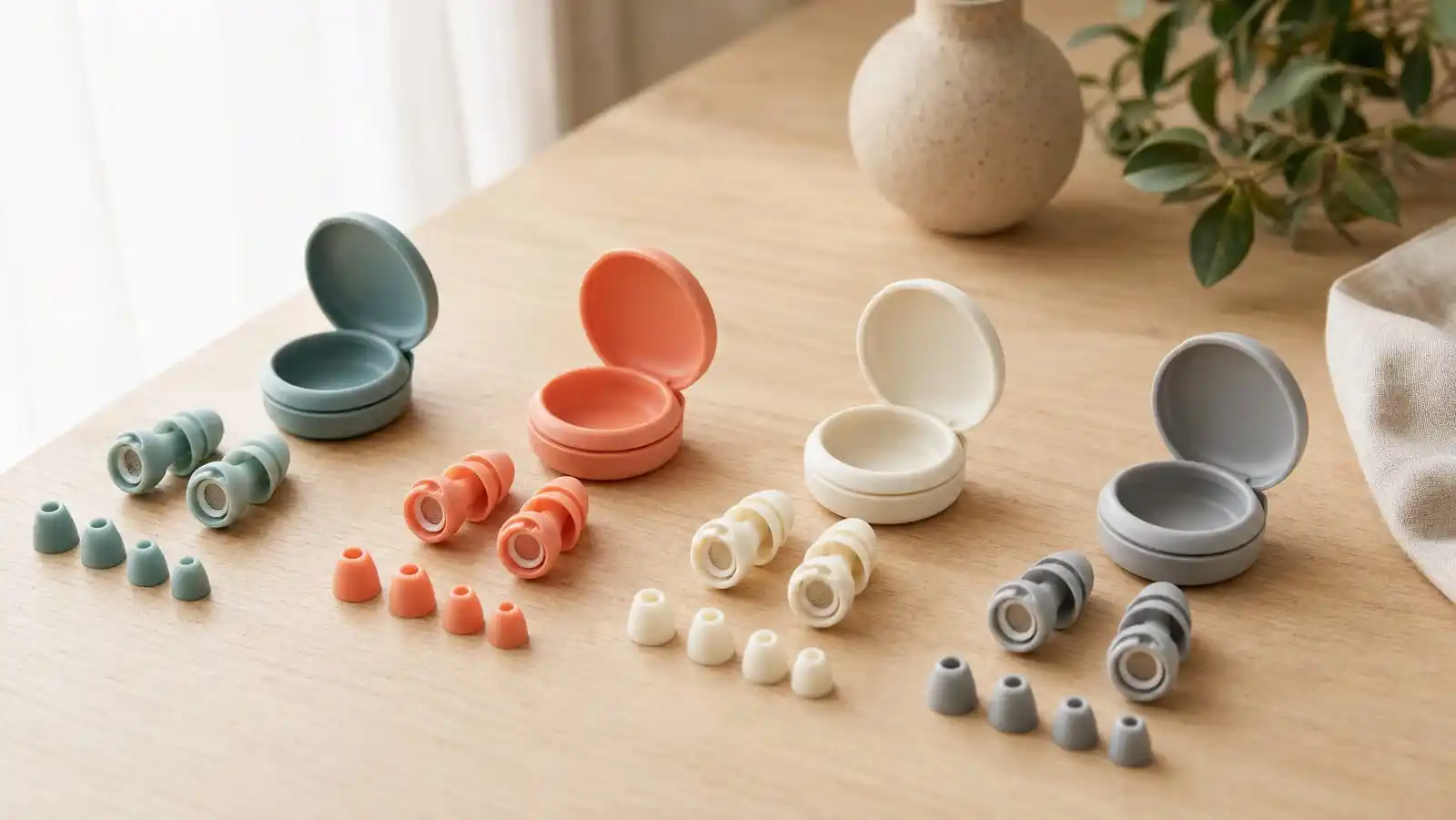
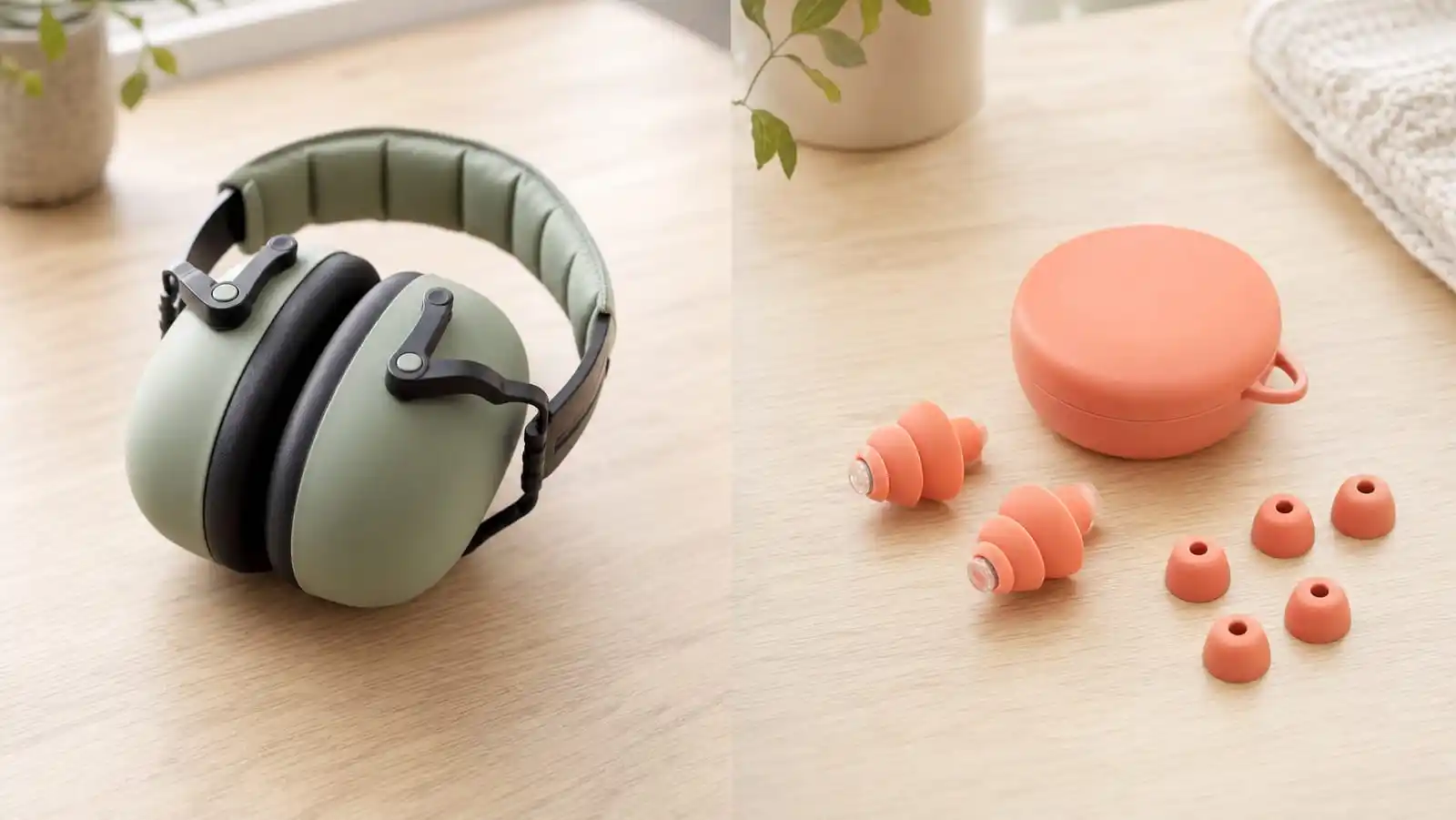
This list is deliberately equipment-free. For the hardware side, our guide to auditory sensory tools for autism covers it — but start here, because a quieter room changes what any tool has to do.
According to a 2021 meta-analysis in Ear and Hearing by Williams, Suzman and Woynaroski, pooling 87 independent samples and 13,093 autistic participants, published via PubMed Central, current hyperacusis prevalence was 41.42% on interview and questionnaire measures, with a lifetime estimate of 60.58%; on objective and observational measures it fell to 27.30%. The figure you see quoted depends on how it was measured.
Lowering the Total Auditory Load
The cheapest gains are subtractions. A child does not hold a separate budget per sound. There is one budget, and the fridge is spending it.
1. Run a ten-minute auditory clutter audit
Sit on the floor of the room your child uses most, at their head height, and list every sound source for ten minutes: fridge compressor, extractor fan, laptop fan, flickering strip light, traffic through one thin window. Most rooms hold more sources than you would guess before counting. You want the two or three that run constantly and serve nobody.
Trade-off: the audit tells you what is there, not what your child minds. The hum you find unbearable may be the one they never mention.
2. Turn off the sound nobody is listening to
The kitchen radio, the TV playing to an empty sofa, the playlist that started four hours ago. For a nervous system that may not filter the room the way yours does, none of that is background — it is another live channel, and switching it off frees capacity for the sounds you cannot switch off. We explain that filtering difference in why sound sensitivity happens.
Trade-off: silence is not neutral for every child. Sound-seekers find a quiet house unsettling, and some use a steady sound to mask an unpredictable one.
3. Break up the hard surfaces
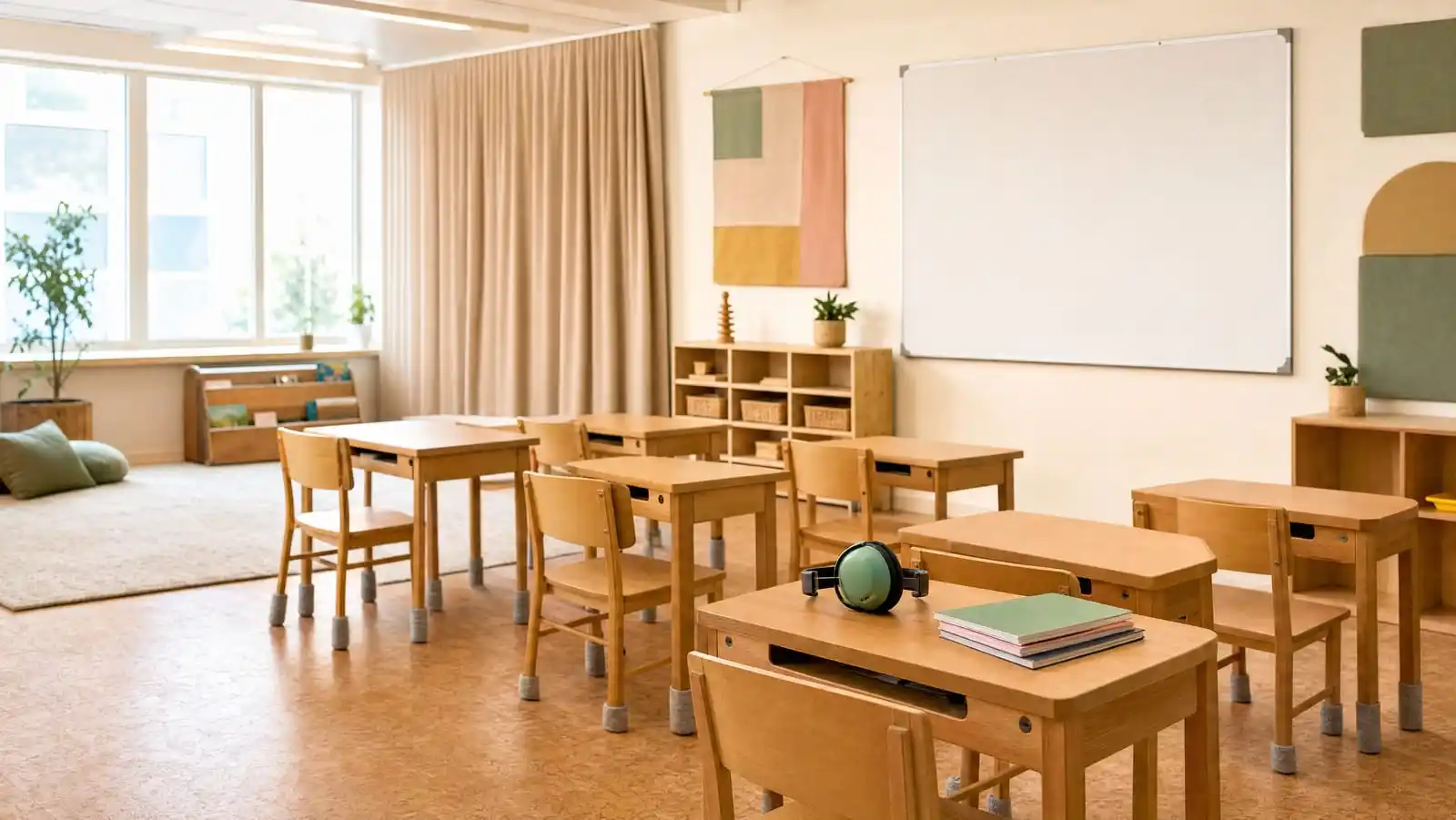
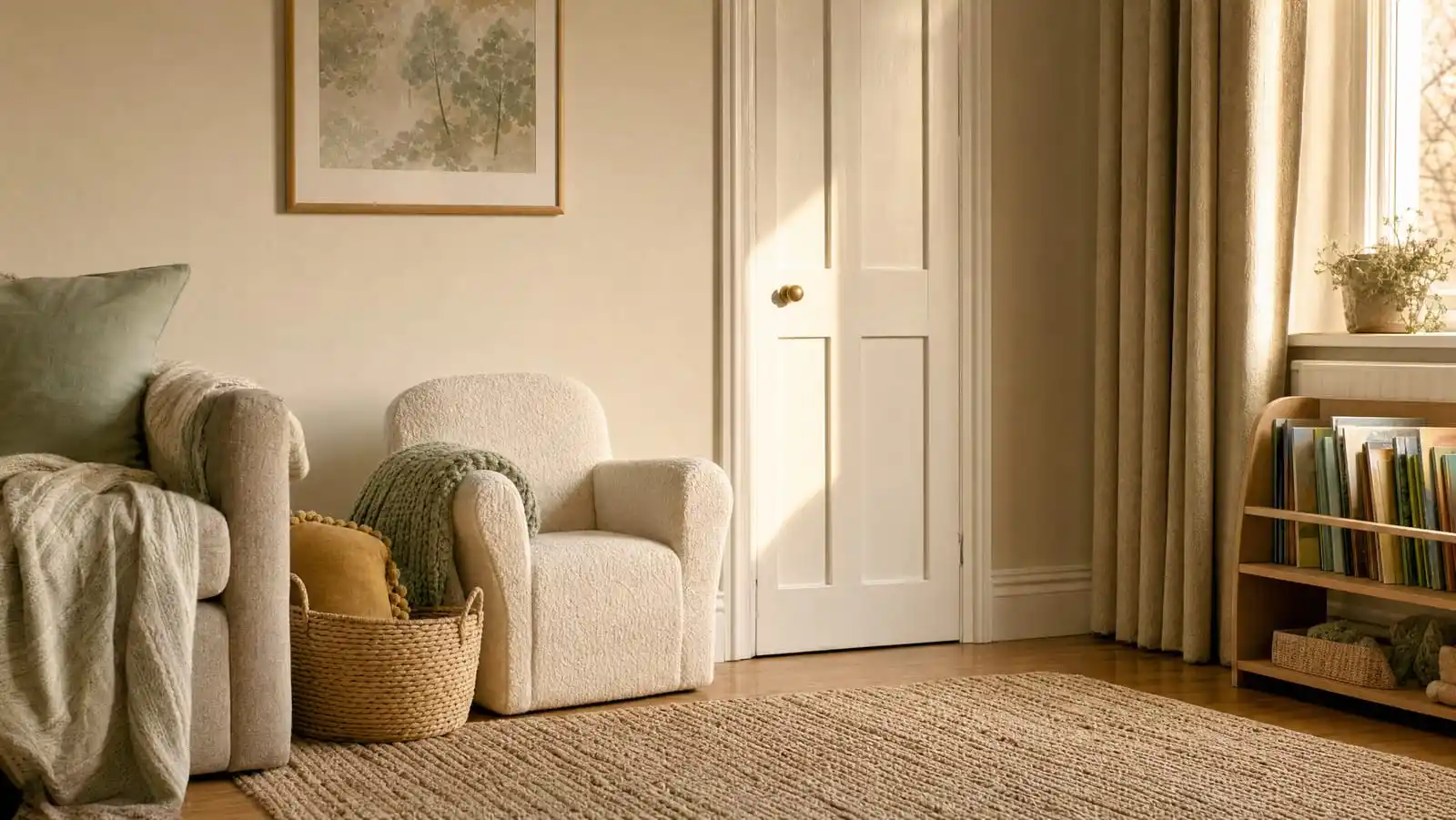
Reverberation — sound smearing as it bounces off hard walls and floors — wrecks speech before it wrecks comfort. ANSI/ASA S12.60, the national standard for school acoustics, caps reverberation time at 0.6 seconds in an unoccupied, furnished classroom under 10,000 cubic feet, and background noise at 35 A-weighted decibels, as summarised by the ANSI Blog. A rug, curtains instead of a blind, a full bookcase and a throw over a leather sofa shorten that tail.
Trade-off: soft furnishings shorten reverberation; they do not lower the source. Teachers stuck with the room they have will find options in our piece on auditory sensory tools for the classroom.
4. Make one-sound-at-a-time a house rule
Two sounds are harder to handle than one, because the child now has to separate them as well as tolerate them. The blender or the music, not both. Homework with the dishwasher off. Applied for a week, this is a change many families report noticing.
Trade-off: it binds the whole household and siblings notice fast. Name it as a house rule, not one child's rule, or you have swapped an auditory problem for a fairness problem.
5. Move the loudest appliances out of the child's day
Coffee grinder, hoover, hairdryer, the tumble dryer's buzzer. Each has a time slot and most are negotiable: grind coffee before they wake, hoover during school hours, batch the noisy jobs into one window the child knows about.
Trade-off: this is household labour rearranged around one person, and it does not scale to three children and two jobs. Move the two loudest offenders only.
Making Noise Predictable
Volume is half the story. A sound you did not see coming lands differently from one you were braced for, and this is the lever most families under-use.
6. Warn before every noise you control
"Blender on in ten seconds." Five words, every time, before every appliance you touch. It removes the startle, gives ten seconds to leave, and over months teaches that noise here is announced rather than inflicted. Consistency beats wording: a warning that comes only most of the time still leaves a child braced for the times it does not.
Trade-off: you will forget, and a missed warning after a reliable month can land harder than no system at all.
7. Put the loud parts on the schedule
If your child uses a visual schedule, the fire drill, assembly, the bell and the end-of-day rush belong on it — not only the lessons. Most schedules list what a child will do and skip what they will hear, which is the part they dread. Ask the school for the fire drill date; if refused, ask for the term window.
Trade-off: knowing a bad thing is coming is not the same as being fine about it. For some children a scheduled dread is worse than an ambush.
8. Count down to noise you cannot avoid
Sirens, a tannoy, the train arriving. Where the sound is coming regardless, narrate it: "That is the tunnel. It gets loud in three, two, one." A countdown turns an event that happens to the child into one they are tracking. NHS advice for parents in the Milton Keynes University Hospital children's hyperacusis leaflet likewise recommends explaining the source of a sound and preparing the child before noisy events such as firework displays.
Trade-off: narration uses your voice, and during an overload your voice is more input. Count down before the sound, not during it.
Safety Warning
Some everyday noises are a hearing-protection question, not only a sensory one. A 2019 study by Nora Keegan in Paediatrics and Child Health, published via PubMed Central, measured automated hand dryers in public places and found many models exceeded 85 A-weighted decibels, the loudest measurement reaching 121.1 dBA — and that many units were louder at children's ear heights than at adult ear heights. The NIDCD's Noisy Planet states that sounds at or above 85 dBA can damage hearing over time, and 100 dBA in under 15 minutes of exposure a day. Use paper towels where they exist, and do not coach a child to tolerate that sound.
9. Let the child be the one who makes the sound
The strategy here with the most direct research behind it. When a sound is triggered by your own action, the brain predicts it and turns the early response down. In a study by Timm, SanMiguel, Saupe and Schroger in BMC Neuroscience, published via PubMed Central, the N1 component of the auditory brain response to a self-initiated sound was suppressed compared with the identical externally initiated sound, whether or not attention was on the sound. So let them press the blender button, start and stop the hoover, pop the balloon; the MKUH leaflet says controlling the sound themselves can often stop a child's fear.
Trade-off: this suits sounds a child is wary of, not sounds that hurt, and it is not a back door into forced exposure. If they decline the button, the offer ends there.
Giving the Child Control Over Sound
Control is not a consolation prize for a noisy room. It changes the cost of the noise.
10. Name the exit before it is needed
Decide in advance, out loud, where the child goes and how they signal it — a card on the desk, a hand sign, or simply walking. No asking, no permission. Guidance for schools published by NAIT in 2019, written by a principal paediatric audiologist in NHS Lothian, says a child may be reassured by having permission to leave the classroom briefly, and that anxiety may increase if forced to remain somewhere distressing.
Trade-off: a pre-authorised exit will occasionally be used to leave maths. Track whether it is being used for one sound or for one subject.
11. Let the child choose the quiet spot
Not the corner you picked because it looks calm — the spot they picked, which may be a stairwell, the space behind the sofa, or a parked car. Your job is to protect it: nobody follows, nobody talks, siblings do not borrow it.
Trade-off: children choose inconvenient spots and occasionally unsafe ones. Veto rarely, and offer two alternatives when you do.
12. Hand over the volume control
Whatever the child listens to alone — tablet, TV, music — they set the level, including louder than you would. Work reported by Reim, Glass and Singer in the Journal of Applied Social Psychology found it was the unpredictability and uncontrollability of noise, not loudness alone, that produced aftereffects on later task performance, and that believing the noise could be stopped reduced them.
Trade-off: the knob is not the same as hearing safety. Agree a ceiling for headphone listening and keep that one non-negotiable.
In the Moment: How to Deal With Noise Sensitivity During an Overload
Most of what helps here is subtraction, and the instinct to help by talking is the one to resist.
13. Cut your words by three quarters
Your speech is more input into a system already over budget. Swap sentences for a few fixed phrases the child knows, and questions for statements. "Are you okay, what happened, do you want to go outside?" is three demands for processing. "We are going outside" is none.
Trade-off: saying less looks like doing nothing and reads as neglect to a bystander. Brief the adults around you beforehand.
14. Drop your own volume before anything else
Before you move the child, lower your voice — quieter and slower than feels natural, close enough to be heard. The MKUH leaflet notes that children pick up on a parent's anxiety and can become more anxious themselves, so staying calm is part of the intervention.
Trade-off: in a genuinely dangerous environment, quiet is the wrong call. Safety first, calm second.
15. Protect the recovery window
The sound ending is not the episode ending. Assume a flat, low-demand stretch afterwards: no debrief, no consequences conversation, no "so what went wrong there." Parents often report the length is fairly consistent for their own child, and knowing yours lets you plan — no supermarket straight after swimming.
Trade-off: that window costs time you may not have. Cancelling the next thing early is cheaper than a second overload.
Lowering the load is not the same as avoidance
These strategies remove noise that serves no purpose; they are not a licence to remove all sound. The MKUH children's hyperacusis leaflet is direct that avoiding noise is not the answer, and that listening to sound in a relaxed, calm way is part of how tolerance recovers. An escape route is healthy. A world that shrinks each month until parties, assemblies and cafes have dropped off the list is the outcome to watch for.
Can Autism Noise Sensitivity Be Reduced? Building Tolerance, Carefully
Sometimes — and this is the section where we will not hand you a method.
Structured desensitisation is real and NHS audiology services run it, but it is prescribed and monitored, not improvised. The NAIT guidance describes recalibration programmes in which a continuous low-level sound is played into the child's hearing system, and states plainly that this is formally prescribed by an audiologist; the MKUH leaflet describes desensitisation as a long process, often many months, run through a hyperacusis clinic. Home-made exposure schedules carry a real risk: one bad session can attach fear to a sound that was only annoying before.
Be equally careful with anything sold as a sound-based therapy. The American Speech-Language-Hearing Association's position statement concluded that auditory integration training has not met scientific standards for efficacy that would justify its practice by audiologists and speech-language pathologists, and the American Academy of Audiology task force found no recent scientific, controlled studies supporting AIT effectiveness.
Hearing protection sits in the same category. Both the NAIT guidance and the MKUH leaflet warn against routine daily use of ear defenders and earplugs for children with hyperacusis, because depriving the ear of ordinary sound can increase sensitivity over time; NAIT calls continued use counterproductive to an audiology treatment plan. Protection at a fireworks display is a different question, and we work through the distinction in our guide to ear defenders and noise-cancelling headphones.
When to Get an Assessment
Strategies are not a substitute for a clinical opinion. Ask for one when:
- The child reports pain, not dislike, in response to everyday sound.
- Tolerance changes suddenly rather than following a long-standing pattern.
- Sensitivity sits alongside signs of hearing difficulty — missed speech, rising TV volume, turning one ear towards you.
- Avoidance is shrinking daily life — school refusal, no cafes, no assemblies.
- Nothing here has moved anything after a consistent month.
Two professions, two jobs. Audiology assesses the ear and sound tolerance itself; the NAIT guidance notes that hyperacusis requires a formal diagnosis and that local audiology services can advise on referral. Occupational therapy addresses how sensory differences play out across the day. The MKUH leaflet also points to child psychology, CAMHS and child development centre support via a GP.
Frequently Asked Questions
Can sound sensitivity improve on its own? Often it eases. The MKUH children's hyperacusis leaflet states that if the problem is managed well, it usually lessens over time. That is not a promise for any individual child.
Do ear defenders make noise sensitivity worse? Routine all-day use may. The MKUH leaflet says regular use of earplugs, earmuffs or ear defenders must be avoided, because depriving the ear of sound leads it to compensate by amplifying quieter sounds. Situational use around damaging noise is separate.
Is auditory integration training worth trying? On current evidence, no. ASHA concluded AIT has not met scientific standards for efficacy, and the American Academy of Audiology found no recent controlled studies supporting its effectiveness.
Should a child be made to face a sound they fear? Not by force. The MKUH leaflet advises against making children stay in a distressing situation, warning it can link that situation with pain and worsen the reaction; it recommends moving the child away and comforting them.
Helping a Child With Sound Sensitivity Starts With Subtraction
Nothing here makes a sensory difference disappear, and anything promising that deserves suspicion. These fifteen strategies reclaim the margin: less pointless noise, fewer ambushes, more say for the child. Some families notice something shift within a few weeks of applying three or four consistently and some do not, and that tells you which problems are environmental and which need a clinician.
Start tonight with the audit and the one-sound-at-a-time rule, then add the warnings. When you are ready to think about equipment, our guide to autism noise sensitivity picks up where the free strategies stop.