The Complete Guide to Sensory Play, Sensory Bins & Messy Play for Autism, ADHD & SPD
Sensory play activities for autism are ordinary play, arranged so the child controls how much touch, movement and mess arrives: a tray of dry pasta, a tub of warm water, a sealed bottle of slow-falling glitter. They can support regulation, tolerance and language. They do not treat autism, and no filler is safe for every child.
We earn a commission from qualifying purchases made through links on this page, at no extra cost to you.
That last point is the one most guides skip. A sensory bin is a container of small objects, and the biggest decision you make is not which activity to run but what goes in the tub, and whether your child still puts things in their mouth.
This is the hub of our sensory play series: the mechanism, the safety rules that have real regulations behind them, the honest state of the evidence, what to do when messy play is refused outright, and how to set up so clean-up takes two minutes.
The short version:
- Sensory play is play. The evidence for play is strong; the evidence for sensory-integration therapy is limited and contested, and the two claims get sold together.
- Filler safety is a two-question test: does this child still mouth objects, and does this material expand after it is swallowed.
- Water beads are the one category with a new federal rule behind it, and the rule does not make loose beads safe for a mouthing child.
- Closed play (bottles, bags, lidded trays) delivers most of the benefit with none of the clean-up, and it is the honest starting point for a child who hates mess.
- Tools beat filler. A set of scoops and tweezers turns any material into fine-motor work.
- Nothing here is a treatment. If sensory differences are affecting eating, sleeping or school, that is a conversation with a paediatrician or occupational therapist, not a shopping decision.
What Sensory Play Actually Is
Sensory play is play that deliberately supplies a particular kind of input — touch, pressure, movement, sight, sound or taste — in a dose and a container the child can control. The full version of what sensory play is and how it works gets its own article, but the working definition is that short, and the word doing the work is control.
That matters because sensory differences in autism, ADHD and sensory processing differences run in two directions at once. The same child can seek deep pressure and flee a wet sponge. A bin lets you separate those: the child chooses whether to plunge both hands in, use a scoop, or watch from a chair.
The scale of the need is well documented, if loosely measured. A 2023 multi-site analysis of 3,866 autistic young people by the Autism Sensory Research Consortium, published in Molecular Autism, cites an estimate that "the point prevalence of a child displaying differences in any of the three response patterns" — hyper-reactivity, hypo-reactivity and seeking — is 74 percent, a figure it draws from Autism and Developmental Disabilities Monitoring Network surveillance data rather than from its own sample. The 2017 systematic review in Pediatrics by Weitlauf and colleagues is more cautious: estimates indicate that 42 to 88 percent of people with autism "have impairments related to sensory processing that include both hyper- and hyporesponsiveness."
Touch is the system most sensory play recruits, which is why our complete guide to tactile sensory toys is the companion piece to this one: it covers the products, where this page covers the activities.
What sensory play is not
It is not a treatment for autism. It does not reduce autistic traits, and anyone selling it that way is overselling. What it can plausibly do is give a child a predictable, low-demand way to get input they are looking for, build tolerance for textures at their own pace, and create a shared activity that is easier to talk during than a face-to-face conversation.
What the Evidence Does and Does Not Say
Play has a strong evidence base. Sensory-integration therapy has a weak and contested one. Sensory play sits in the first category, and the marketing borrows credibility from the second.
On play, the American Academy of Pediatrics is unambiguous. Its 2018 clinical report The Power of Play, published in Pediatrics, states that "developmentally appropriate play with parents and peers is a singular opportunity to promote the social-emotional, cognitive, language, and self-regulation skills that build executive function and a prosocial brain," and that play "is not frivolous: it enhances brain structure and function."
On therapy, the picture is messier, and you should know it before you spend money.
- The AAP's 2012 policy statement on sensory integration therapies, published in Pediatrics, says occupational therapy using sensory-based therapies "may be acceptable as one of the components of a comprehensive treatment plan," but that "parents should be informed that the amount of research regarding the effectiveness of sensory integration therapy is limited and inconclusive." The same statement says that because there is no universally accepted framework for diagnosis, "sensory processing disorder generally should not be diagnosed," and that other developmental and behavioural conditions must always be considered.
- The 2017 Pediatrics systematic review found 24 studies including 20 randomised controlled trials, of which only three had a low risk of bias. Sensory integration-based approaches improved sensory and motor skills-related measures at low strength of evidence. Its conclusion is that some interventions "may yield modest short-term" improvements — the paper defines short-term as under six months — but that "the evidence base is small, and the durability of the effects is unclear."
- A more favourable 2024 systematic review of 16 studies published between 2014 and 2023, drawn from a 2013-2023 search window, in the journal Children, concluded that sensory integration intervention "meets the criteria to be considered an evidence-based practice" for young autistic children. Read its own limitations alongside that: the authors write that "the heterogeneity of the interventions and the different methodologies of the studies limit our ability to generalise the effects," note that the included studies focused mainly on clinical settings, and state that long-term effects have not been evaluated.
So: encouraging signals, small and heterogeneous studies, and real disagreement between expert bodies. Our reading is that this is a good reason to treat sensory play as play — cheap, pleasant, low-risk — and a bad reason to spend hundreds of dollars on a system marketed as therapy.
The most useful thing in the 2012 AAP statement is practical. It tells clinicians to help families "create explicit treatment goals, designed at the onset of therapy, focused on improving the individual's ability to engage and participate in everyday activities," and to set a time limit for reviewing whether it worked. Borrow that for your kitchen table. Pick one functional goal — tolerates sticky hands at dinner, washes hair without screaming, stays at the table for ten minutes — and give it six weeks.
Choosing Safe Sensory Bin Fillers
Before anything else, answer two questions: does this child still put non-food objects in their mouth, and does this material get bigger after it is swallowed. If the answer to the first is yes, you are limited to taste-safe fillers under close supervision. If the answer to the second is yes, the material does not belong in your house.
The long answer to which sensory bin fillers are safe depends on your specific child, but the regulatory floor is the same for everyone and it is worth knowing.
The rules that actually exist
Two federal rules do most of the work.
Small parts. The US Consumer Product Safety Commission bans children's products intended for children under three that present a choking, aspiration or ingestion hazard because of small parts. CPSC defines a small part as "any object that fits completely into the small parts cylinder," a test fixture that "approximates the size of the fully expanded throat of a child under three years old." Almost every dry sensory filler — rice, lentils, pasta, beads, pom-poms — is a small part by that definition.
Small balls. Separately, under the Child Safety Protection Act, a ball intended for children under three is banned if it passes through a 1.75-inch template, as implemented in the 1995 final rule in the Federal Register at 16 CFR 1500.18(a)(17). It reaches only balls intended for under-threes, so an ages-3+ product is not illegal — but the threshold is still a useful yardstick. One 71-piece counting and sorting set we looked at uses hedge balls averaging about 3 cm, roughly 1.18 inches, across — well under that 1.75-inch threshold — and its own listing carries an explicit choking-hazard warning and tells buyers to supervise play at all times. Chunky is not the same as safe.
Water beads: the one category with a new rule
Water beads get their own section: the regulation changed this year, and the injury data is not ambiguous.
According to the CPSC's Water Beads Information Center, water beads can "grow 100X their original size when exposed to water," nearly 7,000 water bead-related ingestion injuries were treated in US emergency departments from 2018 through 2022, and the agency is aware of the death of a 10-month-old girl in 2023. Swallowed beads can keep expanding inside the body, causing vomiting, dehydration and intestinal blockages that may require surgery; beads inserted into ears can damage ear structures and cause hearing loss. CPSC says to seek medical treatment immediately if a child swallows a bead or puts one in an ear or nose.
CPSC then issued a mandatory standard, published in the Federal Register in December 2025. Per the agency's water bead toys business guidance, the rule is effective March 12, 2026 and applies to covered toys manufactured on or after that date. It limits extractable acrylamide to 325 micrograms from 100 small beads or one large bead — a small bead being under 4.0 mm in all dimensions when dehydrated — and requires that fully expanded beads pass through a 5.0 mm funnel test gauge. Warning labels are required on the toy, its packaging and its container, including for toys with beads sealed inside, such as balls filled with water beads. Importers, manufacturers and private labelers must certify compliance based on testing by a CPSC-accepted third-party laboratory.
Read the scope before you relax. It covers water bead toys and toys containing water beads, so beads sold for non-toy uses — vase filler, garden and craft products — sit outside it. It is not retroactive: the tub in your cupboard was never tested against it. And it is a product standard, not a ban on having beads at home. CPSC's consumer advice has not softened either: the agency tells families to remove these products "from any environment with children," and advises a secure, out-of-reach container for any you keep. Our own view, not the agency's, is that removal is simpler, because dry beads are small enough to vanish into a carpet and be found later by the youngest person in the house. A compliant toy is one that met a test, not one that is safe on the floor near a toddler. Our guide to sensory bins and water beads covers the category in detail.
What we use instead
For families replacing water beads, the straightforward swap is a non-food, non-expanding filler. The Educational Insights Pluffle Mini 8-pack is $19.99 as of November 2026, against a $34.99 list price, for eight mini tubes of foam filler in eight colours. The manufacturer states that it is non-toxic and free of major allergens including nuts, gluten and latex, that it vacuums off surfaces, and that it never dries out or hardens; it is labelled ages 3+. We have not independently tested the allergen claim, and ages 3+ means what it says — this is not a filler for a child who mouths.
Two more things worth looking for on any listing. Documentation: one hand-dyed rainbow rice we looked at states independent testing to the ASTM F963 toy safety standard with per-batch lot numbers, which is more than most dyed fillers offer. And scatter: moldable play sands stick to themselves rather than to the carpet, which matters more than any other feature if you have a rug.
Taste-Safe and Edible Sensory Play
Taste-safe means a mouthful will not poison a child. It does not mean food, it does not mean sterile, and for flour-based recipes it does not even mean safe to handle uncooked.
That last point surprises people, and it changes half the taste-safe sensory play recipes circulating online. The US Centers for Disease Control and Prevention is explicit: do not "let children play with or eat dough made with raw flour," and its guidance adds that "this includes dough for crafts," naming homemade play dough and holiday ornaments. The reason is that "flour doesn't look like a raw food, but most flour is raw" — it "hasn't been treated to kill germs that cause food poisoning," and "germs are killed only when flour is baked or cooked."
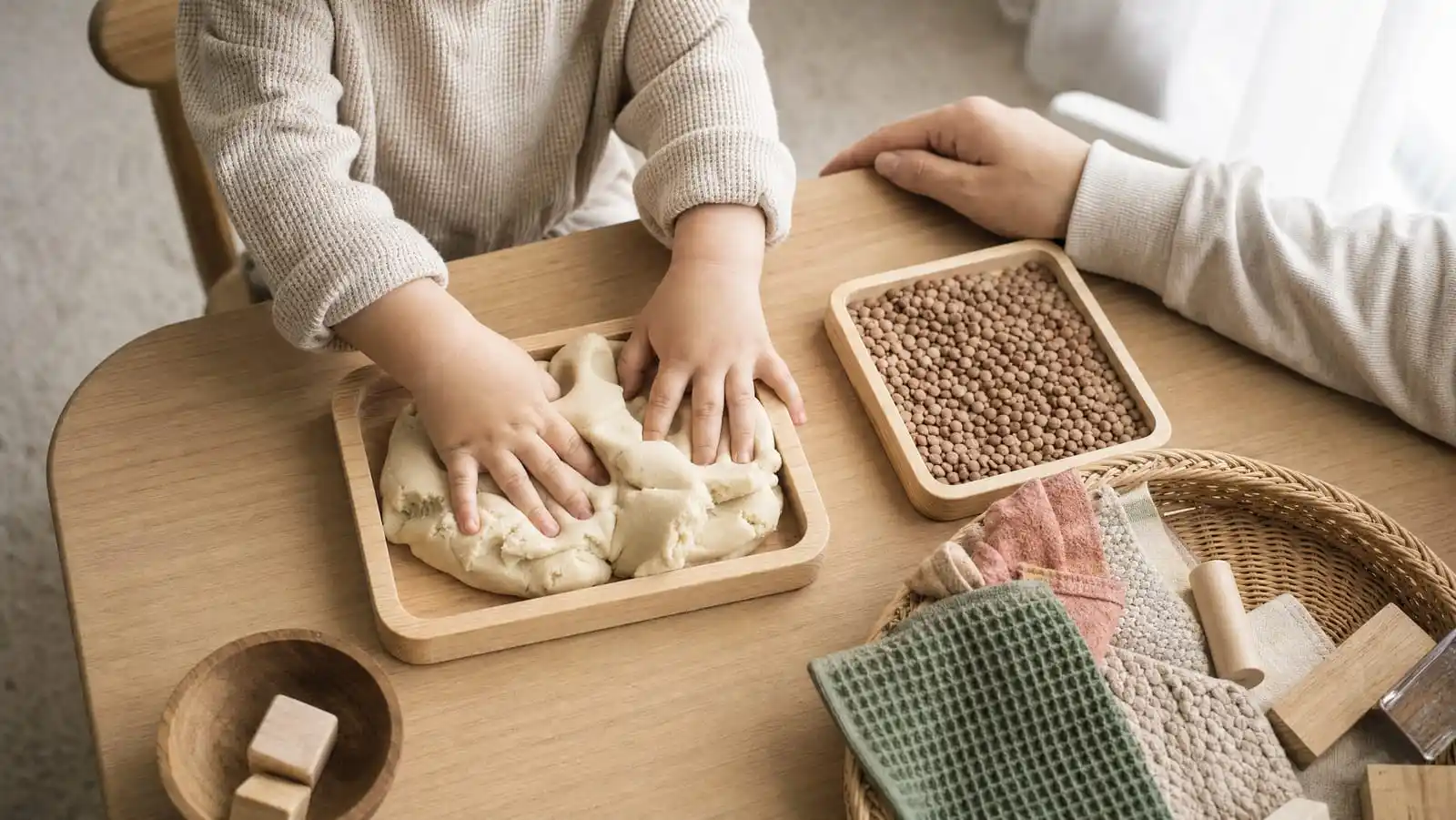
The practical fix is small: cook it. A stovetop playdough that is heated through is a different proposition from a stir-and-go flour recipe, and cooked playdough also lasts longer. If you would rather skip the chemistry entirely, our guide to therapy putty and sensory dough covers the manufactured options, several of which are firmer and better suited to hand-strength work than any kitchen recipe.
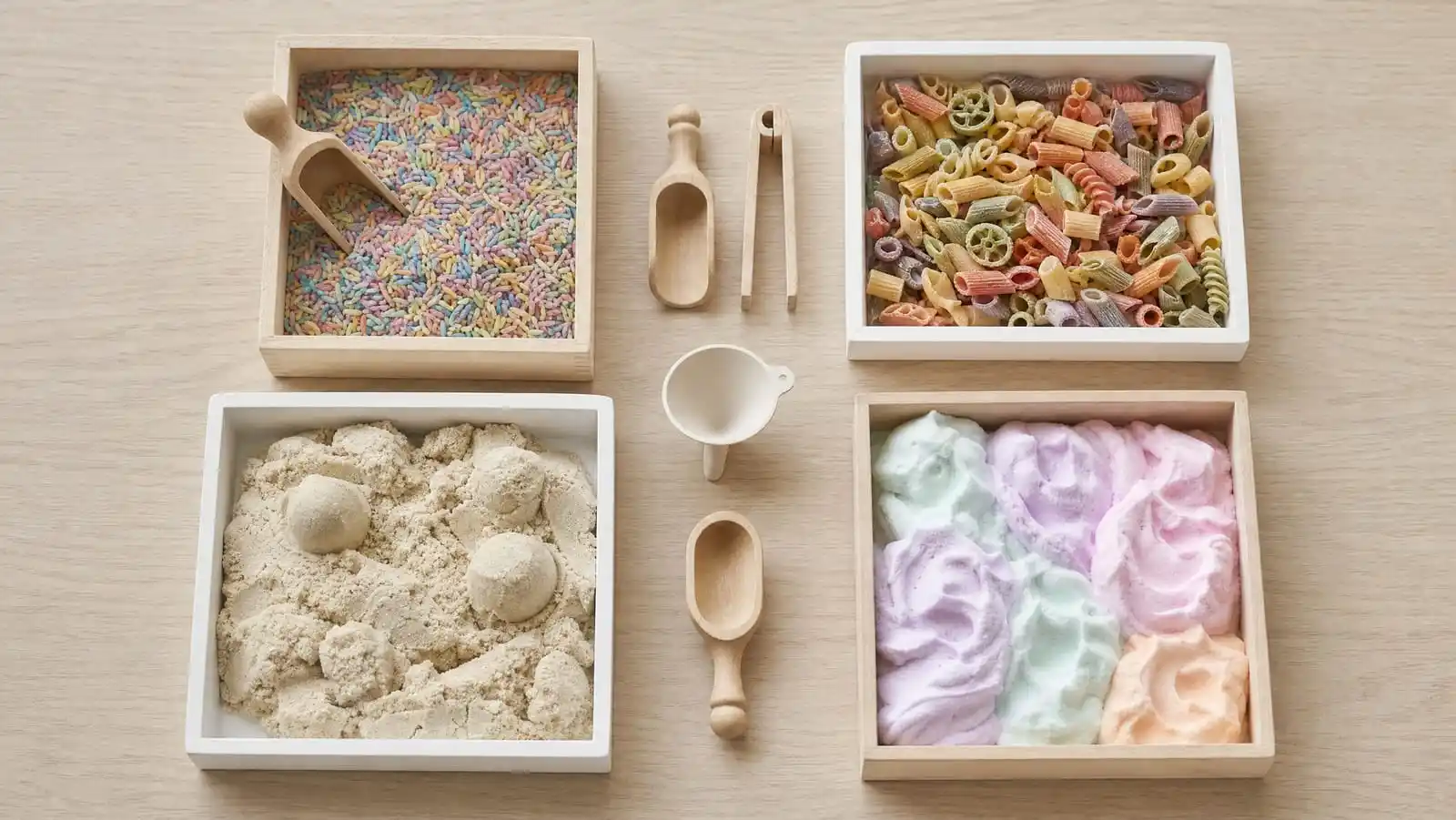
Taste-safe fillers that need no cooking:
- Cooked and cooled pasta, plain or coloured after cooking
- Cooked rice, used warm or cold
- Puffed rice or puffed corn cereal, which is dry, light and vacuums up easily
- Whipped aquafaba or shaving-foam substitutes made from food ingredients
- Ice, in cubes, blocks or frozen into shapes
- Water with a few drops of food colouring
One honest caution about food play
If your child has a narrow diet, think before you turn dinner ingredients into toys. Food selectivity is more common in autistic children: a 2023 study in the Journal of Clinical Medicine of 207 analysed participants found a higher incidence of food selectivity and greater severity in children with autism than in children without a diagnosis, averaging 9.1 selectivity traits versus 6.9. One study, and it tells us nothing about whether food play helps or hinders eating. It does tell us food is loaded territory for many of these children, so take any plan that mixes play and mealtimes to the therapist who knows yours.
Closed and No-Mess Sensory Play
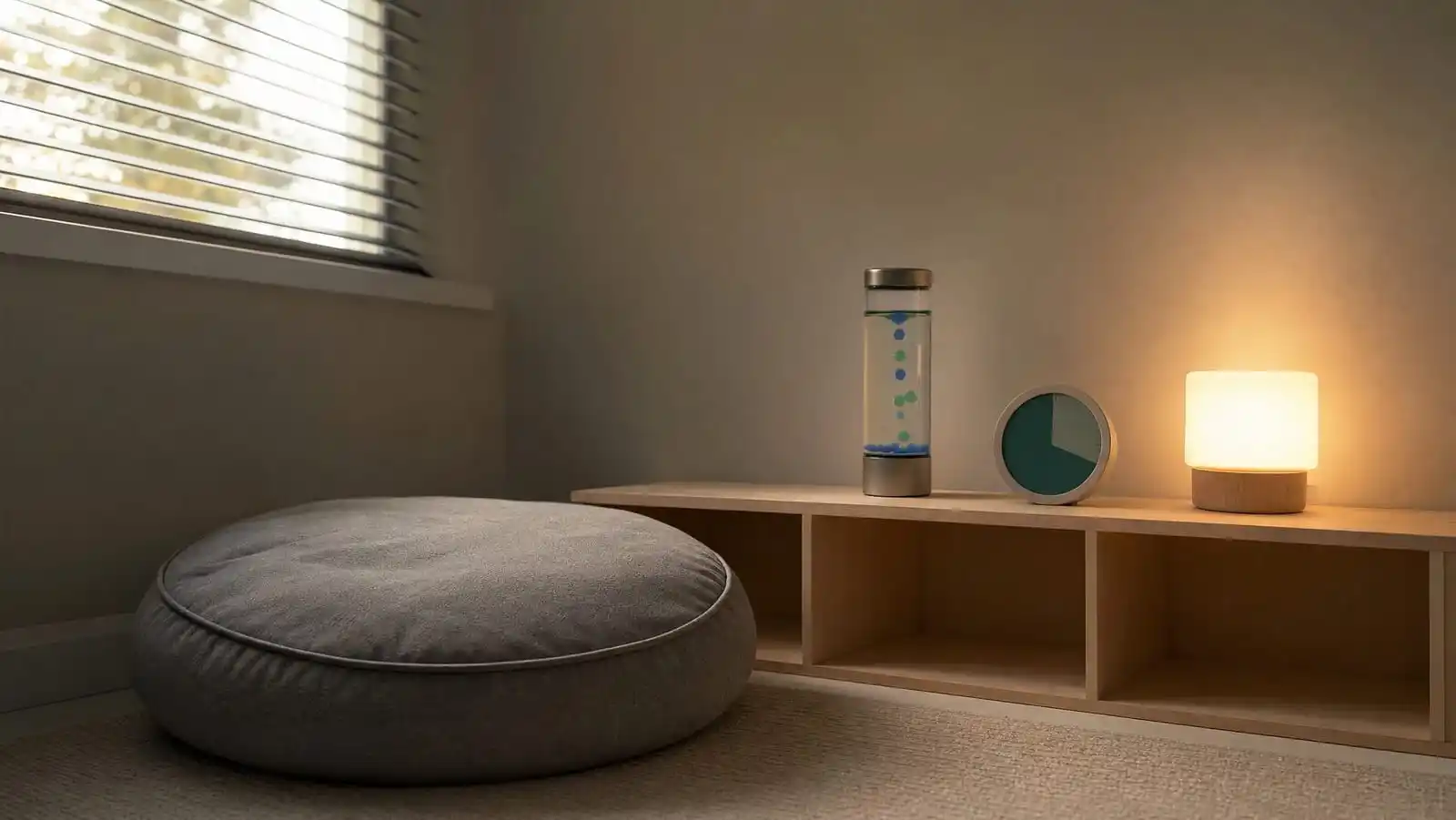
Closed play is sensory play with a lid on. The input is visual and auditory rather than tactile, the child cannot get the material on their hands, and there is nothing to clear up — which makes it the right place to start for most anxious, mess-averse and under-3 children.
The classic format is sensory bottles and calm-down jars: a clear plastic bottle, water, a thickener such as clear glue or glycerine, and something that falls slowly. Glitter is traditional. Sequins, beads, small plastic animals, oil and water in two layers, or a single drop of food colouring all work. The slower the fall, the longer the watching.
Two practical notes. Seal the lid properly — a bead of strong glue inside the cap, then a shake test over the sink. And do not put water beads inside a sensory bottle. CPSC's standard reaches beads in toys "whether accessible or not," so a manufactured bead-filled ball must meet the size and acrylamide limits and carry the warning label — a bottle you glue shut at the kitchen table has met none of that, and a dropped bottle puts loose beads on the floor.
More no-mess sensory play ideas, roughly in order of how little they ask of you:
- A zip bag of hair gel and glitter, taped along all four edges to a window or table
- A tray of dry rice under cling film, so the child can push the grains around through the plastic
- Pouring dry pasta between two jugs over a baking tray, which is contained and surprisingly absorbing
- Resistance play: squeezing a stress ball, pushing palms together, kneading dough inside a sealed bag
- Light-based play, where the input is entirely visual and the clean-up is switching the lamp off
Several of the best options need no equipment at all, which we cover in tactile activities that need no equipment. If you would rather the texture arrive on an object than in a tub, textured sensory toys do the same job with a washable surface.
When Messy Play Gets Refused
Refusal is information, not defiance. A child who pulls their hand back from cold spaghetti is telling you the input is too much, too wet or too unpredictable — and the response that works is to make it smaller, not to insist.
Here is the sequence we would run with a child who refuses messy play, over weeks rather than one afternoon.
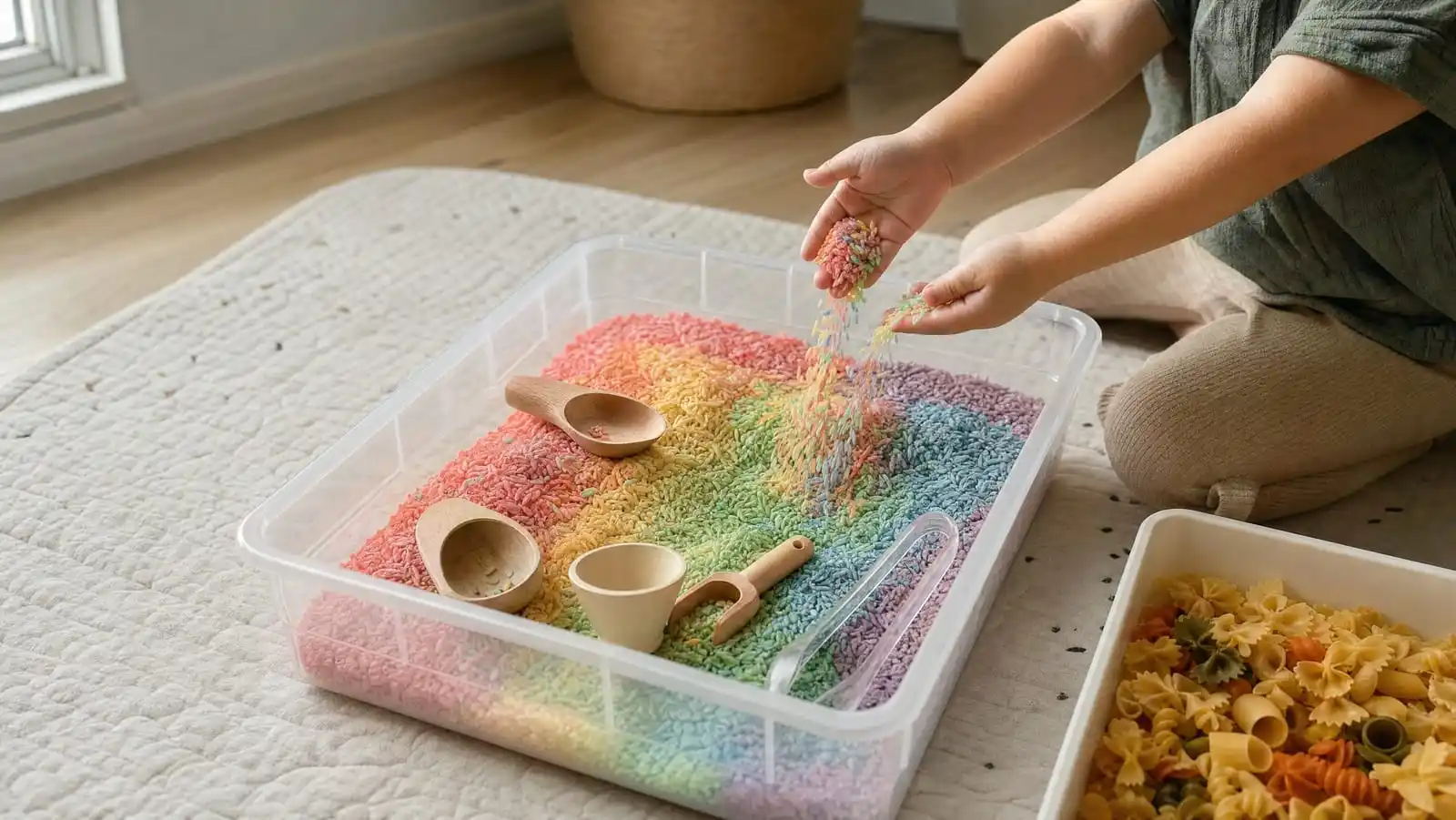
- Move to dry. Dry materials are often accepted when wet ones are refused — a pattern we see, not a tested finding. Rice, pasta, oats, beans, sand.
- Add a tool. A scoop, a pair of tongs or a spoon puts six inches between skin and texture, and it keeps the child in the activity rather than out of it.
- Shrink the target. One finger, for two seconds, then wash. Tolerance is built in repetitions, not in duration.
- Make the exit obvious. A damp cloth and a towel on the table, visible before you start, removes the trapped feeling that drives most refusals.
- Let them watch. Parallel play counts. Plenty of children join in week three after watching for two weeks.
- Stop before the limit. End the session while it is still going well, every time.
Never hold a child's hands in a material they are fighting. It does not build tolerance, and it costs you the trust you need for next week's attempt.
If refusal is broad and persistent — clothing labels, hair washing, sand, grass, hugs — read our guide to tactile defensiveness next, and raise it with an occupational therapist. Strong, consistent tactile aversion affecting daily routines is worth a professional assessment rather than a new tub of filler.
Water Play and Wet Sensory Activities
Water is the most powerful sensory material in the house and the only one with a drowning risk. Treat it as supervised play, every time, at every age.
Good water play sensory activities are mostly about varying one property at a time: temperature, depth, container, or what is floating in it. Occupational therapists commonly describe warm water as calming and iced water as alerting; treat that as a hypothesis about your child, not a rule. A sink, a few jugs, a sponge and a turkey baster will hold most children longer than any purpose-built toy.
Supervision is not negotiable. The CDC advises adults to supervise closely and constantly when children are in or near water, including bathtubs, to assign a specific adult to supervise each child, and notes that drowning "happens in seconds and is often silent." Children who have had swimming lessons still need close and constant supervision. For sensory play that means staying in the room, and emptying every container the moment you finish.
Activities worth trying:
- Washing station: plastic animals, a nail brush, a little soap, a drying towel
- Ice rescue: small toys frozen into a block, freed with warm water and a spoon
- Transfer work: two bowls, a baster or sponge, and a target line to reach
- Outdoor pouring: a wall, a bucket and a paintbrush
Water play also pairs well with pressure work before bed: warm water plus the activities in our proprioceptive and heavy work guide is a more reliable wind-down than either alone.
Sensory Play by Age
The material changes with age far less than the framing does. A teenager will not sit at a tub of rainbow rice labelled "sensory bin", but will happily work clay, wash a car or knead bread.
The developmental ordering is useful here. The AAP's clinical report notes that object play "progresses from early sensorimotor explorations, including the use of the mouth, to the use of symbolic objects" for "communication, language, and abstract thought." Mouthing is a stage, not a problem — but it is the stage that dictates your filler.
Babies and young toddlers, 0 to 2. Assume everything goes in the mouth. Taste-safe only, seated, within arm's reach, and short. Closed bottles and bags are ideal. No small parts, no beads, no loose dry grains.
Ages 3 to 5. This is the peak bin age, and most sensory play for toddlers and preschoolers is scooping, pouring, burying and transferring. Dry fillers become practical once mouthing has genuinely stopped, and a dedicated surface starts to earn its keep — our guide to sand tables for toddlers covers that step. Expect play to be about process rather than any outcome.
School age, 6 to 12. Add a purpose. Sorting, counting, hunting for hidden letters, digging a dinosaur out of sand. Children this age also start to self-report what they need, which is worth taking seriously.
Ages 13 and up. Drop the word "sensory" and keep the input: sensory play for older kids and teens means clay, bread dough, car washing, gardening, slime chemistry, hand-strength putty and cooking. The goal shifts from exploration to regulation, and dignity matters — anything that looks like a preschool activity will be refused on sight, correctly.
Setting Up: Tables, Trays and Containment
The reason sensory bins die out in most houses is not boredom. It is clean-up. Fix containment first and the activity survives.
For sensory tables and trays, the choice is simply how much containment you need. A deep plastic under-bed storage box with low sides sits on the floor and holds two children. A rimmed baking tray contains a single child's dry play on a table and slides into a cupboard. A purpose-built table with a lid keeps the material in place between sessions, which is the real feature — a lid turns a 20-minute setup into a 20-second one.
Four containment habits that do more than any product:
- Put a cheap flat sheet or shower curtain under the bin and pick it up by the corners afterwards
- Keep the bin half full. Material scatters in proportion to how much is above the rim
- One filler at a time. Mixed fillers cannot be reused
- Play in the kitchen or outdoors, not on carpet, when the filler is dry and fine
The accessory that changes the activity most is the one families skip. Good sensory bin tools and scoops add fine-motor and hand-strength work to whatever material you already own, and they extend attention: a child who loses interest in rice in three minutes will spend fifteen moving it with tweezers. The GCTWFYK 11-piece sensory bin tool set is $16.95 as of November 2026 and includes five scoops, a scissors clip, tweezers, a silicone tong, a shovel, a funnel and a dropper, with smooth rounded edges per the manufacturer. Kitchen equivalents — measuring spoons, a turkey baster, ice tongs, a funnel from the baking drawer — do the same job for nothing.
Store dry filler in an airtight container, labelled, and keep it well out of reach between sessions. For more on choosing the materials themselves, our tactile sensory toys guide sits alongside this page.
Sensory Play That Teaches
A bin is a context, not a curriculum. What it does well is hold a child's attention in one place, with their hands busy and the pressure off — which is an unusually good setting for language.
This is why using sensory bins to teach speech and early literacy is popular with therapists: the child is motivated, the adult is alongside rather than opposite, and every scoop creates a natural turn. The AAP's clinical report describes object play as progressing toward the use of objects "for communication, language, and abstract thought," and identifies play with parents and peers as promoting "social-emotional, cognitive, language, and self-regulation skills."
What that looks like in practice:
- Narrate, do not quiz. "You found the blue one" beats "What colour is that?" Commenting invites a response; testing closes it down.
- Bury the target. Hide five objects whose names you are working on, and let finding them be the reward.
- One sound at a time. Letter tiles or foam letters in rice, hunting for the letter in the child's own name first.
- Build in waiting. Hold the scoop a beat longer than feels comfortable. Pauses do more for turn-taking than prompts.
- Count what you pour. Scoops, cups, objects into a jar. Early number work hides easily in transfer play.
Keep the claims modest: a bin is a good place to practise language a therapist is already targeting. It is not a substitute for speech and language therapy, and no bin teaches reading.
A 15-Minute Session That Survives a Bad Day
On the days when nobody has the energy, this is the version that still works.
- One tray, one filler, two tools. Nothing else on the table.
- Sheet underneath, damp cloth and towel in sight.
- Sit alongside, not opposite.
- Start by playing yourself and saying nothing for the first minute.
- Narrate what the child does, not what you want them to do.
- End it while it is still going well, and put the lid on.
If it lasted four minutes, that was a success. Repetition builds tolerance; a short good session beats a long bad one.
Frequently Asked Questions
Is sensory play a treatment for autism?
No. It is play, and it should be chosen for the same reasons you choose any play: the child enjoys it, it gives them input they are looking for, and it creates time together. The AAP's 2012 policy statement describes the research on sensory integration therapy as "limited and inconclusive," and the 2017 Pediatrics systematic review found a small evidence base with unclear durability. Neither finding is a reason to stop playing. Both are reasons to be sceptical of anything marketed as treatment.
Are water beads banned now?
Not banned — regulated, and narrowly. CPSC's mandatory standard for water bead toys took effect March 12, 2026, setting acrylamide limits, an expanded-size test and warning-label requirements, with third-party testing and certification. It is not retroactive, and beads sold for non-toy uses sit outside it. Separately, and without softening, the agency still advises families to remove water beads from any environment with children. Compliance with a toy standard is not the same as being safe around a child who mouths objects.
What age can a child have a rice or pasta bin?
Once mouthing has genuinely stopped, which is a judgement about your child rather than a birthday. Dry grains are small parts, and CPSC bans products with small parts for children under three. Before that, use taste-safe fillers or closed play, seated and supervised.
My child eats the filler. What now?
Switch to taste-safe materials and stay within arm's reach. If eating non-food items is persistent or involves things like soil, chalk or paper, mention it to your paediatrician — persistent ingestion of non-food substances needs a clinical conversation, not a different tub.
How long should a session last?
Shorter than you think. Five to fifteen minutes, ended on a good note, two or three times a week beats one long session. The point is the number of pleasant repetitions, not the minutes.
Explore the full series
- What Is Sensory Play? How It Works in Autism, ADHD & SPD — What sensory play means, which senses it feeds, and what the evidence does and does not show.
- Safe Sensory Bin Fillers: What Changed Under the 2026 Water-Bead Rule — The CPSC water-bead rule, what it covers, and which fillers are safe by age and mouthing risk.