This article contains affiliate links. We may earn a commission if you make a purchase through our links, at no extra cost to you.
Key Takeaways
- The sensitivity persists; the context changes. Environments get less negotiable, visible supports less acceptable, and you become your own advocate.
- Decreased sound tolerance is common in autism. A 2021 meta-analysis of 67 studies put current prevalence at 41.42 percent on questionnaire measures, 27.30 percent on observational ones.
- Unsupported endurance is the main adult hazard. Autistic burnout, as defined in the research, includes reduced tolerance to stimulus.
- For filtering earplugs, 17 to 24 dB is a design target, not a shortfall. Enough to lower the room, not enough to remove the conversation.
- At work you can ask in plain English. EEOC guidance says a request need not mention the ADA, nor open your full medical history.
Autism noise sensitivity in adults is rarely something people grow out of — what changes is everything around it. The sound still lands the same way, but the lecture hall, the open-plan office and the commute are not negotiable the way a classroom was, nobody is writing you a plan, and the support that worked at nine carries a social cost at nineteen.
Two readers. If you are an autistic teen or adult managing your own sound environment, this is your page and we address you directly. Parents of a teenager whose supports have stopped working: start at the work and study sections. Our pillar guide to auditory sensory tools for autism and ADHD covers the mechanism this article assumes.
What Changes at Adolescence
Nothing about the ear changes. The arithmetic of being seen changes.
Decreased sound tolerance is well documented in autism and does not look like a childhood phase. Pooling 67 articles, Williams, Suzman and Woynaroski, in Ear and Hearing in 2021, estimated current prevalence of hyperacusis in autism spectrum disorder at 41.42 percent and lifetime prevalence at 60.58 percent on interview and questionnaire measures, falling to 27.30 percent, with a wide credible interval of 14.92 to 46.31 percent, on observational or objective measures. It spans all ages rather than isolating adults, and the gap between those figures is the gap between what a person feels and what an observer records.
What shifts with age is the cost ledger. Ear defenders are visible across a room, and parents and clinicians commonly report that somewhere in late primary or early secondary school a child who relied on them stops — not because the noise improved, but because being conspicuous started to cost more. We have no good data on when that happens, so treat it as a pattern, not a statistic. Either way the tool gets abandoned, nothing replaces it, and the advocacy moves to you.
Masking, Endurance and Autistic Burnout
The central adult risk is not the noise. It is the habit of absorbing it silently and calling that coping.
In the study that defined autistic burnout for research purposes, Raymaker and colleagues, in Autism in Adulthood in 2020, interviewed 10 autistic adults, drew on 9 further employment interviews where burnout arose unprompted, and analysed 19 public internet sources. They described a syndrome "resulting from chronic life stress and a mismatch of expectations and abilities without adequate supports," characterised by "pervasive, long-term (typically 3+ months) exhaustion, loss of function, and reduced tolerance to stimulus." Note that last item: it is a feature of burnout there, not only a cause.
Masking is where the cost accumulates. A 2025 study by Benatov, Sarel-Mahlev and Bar Yehuda in Autism in Adulthood surveyed 92 autistic adults, mean age 33.4, recruited through Israeli autistic-led online forums and social media groups. Camouflaging and burnout-exhaustion both correlated positively with depression, with burnout-exhaustion partially mediating the link. The authors note the limits — cross-sectional design, self-report screening for autism status, an online convenience sample — so this is a direction, not a dose. No study we found claims earplugs prevent burnout; it is the alternative, suppressing the reaction and treating recovery as optional, that has documented costs.
Discreet Tools, and What Each One Actually Does
Filtering earplugs: the everyday answer
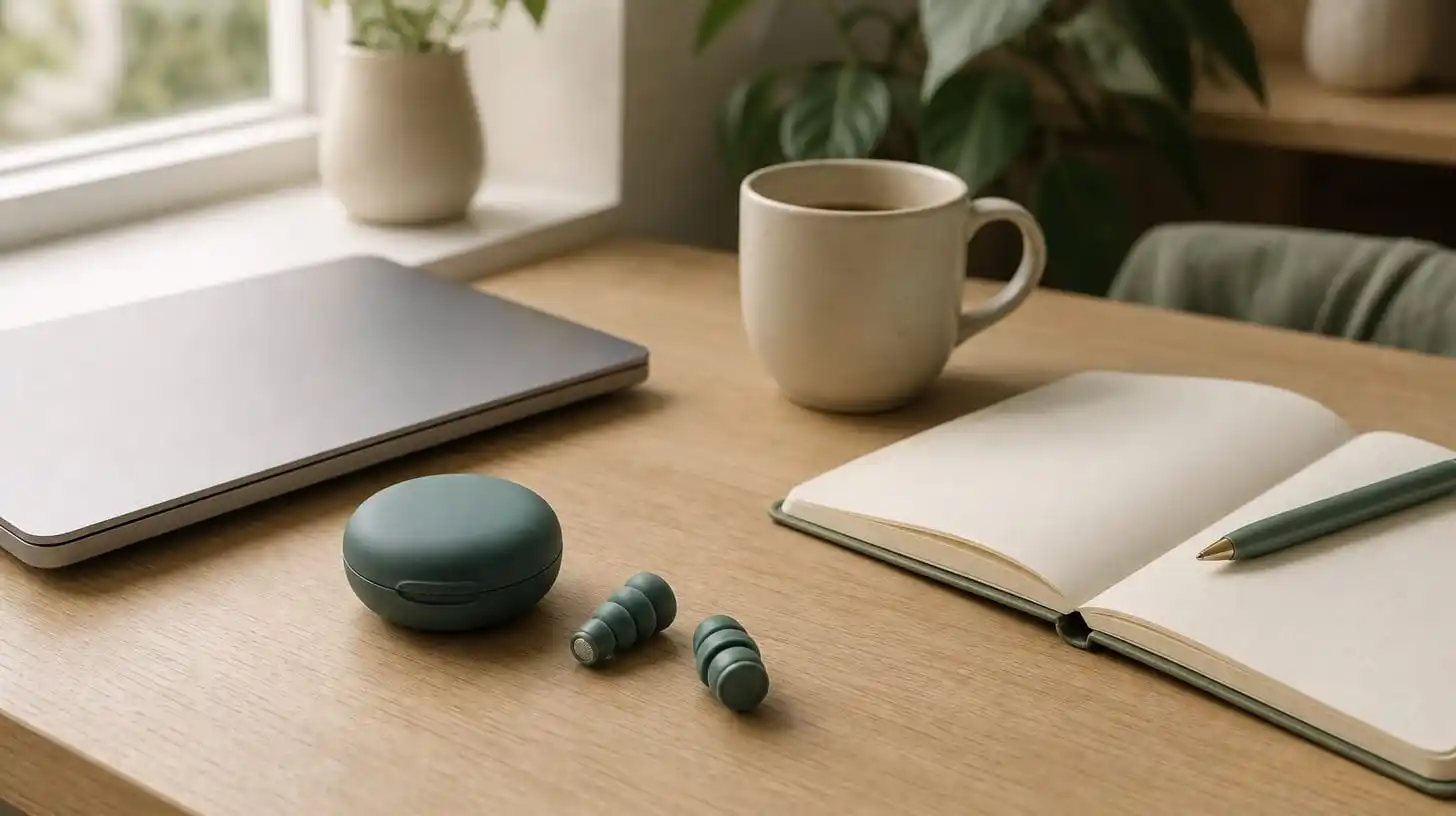
Filtering earplugs are the main adult tool because they are the only option that is invisible, wearable for hours and still lets speech through. A filter lowers the whole spectrum fairly evenly — a different job from blocking. The meeting gets quieter; you are still in it.
The EarPeace Everyday Ear Plugs cost $33.95 as of September 2026. The EarPeace listing states 22 dB high-fidelity filters that "reduce noise discomfort and fatigue while still allowing you to hear," soft silicone shaped to mimic the natural contour of the ear, four US patents, and three sets in small, standard and large; EarPeace describes them as virtually invisible when worn. Sizing matters: the tip that seals your left ear may not seal your right.
The Loop Experience 2 is $34.95 as of September 2026. Loop states 17 dB SNR of filtered noise reduction and that it qualifies as certified hearing protection, with four ear tip sizes. Manufacturer claims, not figures we have measured.
Seventeen to twenty-two decibels sounds modest, and that is the point: a filter removing 30 dB would also remove the colleague talking to you. For scale, NIOSH sets a recommended exposure limit of 85 dBA over an eight-hour workday, and most of what makes an office unbearable is nowhere near it.
Treat any labelled figure as a ceiling, not a guarantee: OSHA's 2026 safety bulletin on hearing protector fit testing calls the labelled noise reduction rating "a laboratory-derived number" that "is rarely achieved in real-world workplace settings," and notes NIOSH updated its advice in 2025 to favour individual fit testing over derating the label. For fit and sizing, see the best filtering earplugs for sensory-sensitive kids and teens.
Maximum-attenuation plugs: sleep and transit
For sleep and commuting you do not need speech to get through, so you can trade clarity for quiet. The Loop Quiet 2 is $24.95 as of September 2026; the Loop listing states up to 24 dB SNR of noise reduction, certified hearing protection, flexible silicone the company says suits side-sleepers, and four tip sizes.
Trade-offs: deeper insertion means more occlusion, so your own voice gets loud, and anything that cuts what reaches your ears overnight also cuts alarms. If nights are the pressure point, see teen sleep and sensory processing.
Earbuds and active noise cancellation
Cancellation and filtering are not competing products; they work on different frequencies. Writing for USC Viterbi's illumin, the engineering explainer notes that ANC headphones "have a noticeable dip in functionality at 1,000 Hz," that above 1,000 Hz "passive headphones block just about as much sound as ANC headphones," and that current designs yield roughly 20 to 40 dB of reduction overall.
So ANC is excellent against ventilation drone and aircraft cabins, weak against what wrecks an open-plan afternoon: speech. For that you want isolation or a filter. See noise-cancelling headphones for autism and ear defenders versus earplugs.
Before you put anything in an ear
Earplugs and their interchangeable tips are small detachable parts and a choking risk for young children; if there are toddlers in the house they live in a case, not a bedside table. They can also be pushed too far into the canal. Speak to a GP, audiologist or ENT first if you have ear tubes, an ear infection, ear pain, a perforation or a history of impacted wax.
Routine protection in safe environments is contested
The American Speech-Language-Hearing Association's practice portal on tinnitus and hyperacusis says that wearing hearing protection to avoid disturbing sounds "is not generally advisable when environmental sound levels are safe," because "avoiding sounds in the environment can make the auditory system become more sensitive to these sounds when protection is not used." ASHA is equally clear that protection in genuinely excessive noise is advisable for everyone. Many autistic adults counter, with reason, that without attenuation some environments are inaccessible. No trial settles this; the middle path is targeted use, with an audiologist involved if you are protected most of your waking day.
Strategies That Need No Equipment
The highest-return adult changes are scheduling decisions, not purchases.
- Budget recovery; do not hope for it. Block out the hours after a wedding or a shift on a busy floor, because the burnout literature's mechanism is cumulative stress without adequate opportunity to recover.
- Control the controllables. Commute off-peak, choose the seat, book the small room.
- Use sound, do not only defend against it. Many autistic adults report that a pink-noise track or familiar music is easier to sit with than unpredictable speech; we found no trial testing that in autistic listeners, so treat it as worth trying rather than established.
- Build the sentence now. "That is too loud for me, I need ten minutes" is the accommodation that follows you into every job.
Auditory load rarely travels alone, and many autistic adults pair sound management with a second regulating input — oral sensory tools for teens and adults covers the discreet end, and noise sensitivity strategies that need no equipment the environmental side.
Noise Sensitivity at Work and in Study
The wording you use largely determines what you get. What follows is general information about the US system, not legal advice; for your own situation talk to a disability employment adviser, union representative or employment lawyer.
You do not have to perform legal fluency. The EEOC's enforcement guidance on reasonable accommodation states that "to request accommodation, an individual may use 'plain English' and need not mention the ADA or use the phrase 'reasonable accommodation,'" and lists acquiring or modifying equipment among the forms accommodation can take. An employer may ask for reasonable documentation where the need is not obvious, but the same guidance says it "cannot ask for documentation that is unrelated to determining the existence of a disability and the necessity for an accommodation," and the ADA National Network adds that requests can be verbal. You are describing a functional limitation, not a diagnostic history.
Vague requests get vague outcomes. This is the kind of wording that survives a reorganisation:
"I have a sensory processing condition affecting tolerance of background noise. To perform the core duties of my role I am requesting: a desk away from the kitchen, printer and main walkway, or a relocatable workstation; permission to wear earplugs or headphones at my desk and in open-plan areas; access to a bookable quiet room for focused work two half-days per week; and remote attendance as an option for all-hands meetings held in the atrium. I am happy to discuss alternatives that achieve the same outcome."
That names the limitation, the duties affected, four asks and room to negotiate, without disclosing any diagnosis detail. Ask where the written record lives, because line managers change, and add a review date. Rules differ outside the US. The UK government's Buckland Review of Autism Employment, published on 28 February 2024 and summarised by the National Autistic Society, reported that just 3 in 10 autistic adults are in work against 5 in 10 of all disabled people and 8 in 10 of non-disabled people, and named sensory environments among the barriers jobseekers face.
For university and exams the route is the disability services office, and it is yours to initiate. The US Department of Justice's ADA guidance on testing accommodations describes them as changes to the regular testing environment that let candidates "demonstrate their true aptitude or achievement level," and lists distraction-free rooms and extended time among its examples. Ask about reduced-distraction rooms, permitted ear protection in exams, and whether accommodations carry to placements.
Where Protection Is the Wrong Answer
Attenuation is broadband and indiscriminate, so it removes warnings along with annoyances. We do not recommend wearing attenuating earplugs or noise-cancelling headphones while driving, cycling or walking near traffic: sirens, horns and a change in your own engine note are all information, and a filter that lowers the office by 17 dB lowers those too. Local traffic law in some jurisdictions restricts headphone use while driving, so check yours; the same logic covers machinery and lone working. And nothing in your ears fixes a bad room, which is a building problem, not a personal accommodation.
When to Involve a Professional
Get a hearing test at least once, even with an autism diagnosis in place. Hearing loss, middle-ear problems and tinnitus can all look like sound aversion from outside. ASHA's practice portal states that "audiologists play a central role in the assessment, diagnosis, and management/treatment of individuals with tinnitus and/or hyperacusis."
- An audiologist, for a hearing assessment, hyperacusis evaluation, and an honest answer on whether your protection use is helping or entrenching things.
- An occupational therapist, for the environmental and routine side, where provision exists.
- A GP or primary care physician, to rule out pain, infection and medication effects.
Naming the problem precisely helps, because the three states conflated here have different treatments: the difference between hyperacusis, misophonia and sensory overload sets them apart, and why sound sensitivity happens in autism covers the mechanisms. Adult sensory services are hard to access in many systems — but equipment, scheduling and accommodation requests need no clinician's signature.
Frequently Asked Questions
Will wearing earplugs every day make me more sensitive? Genuinely contested. ASHA advises against hearing protection to avoid disturbing sounds when environmental levels are safe, on the basis that avoidance can increase the auditory system's sensitivity. Many autistic adults report that without attenuation, work and social life become inaccessible. If you are protected most of your waking hours, ask an audiologist.
Do I have to tell my employer I am autistic to get a quieter desk? Under US rules, not in that form. The EEOC guidance says a request may be made in plain English without mentioning the ADA, and that an employer is entitled only to documentation establishing a disability and explaining why the accommodation is needed.
My teenager has stopped wearing their ear defenders. What now? Treat it as information, not refusal: it often means visibility has started to cost more than the noise. The usual next step is something discreet they pick themselves, plus a say over seating, timing and when they may leave a room.
Bringing It Together
The sound did not get easier. What changed is that the supports now have to be chosen by you, fit environments nobody will redesign, and survive being used in front of other people — which makes discretion an engineering constraint rather than vanity.
So pick tools for situations rather than days: a filter for the room you cannot leave, maximum attenuation for sleep and transit, cancellation for the hum, nothing at all when driving. Schedule the recovery. And treat the urge to simply endure as the thing to manage, because that is the part the research attaches a cost to. For the mechanisms behind autism noise sensitivity and tools across every age, our pillar guide is next.