What Is Sensory Play? How It Works in Autism, ADHD & SPD
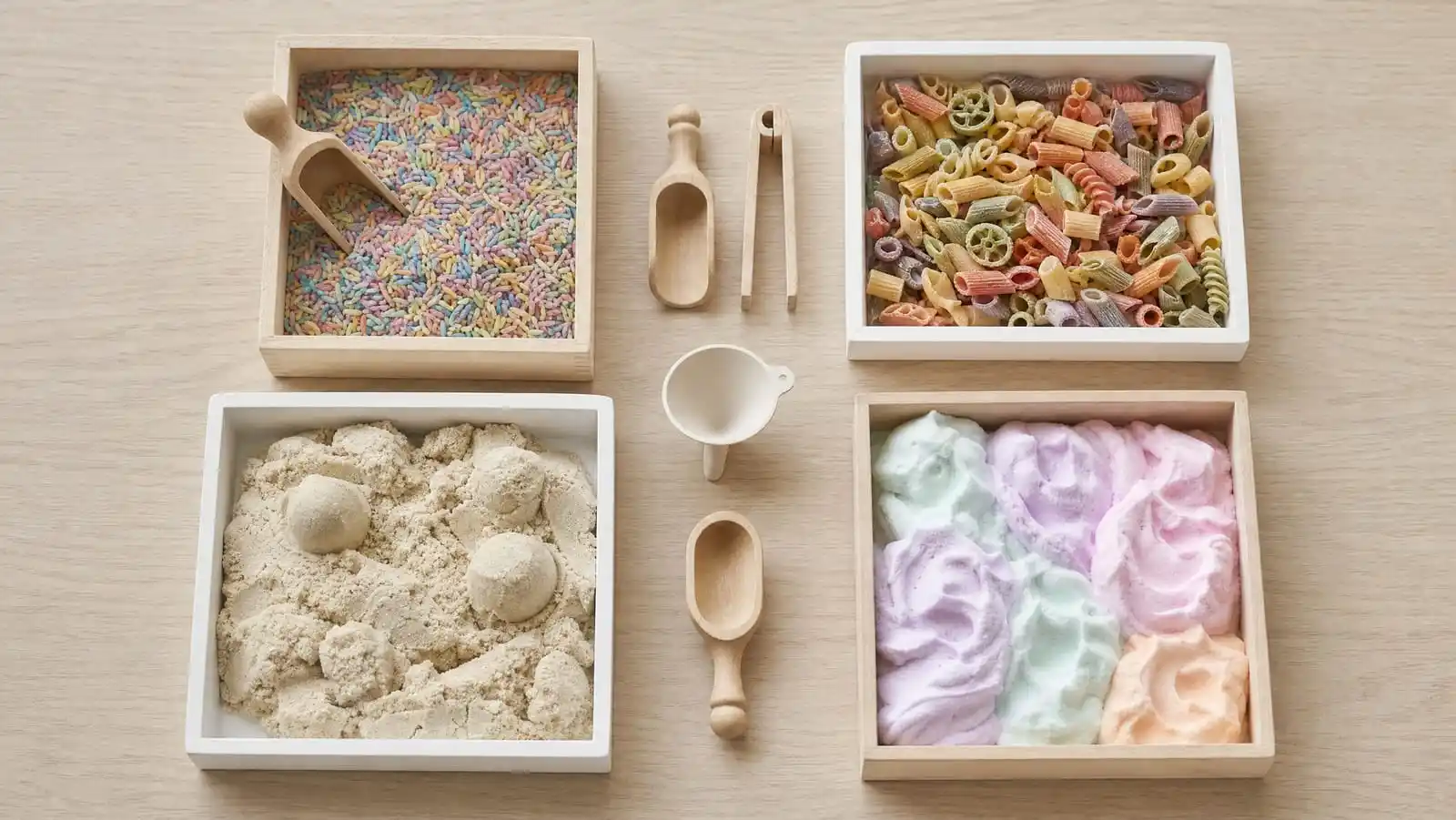
Sensory play is play organized around a deliberate sensory ingredient — texture, movement, weight, sound, temperature — rather than around a toy's instructions. Scooping dry rice, pushing a swing, squeezing dough: the input is the activity. What sensory play for autism adds is intent. You choose the kind of input your child's nervous system seems to be asking for, set it up, and then let them play.
Sensory play is not a treatment for autism, and we are not going to pretend it is. It is a way of meeting a child where their sensory system already is — which, for a lot of families, is useful on its own.
Our complete guide to sensory play and sensory bins covers the practical setups: bins, fillers, tools, cleanup. This article covers what is going on underneath, and what the evidence does and does not support.
The Eight Sensory Systems, in Plain Language
Most of us were taught five senses. Occupational therapists work with eight.
The NHS Greater Glasgow and Clyde occupational therapy service's sensory processing training describes eight sensory systems: five that gather information from the outside world, and three that report from inside the body.
- Sight (visual). The NHS resource is careful here: sensory processing is not about how well a child sees, but about what the brain does with what the eyes send it.
- Hearing (auditory). Same logic: a ticking clock usually fades into the background; for some children it never does.
- Touch (tactile). Receptors in the skin report texture and temperature, and the system also protects — it is why your hand leaves a hot pan before you decide to move it. Receptors in the mouth report whether food is crunchy, smooth or chewy.
- Smell (olfactory) and taste (gustatory). These two work closely together, which is part of why smell can drive food refusal.
- Vestibular (balance and movement). When the head and body move, fluid in the inner ear moves too, telling the brain how it is traveling through space.
- Proprioception (body position and force). Receptors in the muscles and joints report where body parts are and how much effort they are using — the difference between lifting a feather and a heavy bag.
- Interoception (the inside sense). Receptors in organs including the heart, lungs, stomach and bladder feed back hunger, thirst, needing the toilet, being too hot, and the physical clues that add up to an emotion — a racing heart meaning anxiety.
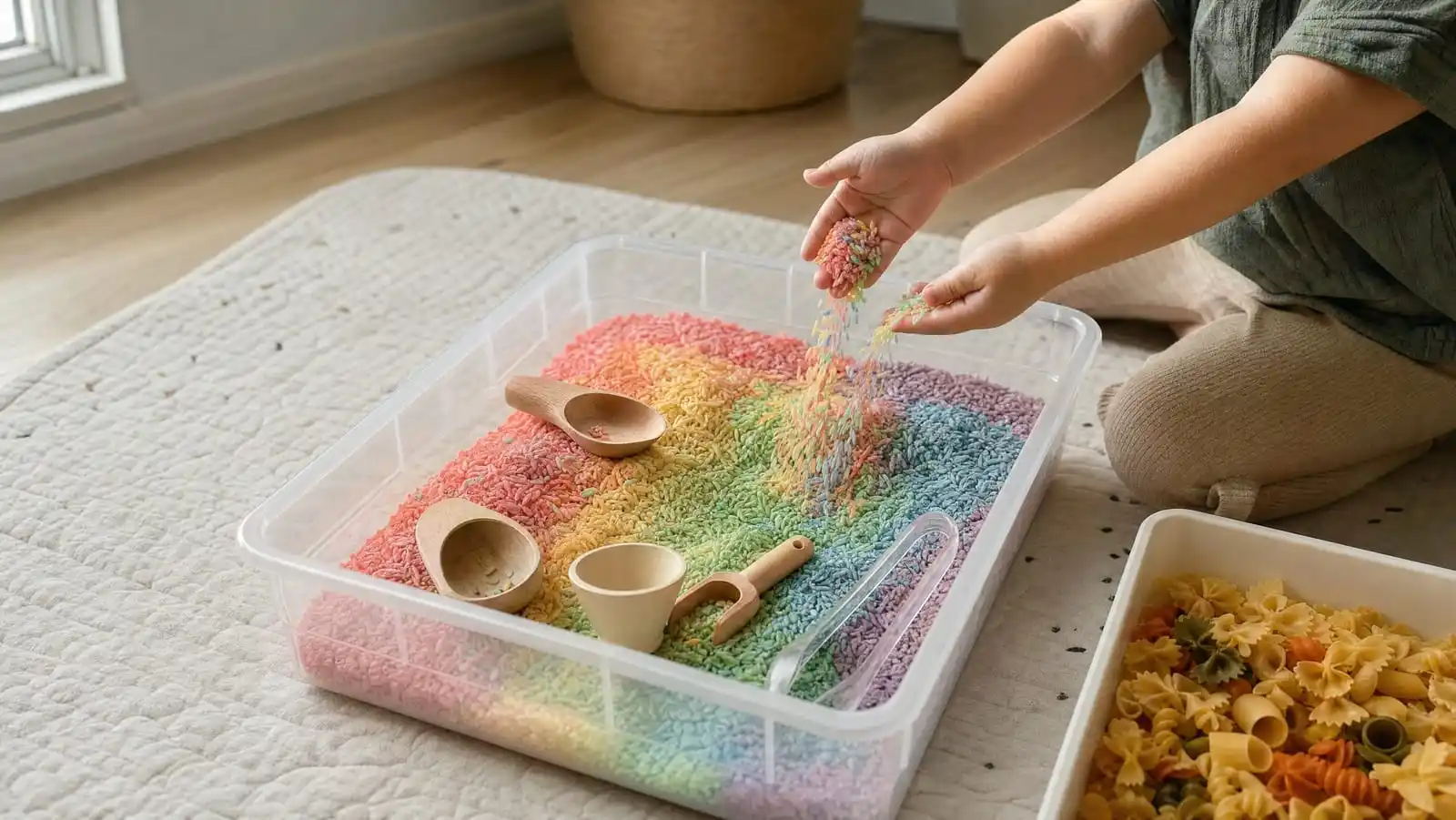
The same NHS training makes a point we would underline: the systems are separated out to make them teachable, but "in real life they all work together." A child with both hands in a rice bin is running touch, proprioception, vision and hearing at the same time. If the body-awareness system is the one you are chasing, we go deeper in proprioception and body awareness explained.
Sensory Play vs. Ordinary Play: What Actually Differs
Not the materials. The difference is that an adult chose the input on purpose, and then got out of the way.
- There is a named input. "Ten minutes of swinging before homework" is sensory play. "Go and play" is play, and that is fine too — it is just not aimed at anything.
- There is no performance target. No right answer, no finished product, no correct way to hold the scoop.
- The child sets the pace. Head Start's guidance on designing messy play for infants and toddlers describes this kind of open-ended exploration as building curiosity, initiative, focus and persistence, and notes it works best when children set their own pace.
The moment a sensory bin becomes a task with a correct outcome, you have swapped a sensory activity for a compliance activity, and most of the value goes with it.
Head Start also flags the caveat: some children are very sensitive to sensory input and will not want to get messy, so an adult should stay close and make cleaning up quick and easy. A bin a child can walk away from is doing its job.
Why Sensory Play Is Used With Autistic and ADHD Children
Because sensory differences are very common in these children, and play is the lowest-stakes place to work with them.
How common? In a 2016 brief report in the Journal of Autism and Developmental Disorders, Green and colleagues compared 10- to 14-year-olds with autism to peers who had special educational needs but not autism, and found atypical sensory behavior in 92% of the autism group and 67% of the comparison group. Read both numbers: sensory differences are near-universal in that autistic sample, and common in children without an autism diagnosis.
That matches how the American Academy of Pediatrics framed it in 2012. Its policy statement on sensory integration therapies states that "difficulty tolerating or processing sensory information is a characteristic that may be seen in many developmental behavioral disorders, including autism spectrum disorders, attention-deficit/hyperactivity disorder, developmental coordination disorders, and childhood anxiety disorders." We flag the date on purpose: AAP policy statements expire five years after publication unless reaffirmed.
Green and colleagues also found that greater sensory difficulty went with more severe restricted and repetitive behaviors and with higher emotional problems on parent and teacher questionnaires — but not with IQ. Sensory load and distress travel together, which is the practical argument for taking a child's sensory profile seriously whatever their diagnosis.
Why play rather than a program? The benefits of sensory activities for autism and ADHD are mostly practical ones: play is voluntary, repeatable, bounded, cheap, and something you can do together at 4pm on a Tuesday. A tray of textures can tell you a lot about your child in ten minutes.
Sensory Seeking vs. Sensory Avoiding: The Same Bin, Two Jobs
The NHS training frames this as thresholds. A child with a high threshold needs a lot of input before it registers, so they go looking for it: spinning, humming, banging, crashing, mouthing. A child with a low threshold is swamped by ordinary amounts, so they get away from it: covering ears, refusing hair brushing, hating the feel of certain clothes, objecting to standing in a line.
The AAP notes that a proposed classification of sensory processing difficulties subdivides sensory modulation problems into overresponsive, underresponsive and sensory seeking or craving subtypes — while being clear that this definition "has been proposed but has not been universally accepted."
One rice bin serves both, run differently.
If your child seeks input: make it bigger, not smaller. Deeper fill, more resistance, heavier scoops, bigger movements, a bin on the floor they can kneel in. Pair it with push-and-pull work so the muscles get loaded too. Sensory bins and water beads covers the setups we would start with.
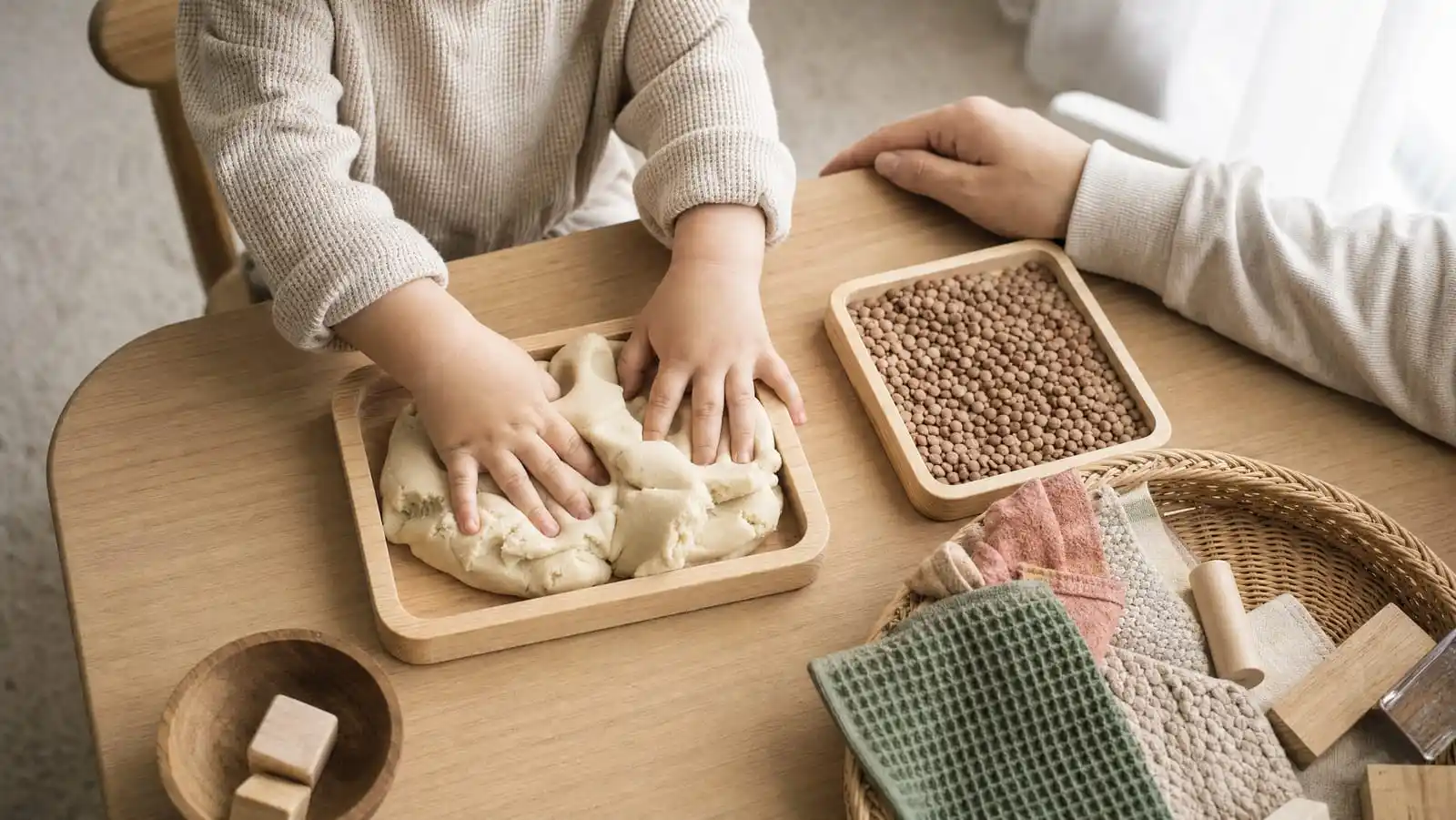
If your child avoids input: shrink the ask. Dry before wet, tools before hands, a fingertip before a palm, thirty seconds before ten minutes, and a towel and a sink in sight the whole time. Never move their hand into the material for them. Our guide to tactile defensiveness goes through this gradient properly, and tactile activities that need no equipment is where we would begin if a bin is already a hard no.
Most children are not one or the other. They seek movement and avoid wet textures, or tolerate everything until 6pm and nothing after. Profiles can shift with tiredness, hunger and stress — which is why a bin that worked on Monday can be refused on Thursday without anything having gone wrong.
For choosing textures, our complete guide to tactile sensory toys breaks them down by how much input each delivers.
What Sensory Play Is Not
It is not a treatment for autism. Autism is not a condition that play fixes, and no honest reading of the research says otherwise. Sensory play can change how an afternoon goes. It does not change who your child is, and it should not be sold to you as doing so.
The clinical evidence for sensory integration therapy is genuinely mixed. The AAP's policy statement puts it bluntly: parents "should be informed that the amount of research regarding the effectiveness of sensory integration therapy is limited and inconclusive." The same statement concludes that "occupational therapy with the use of sensory-based therapies may be acceptable as one of the components of a comprehensive treatment plan" — a component, not the plan.
The reviews disagree with each other, and the disagreement is about scope. A 2012 systematic review in Research in Autism Spectrum Disorders by Lang and colleagues looked at 25 intervention studies: 3 reported benefits, 8 were mixed and 14 found none, and the authors concluded that "the current evidence-base does not support the use of SIT" for children with autism, noting serious methodological flaws in many studies including the three positive ones. A narrower 2019 review in Autism Research by Schoen and colleagues looked only at Ayres Sensory Integration delivered with fidelity and concluded it meets the Council for Exceptional Children's criteria for an evidence-based practice for autistic children roughly aged 4 to 12 — a conclusion that rests on three studies, two of them randomized trials with 69 participants between them, assessed by reviewers who are themselves Ayres Sensory Integration researchers, though they report no conflict of interest and say no reviewer rated their own study.
Our reading: neither "proven" nor "debunked" is accurate, and anyone telling you otherwise is selling something.
Sensory processing disorder is not a diagnosis you should expect to be given. The AAP recommends that pediatricians "should not use sensory processing disorder as a diagnosis," because there is no universally accepted framework for it, and that autism, ADHD, developmental coordination disorder and anxiety disorder "must be considered and thoroughly evaluated" when sensory symptoms show up. A sensory profile describes how a child responds. It does not explain why.
And sensory play is not automatically harmless. The AAP cites one small study cautioning about possible negative behavioral effects of sensory integration therapy in some populations; in that study of four autistic children, a behavioral intervention reduced challenging and self-injurious behavior more than sensory integration therapy did. Four children is not a verdict, but it is a reason to watch what actually happens in your own house rather than assume input is always calming. Filler choice matters too, especially with anything small enough to swallow — we cover that separately in Safe Sensory Bin Fillers: What Changed Under the 2026 Water-Bead Rule.
How to Read Your Own Child's Profile
You do not need a label to start. You need a week of notes.
- Write down what they seek. Spinning, crashing, chewing, squeezing, humming, pressing their face into cushions. Each of those points at a system.
- Write down what they flee. Specific textures, specific sounds, haircuts, labels in clothes, wet hands, crowds.
- Note the time of day. Many children cope less well when tired, hungry or coming out of a demanding environment like school.
- Offer one system at a time. A bin that is loud, wet, bright and crowded tells you nothing when it fails.
- Keep sessions short and leave early. We would start with ten minutes and stop while it is still going well.
If sensory responses are affecting daily life — eating, sleeping, dressing, school, safety — an occupational therapist is the right person to ask. The AAP notes that OTs commonly use standardized measures such as the Sensory Profile to describe how sensory processing is affecting a child's everyday functioning — a more useful question than whether a label applies.
If you are paying for sensory-based therapy, the AAP's own advice to pediatricians is a good consumer checklist: set explicit goals at the start, focused on your child's ability to take part in everyday activities, keep a simple record of effects, and set a date to review whether it is working.
Frequently Asked Questions
What is sensory play for autism?
It is play deliberately built around a chosen sensory input — texture, movement, weight, sound, smell — used with an autistic child because sensory processing differences are so common in autism. Green and colleagues found atypical sensory behavior in 92% of autistic 10- to 14-year-olds in their 2016 study. The play itself is ordinary: rice, water, dough, swings. What makes it "sensory play" is that you picked the input on purpose and let your child lead.
Does sensory play help autism?
It may help your child's day. It does not treat autism. The AAP states that research on the effectiveness of sensory integration therapy is "limited and inconclusive," and published reviews disagree — Lang and colleagues found no support across 25 studies in 2012, while Schoen and colleagues rated a fidelity-controlled version an evidence-based practice in 2019 on the basis of three studies. For play at home, the honest case is simpler: it is cheap, it is usually enjoyable, and it tells you things about your child.
Is sensory play the same as sensory integration therapy?
No. Sensory integration therapy is a clinical intervention delivered by a trained therapist with specific protocols and equipment, and it is what the research above tested. A bin of rice on your kitchen floor is play. None of those trials tested that, and claims that stretch clinical findings to cover home play go further than the evidence does.
How long should a sensory play session last?
We would start with ten minutes and end before your child does. Short and frequent beats long and forced, because the aim is for it to stay something they choose. If a child is still engaged and regulated at twenty minutes, let it run.
Can sensory play make my child more dysregulated?
Yes, sometimes — which is why you watch rather than assume. Strong movement input in particular can wind some children up rather than settle them. The AAP references a small study in which a behavioral intervention outperformed sensory integration therapy for reducing challenging behavior in four autistic children. Note what follows each session, and drop anything that reliably ends badly.
The Bottom Line
Sensory play is a tool, not a therapy. Its value is unglamorous: it gives a seeking child input in a form that is safe and bounded, it gives an avoidant child a way to meet a texture on their own terms, and it tells you which of the eight systems your child is working hardest to manage. The research on clinical sensory integration is unsettled, and we would rather say so than oversell a bag of rice.
When you are ready for the practical end — which fillers, which bins, how to set one up so cleanup takes two minutes — start with Sensory Toy Space's sensory play guide. And if sensory responses are getting in the way of eating, sleeping, dressing or school, an occupational therapist can assess your child in a way no article can.