This article contains affiliate links. We may earn a commission if you make a purchase through our links, at no extra cost to you.
Key Takeaways
- Under about five, or for any child who refuses things in the ear canal: ear defenders. They go on in two seconds and there is nothing to swallow.
- School-age, and needs to hear the teacher through the noise: filtering earplugs. They aim to lower the volume without deleting speech.
- A bigger decibel number is not automatically better. Over-attenuation cuts a child off from the speech and environmental cues they use to stay oriented.
- NRR and SNR are different standards with different maths. Per 3M's technical note, the NRR for an earmuff typically runs 5 to 6 dB below its SNR — same product, different ruler.
- Earplugs carry a choking-hazard caveat for young children, per the American Academy of Pediatrics; both plug sets here are rated by their makers for ages 6 and up.
- All-day use of either is contested. Autism practice guidance argues against ear defenders during hyperacusis treatment; a survey of 255 professionals found no consensus.
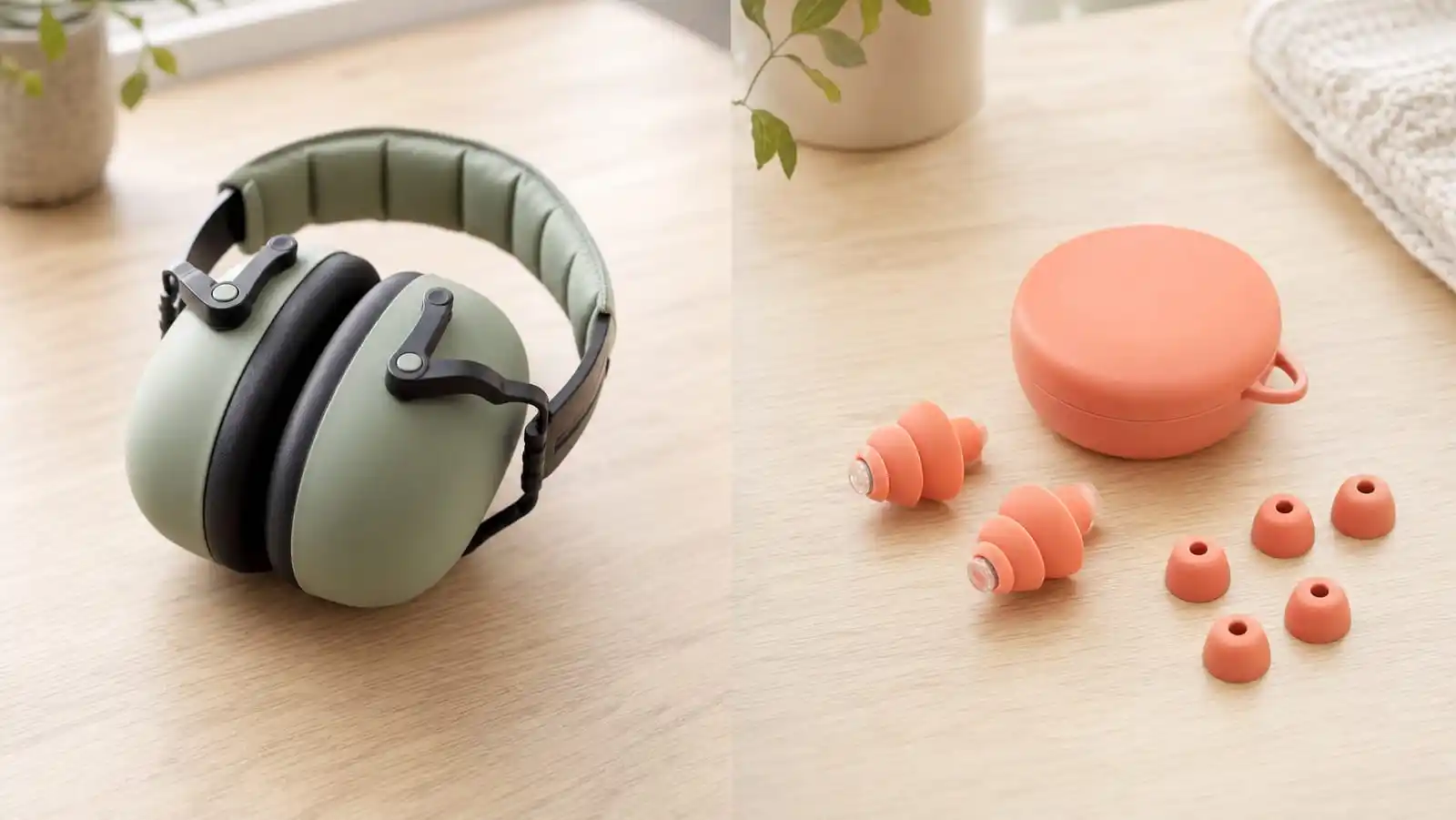
For a child under roughly five, and for any child who will not tolerate something in the ear canal, buy ear defenders. For a school-age child who still needs to hear the teacher, and for a teenager who will not wear anything visible, buy filtering earplugs. That is the answer most families arrive at. The rest of this article is why, and where it breaks.
Both sit inside the same larger picture of noise sensitivity and auditory tools, and neither is a treatment. They change how much sound arrives, not how a nervous system handles what gets through — for that, start with why sound sensitivity happens.
The Short Answer
| | Ear defenders (earmuffs) | Filtering earplugs | |---|---|---| | Typical age range | Infancy upward, limited only by head size | Makers of both sets in our data state ages 6 and up | | Effect on speech | Muffles everything, voices included | Lowers volume more evenly; speech stays largely intelligible | | Visibility | Obvious from across a playground | Close to invisible under hair | | How easily lost | Hard to lose, too big to vanish | Lost constantly without a case, cord or clip | | All-day wearability | Limited by clamping force and heat | Limited by canal comfort; Loop states 90-minute sessions, up to 3 hours a day | | Price band | $9.99 to $13.49 for the pairs in our data, as of September 2026 | $13.25 to $34.95, as of September 2026 | | Worst at | Conversation, hot rooms, haircuts, sleeping | Very loud events, young children, being found again |
How They Actually Differ Acoustically
An ear defender is a passive attenuator: a rigid cup sealed against the head by a sprung band, dense foam inside. A filtering earplug sits in the canal and usually has a deliberate acoustic channel that lets some sound through.
The difference is not just how much they cut but how evenly. Earmuffs attenuate high frequencies better than low ones, so a child in defenders can still hear a bus engine while consonants disappear. Filtering plugs aim for a flatter reduction: quieter, not mumbled.
This is why a bigger number can be the wrong purchase. A child who cannot hear an instruction, a car or their own name will often pull the protection off — or keep it on and become harder to reach. The goal is to take the top off the noise, not to seal the child out of the room.
NRR and SNR Are Two Different Rulers
They cannot be compared directly, and most product listings encourage you to try. According to Elliott Berger's E-A-R/3M technical note on hearing protector ratings, the NRR is the US rating mandated by the Environmental Protection Agency, computed from ANSI S3.19 test data with two standard deviations subtracted from the mean attenuation plus a flat 3 dB spectral safety factor. The SNR is the international rating in ISO 4869-2, computed from ISO 4869 data with typically one standard deviation subtracted and no spectral safety factor.
Berger's note states that for an earmuff the NRR "is in fact lower, by 5 to 6 dB, than the SNR or SLC80" — one product, two labels, a five-to-six-decibel gap created entirely by the paperwork. He also notes that the ANSI data behind the NRR is the least representative of real-world performance of the three standards, and that the laboratory-to-real-life gap is larger for earplugs than for earmuffs. So compare NRR with NRR, SNR with SNR, and treat every published figure as a ceiling.
What the numbers feel like in practice
The ProCase kids' ear muffs, $9.99 as of September 2026, are rated SNR 27 dB and, per ProCase's listing, certified to ANSI S3.19 and CE EN 352-1. Loop publishes 16 dB SNR for its Engage Kids 2 plugs, $34.95 as of September 2026. Eleven decibels separates them, and that gap is the decision: the defenders are for a fireworks display, the plugs are for a Tuesday. Neither figure is a promise — iClever, whose SNR 29 dB EM01 muffs list at $13.49 as of September 2026, states in its own listing that "earmuffs cannot 100% eliminate noise".
Age and Development
The floor for earplugs is a safety floor. The American Academy of Pediatrics advises parents to "use hearing protection such as protective earmuffs" and notes that "earplugs can be used but may pose a choking hazard to young children". The AAP does not name an age; product makers do. Both filtering plugs in our data are rated by their makers for ages 6 and up — Loop states 6 to 12 years for Engage Kids 2, and Softvox states ages 6 and up. Below that, earmuffs are the practical option, and the AAP's other point matters more: infants and young children rely on adults to move them away from the noise in the first place.
The ceiling for defenders is a comfort ceiling. Earmuffs attenuate by sealing, sealing needs headband force, and that force lands on temples and jaw. For a touch-sensitive child, you have swapped a sound problem for a tactile one. Two specs predict how long a pair survives: telescopic range per side — ProCase gives up to 32 mm, iClever up to 38 mm and states ages 5 and up — and headband pressure, which iClever claims is "1/3 less pressure than other average ear muffs". If the arms are near the top of their travel on day one, you have probably bought about a year.
Then there is the reason nobody prints on a spec sheet. Somewhere around ten to twelve, visibility often starts to cost something. Bright earmuffs mark a child out in a corridor, and that can be why a child who wore defenders happily for five years suddenly will not. Switching to plugs solves a social problem, not an acoustic one, and that is a legitimate reason to switch. If defenders are still the right category, our round-up of the best noise-cancelling headphones for autism compares clamping force and telescopic range across six pairs.
Small parts, small canals
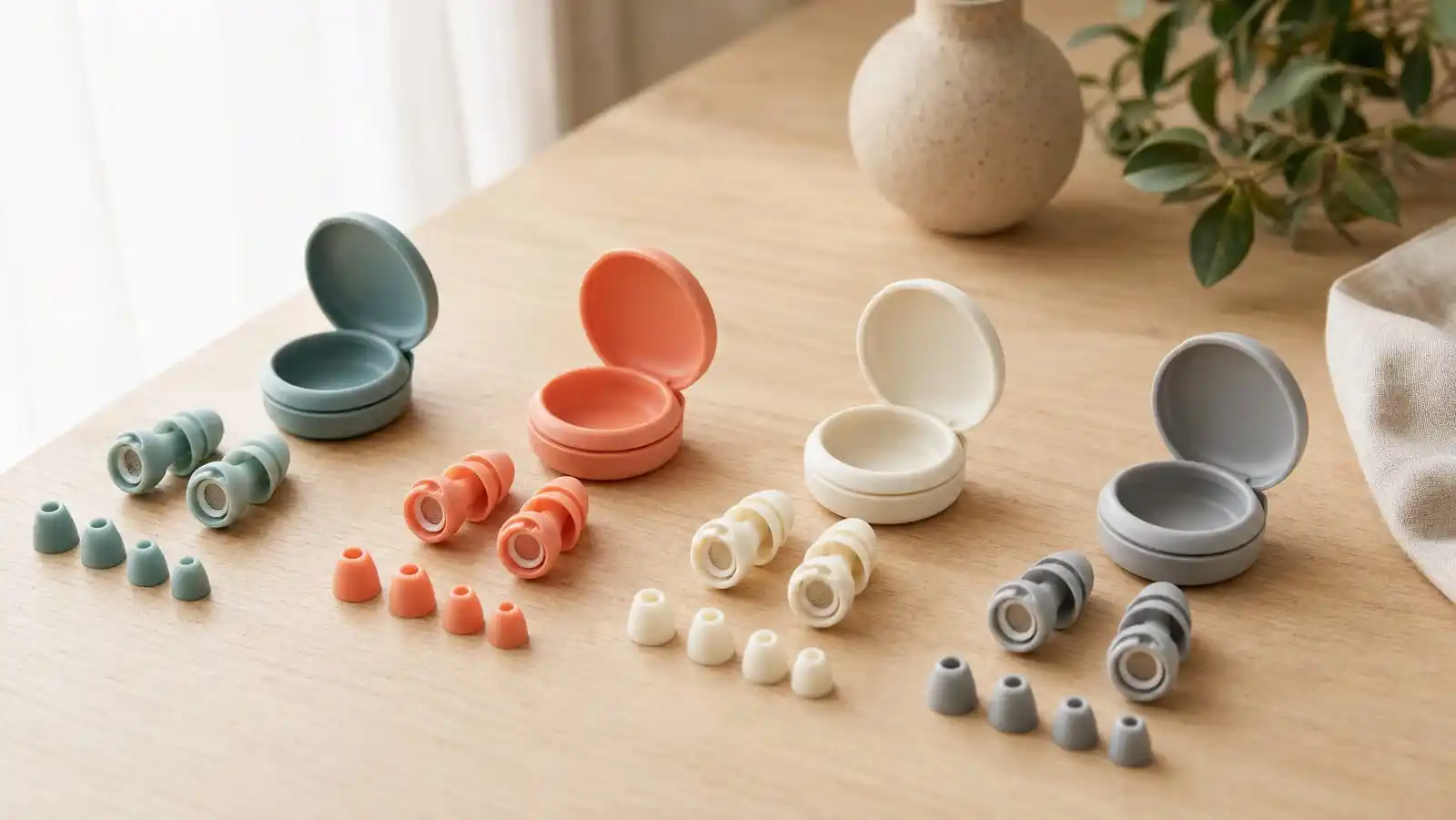
Filtering earplugs come with interchangeable silicone tips — four sizes each on the Loop and Softvox sets. Loose tips are small enough to be swallowed or pushed further into an ear canal. Keep spares in the case and away from younger siblings, check the tip is still on the plug when it comes out, and do not put earplugs in a child who cannot reliably remove them or tell you they hurt. If a tip comes off inside the ear, do not fish for it with tweezers or a cotton bud; ask a GP or audiologist to look.
Setting by Setting
- Classroom — filtering earplugs. Six hours of scraping chairs and background chatter is the load plugs were designed for, and the child can still hear instructions. Trade-off: they get lost, and a school may have a policy. A long connecting string, like the one on the Softvox kids' plugs at $13.25 as of September 2026, buys back some of the loss rate. Softvox is clear that its plugs are "not intended for professional or extreme high-decibel hearing protection" — a school hall, not a motorsport track.
- Fireworks, concerts and motorsport — ear defenders. The one case where the bigger number is the right number, and visibility is a feature: adults nearby can see the child is protected. Under-threes belong in muffs here, and further from the source.
- Haircuts — earplugs. Counterintuitive, but a barber needs access around the ears, and a headband is in the way. Dentists — defenders, since the drill is high-frequency and nobody needs to hear the hygienist's small talk.
- Supermarkets — filtering earplugs. Long, moderate, unpredictable noise, plus a child who needs to hear you. Defenders work too, but forty minutes of clamped cups in a warm shop gets sweaty.
- Flights — defenders for younger children, plugs for teens. Muffs double as a sleep prop against cabin roar. Neither addresses the pressure discomfort some children get on descent; that is a different mechanism, worth raising with your GP rather than solving with foam.
- Sleep — usually neither. A headband is not sleepable, and Loop's own guidance for Engage Kids 2 is 90-minute sessions up to three hours a day, which is not a night's wear. Environmental fixes — a quieter room, a sound machine, a door seal — do more here.
When the Answer Is Both
The common setup is two tools with two jobs: defenders in the car for fireworks, assemblies and the dentist, plugs in a pocket case for the daily background load. At the prices in our data that is roughly $23 to $48 combined, as of September 2026. The cost is two things to lose, and a child who has to judge which one a situation needs — a skill worth teaching explicitly. For the plug half of that pair, we compare fit, retention and price in the best earplugs for sensory-sensitive kids.
Sometimes the answer is neither. The American Academy of Pediatrics offers a useful field test: if you have to raise your voice to talk to someone an arm's length away, it is too loud, and "if an environment sounds too loud for an adult, it probably is too loud for a child". That test often points at the room, not the child. Moving a desk away from an air vent, or leaving assembly five minutes early, removes the trigger rather than muffling it.
All-day protection: a genuinely open question
Guidance published by the National Autism Implementation Team for schools and nurseries takes a firm line: "the use of ear defenders is counterproductive to any treatment plans audiology will put in place", because "the continued use of ear defenders results in an increase in a child's auditory gain; which means that they become MORE sensitive towards sounds". It strongly recommends against ear defenders for a child formally being treated for hyperacusis. That is clinical reasoning rather than a trial result, and the field has not settled it. A survey of 255 professionals and graduate students published in Language, Speech, and Hearing Services in Schools found that 66% had observed autistic people using ear protection — headphones (91%), earmuffs (44%), earplugs (33%) — and concluded there is "uncertainty among various stakeholders of the benefits and possible negative effects" of these devices. If your child is under audiology care, follow that team's plan over any article.
Frequently Asked Questions
Are earplugs safe for a four-year-old? Generally not as a first choice. The American Academy of Pediatrics recommends protective earmuffs and warns that earplugs "may pose a choking hazard to young children", and the makers of both plug sets here rate them for ages 6 and up. If a four-year-old genuinely cannot tolerate muffs, that is a conversation for an audiologist or OT.
Is an SNR 29 dB earmuff better than an NRR 25 dB one? Not necessarily, and possibly not at all. Per Berger's 3M note, an earmuff's NRR typically lands 5 to 6 dB below its SNR because of the extra standard deviation and the 3 dB spectral safety factor in the US calculation. Those two labels could describe near-identical performance.
How loud does a place have to be before this is about hearing damage? A World Health Organization review of noise exposure limits for children in recreational settings recommends an exposure limit of 80 dBA as an eight-hour LEX for children, and notes that 75 dBA would be the recommendation for maximum protection. Most sensory use sits well below that — it is about tolerability, not damage. The two overlap at fireworks and concerts.
Will wearing ear defenders every day make my child more sensitive? It might, and the evidence does not settle it. The National Autism Implementation Team guidance argues that continued use increases auditory gain and advises against it during hyperacusis treatment; the professional survey above found no consensus. Many families settle on targeted use — on for the loud thing, off afterwards — with an audiology or OT review if all-day use becomes the norm.
Will school let my child wear earplugs in class? Often yes, if there is a plan attached. A 2026 perspective article on noise-cancelling headphones for autistic students in educational settings, indexed on PubMed, argues that such tools should not be introduced without a plan and tailoring at an individual level. Write down when the tool is used, who holds the spare, and what happens during group discussion.
The Bottom Line
Buy for the setting your child struggles in most, not for the biggest figure on the box. Defenders for short, loud, unavoidable events and for children too young for the canal. Filtering plugs for long, moderate days where hearing still matters. Expect to own both eventually, to lose the plugs at least once, and to treat any all-day habit as a prompt to check in with an audiologist or OT rather than buy a stronger pair.
For the full picture — the mechanism behind sound sensitivity, no-equipment strategies, classroom adjustments and what to do about children who seek sound rather than avoid it — read our complete guide to auditory sensory support.