This article contains affiliate links. We may earn a commission if you make a purchase through our links, at no extra cost to you.
Key Takeaways
- Distance beats equipment. Sound level drops about 6 dB each time you double your distance from the source.
- A guaranteed exit is the plan, not the backup. Leaving at minute nine is a successful outing.
- One sequence fits every loud event. Before, arriving, during, exit, after — for fireworks and for the dentist alike.
- A haircut is not just a sound. Noise, vibration, touch, hair on skin, a cape at the throat.
- Venues hold supports they barely advertise. Sensory rooms, sensory bags, TSA Cares and sunflower lanyards all reward asking in advance.
The most reliable ear protection for fireworks for an autistic child is a well-fitting pair of over-the-ear earmuffs, put on before the first shell goes up, worn from as far back as you can stand, and paired with a plan that lets you leave. The American Speech-Language-Hearing Association advises that for children you "use well-fitting 'earmuff'-style protection that fully covers the ears," and "stay at least 500 feet away from a fireworks launch site, speaker, or other source of loud noise".
That is the short answer, and the smallest part of the job. For the underlying picture of noise sensitivity and auditory sensory tools, see our pillar guide. Below is one repeatable plan for the events a family cannot avoid, plus the three with their own geometry.
Leaving Early Is a Successful Outing
The goal of an outing is not for your child to endure it. It is to go, get something from it, and come home without a cost that lands three days later. A guaranteed, blame-free exit is what makes that possible: a child who knows they can leave is in a different state from one who suspects they cannot.
The hyperacusis guidance from Scotland's National Autism Implementation Team, written with a principal paediatric audiologist, warns that children's anxiety may increase if they are forced to remain in a situation causing distress. So decide in advance what counts as a win: fifteen minutes of fireworks from a car park half a mile back, one side of the head trimmed, dinner eaten before the dancing.
Not a small inconvenience
A meta-analysis by Williams, Suzman and Woynaroski, published in Ear and Hearing in 2021, put hyperacusis prevalence in autistic people at 41.42 percent on questionnaire measures and 27.3 percent on objective ones. See why sound sensitivity happens.
The Five-Beat Plan for Sensory Friendly Outings
Five beats, same order every time.
Before: the three days leading up
Most of the work happens at home, in small pieces, days early.
- Preview the place. Photos, video of last year's display, a drive-past on the school run. KultureCity, which certifies venues as sensory inclusive, publishes social stories that TriplePundit's account of the programme describes as "unique to each venue," detailing the rooms and interactions "with a step-by-step explanation and photos".
- Preview the sound, child-led. Play a recording quietly in another room for a few seconds, child holding the volume and free to stop, then build up across days. Forced exposure is what to avoid.
- Schedule around your child's best hours, practise wearing the ear protection at home, and make the plan together, written on a card they hold: where you will stand, what the signal is, what it triggers.
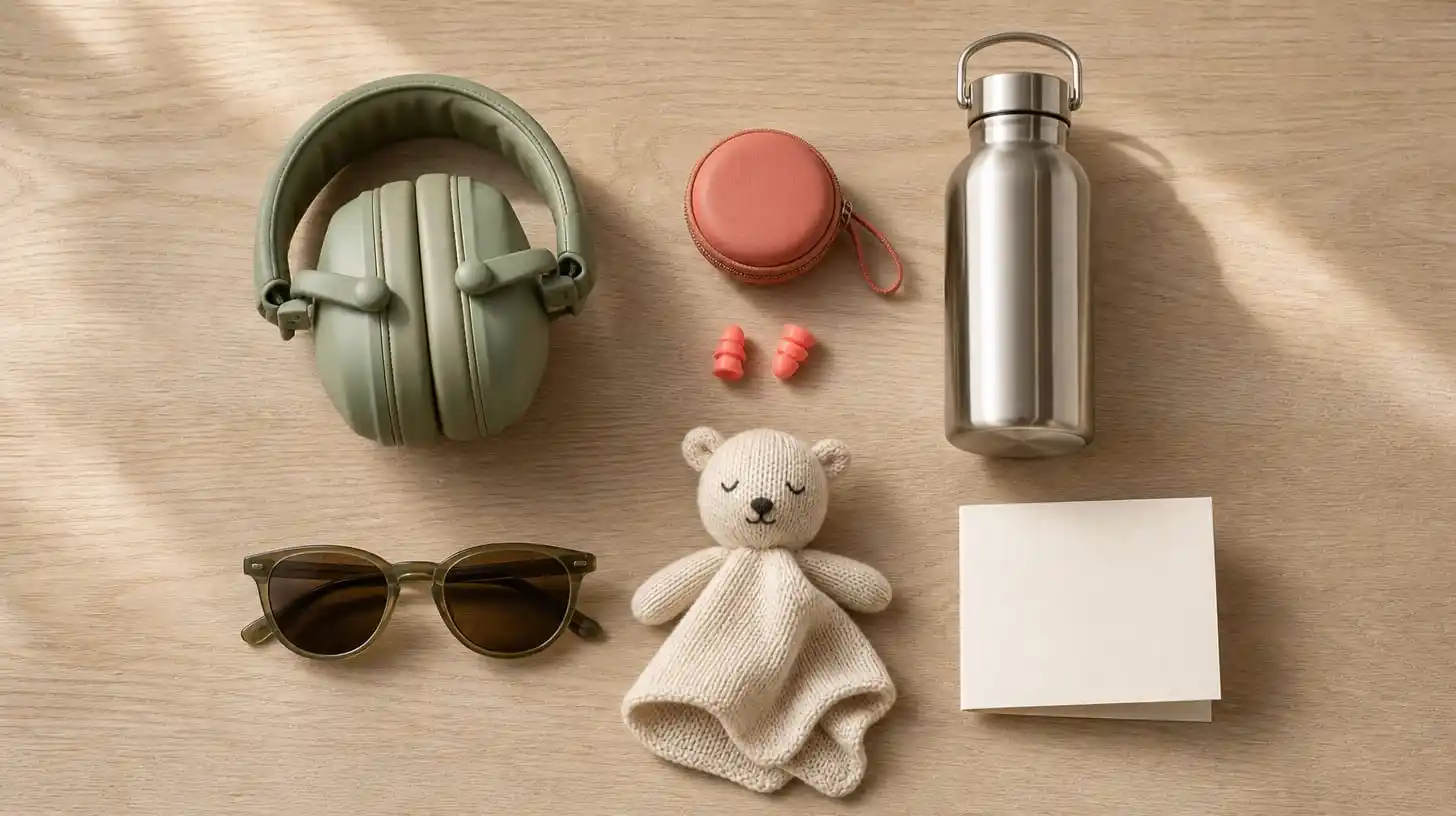
- Pack the kit the night before: ear protection and a spare, a comfort object, something to chew, a cap and sunglasses, a charged phone with the playlist downloaded, snacks, and a pocket fidget from our portable tactile toys for travel.
Most of it costs nothing, and overlaps with our strategies that need no equipment. Folding earmuffs are the workhorse for loud, predictable events: on in seconds, nothing in the ear canal. The ProCase Kids Ear Muffs are $9.99 as of September 2026 against an $18.99 list price; the listing states SNR 27 dB noise isolation, certification to ANSI S3.19 and CE EN352-1, and that the muffs are tight before use and should be stretched over a box for one to two days. Trade-offs: a stated SNR comes from a laboratory fit, not a child adjusting them mid-event; muffs are also hot and press on glasses. For model differences, see the best noise-cancelling headphones and ear defenders. A cheap spare stops a loss ending the evening: the Jozy Kids Ear Protection are also $9.99 as of September 2026, the listing claiming 26 dB passive noise reduction and a foldable ABS shell, but naming no certification standard.
Arriving: find the exit before the noise starts
Scope the escape route while the venue is still quiet. Arrive early, walk the perimeter, and point out two things to your child: the quiet place, and the way out. Stand at the edge near an exit, not mid-row, and ask about any sensory room on arrival rather than when you need it. Then tell one staff member and ask what the venue lends out.
During: one signal, honoured every time
The signal only works if it has never once failed. Agree one unmistakable sign — a hand squeeze, a card, a word — and the rule that when it appears, you leave. Negotiate for five more minutes once and you spend the credibility the plan runs on.
- Keep distance, and put objects in the way — a wall, a car, a hill — and time breaks around the known-loud moments: the finale, the band's entrance, the hand dryers.
- Watch the budget, not the clock. Filtering a loud room may leave less in reserve for queueing and conversation, so leave while things go well.
- Offer preferred audio instead of silence. Their own music at a safe volume is predictable and theirs, which some children prefer to muffled quiet.
For an older child who will not wear anything visible, filtering earplugs are the compromise. The Loop Engage Kids 2 cost $34.95 as of September 2026; Loop publishes 16 dB SNR noise reduction and states ages 6 and up, retails them as 6 to 12 years with four kid-sized tips and a keychain case, and says they filter background noise while keeping speech clear. Sixteen decibels takes the edge off a concourse without making a parent unintelligible; Loop calls them certified hearing protection, but they are no match for a firework. Trade-offs: easy to lose, insertion defeats some children's fine-motor skills, and anything in the ear is intolerable for a tactile-defensive child. See our comparison of ear defenders and earplugs.
Small parts, small ears
Earplugs and their interchangeable tips are small detachable parts: a choking and ingestion risk for young children, any child who mouths objects, and younger siblings. They can also be pushed too far into the canal. Do not use them with toddlers or preschoolers, and ask a GP, paediatrician or audiologist first if a child has ear tubes, an ear infection or impacted wax.
Exit and after: leave at the planned point
Leave when you agreed, even if the moment feels fine. Ending on a good minute is how the next outing starts from a good memory, so build in recovery before the next demand. A day or two later, review it neutrally — what was worst, what helped, what would you change — and write three lines, so next time you are not guessing.
Fireworks: Ear Protection, Then Distance
Fireworks are a different physical problem from a loud room. The ASHA guidance above notes that fireworks set off three feet from the listener can measure 150 dBP, and that "a single loud blast or explosion that lasts less than 1 second can cause immediate and permanent hearing loss." The footnote to Table G-16 of OSHA's occupational noise standard states that "exposure to impulsive or impact noise should not exceed 140 dB peak sound pressure level" — advisory wording that OSHA's July 2025 interpretation letter says "is not in itself an Action Limit (AL) or Permissible Exposure Limit (PEL)". The honest limit: that figure governs adults at work, not children at a display. Nor is impulse noise simply louder noise — a 2018 NIOSH science bulletin notes that "impulsive noise is more likely to cause noise-induced hearing loss than continuous noise of equal energy". So keep a child well back from any launch site even wearing earmuffs, and if they report ringing, muffled hearing or ear pain afterwards, contact a GP.
Then the move that outperforms every purchase. In ideal free-field conditions, sound level drops 6 dB for every doubling of the distance from the source, as the Simon Fraser University Handbook for Acoustic Ecology sets out. Real parks are not free fields, but the direction holds: 800 feet back does more than any earmuff. Watch from a hill, a car park, a bedroom window.
Quieter alternatives exist. In a 2026 KUNM report, Brandy Paulos of the advocacy group Elevate the Spectrum noted that "drone shows can be spectacular and have zero noise", and low-noise displays built around fountains rather than reports are increasingly marketed as sensory-friendly.
Haircuts: the Clipper Is a Package, Not Just a Sound
Autism and haircut sensory noise get blamed on the clipper, but the clipper is four problems at once: a sustained whine, vibration through the skull, unpredictable touch on scalp and neck, and hair falling on skin — plus a cape at the throat and no view of what is happening. Fix them separately.
- Ask for scissors instead of clippers. No vibration, less noise. Trade-off: longer appointment, less precise on short styles.
- Book the first or last slot, keep the same stylist, and let the child sit on a parent's lap — or just watch while a sibling is cut.
- Build up at home across days. Clippers running in another room, door shut, then open, then the same room, then held near, then touching an arm, then the neck. Short, child-led, stopping before distress.
- Drop the cape if the cape is the problem. An old T-shirt, a towel, or a bath straight afterwards.
- Look for a sensory-friendly salon. Some areas have stylists advertising appointments for sensory-sensitive clients; availability varies by region.
That gradual build has published support, but see its size before leaning on it. In a study by Buckley, Luiselli, Harper and Shlesinger, reviewed by the Association for Science in Autism Treatment and published in the Journal of Applied Behavior Analysis in 2020, two autistic individuals in a group home were gradually exposed to the steps of a haircut, from accepting clippers nearby to tolerating longer durations against the scalp, with edible reinforcers at each step. Both completed a full haircut — after roughly 200 sessions each, and the review notes tolerance was never tested in a real salon. If haircuts are a crisis, ask an occupational therapist or behaviour analyst to structure this.
Crowds: Taking an Autistic Child to a Concert, a Stadium or an Airport
Crowds are the opposite problem from fireworks: not peaks, but sustained unpredictable noise with no schedule. The load comes from not knowing when the next cheer arrives, and it accumulates for hours. Go at the quiet hour — park opening, a weekday matinee — and at a wedding ask for one quiet room with a door: often available, rarely offered.
- Read the venue's own accessibility page. Sensory rooms have spread widely — Bham Now reported in April 2026 that the Birmingham Civil Rights Institute opened KultureCity's 1,000th sensory room — and Gillette Stadium's own announcement lists its checkout sensory bags as holding "noise-canceling headphones, strobe-reduction glasses, fidget tools and verbal cue cards", though provision is per-site and changes.
- Theme parks generally run some form of disability access service, usually a return-time system you register for. Rules differ by park and get revised, so check its pages the week you go.
- At the airport, use both schemes. The TSA's Passenger Support programme asks you to submit the TSA Cares form or call at least 72 hours ahead for a specially trained officer, and many airports run the Hidden Disabilities Sunflower scheme — though JFK, which hands out free lanyards pre-security, notes that "the lanyard does not provide priority access or skip-the-line privileges".
The Outings to Skip
Some events are not worth running a plan for, and saying so is not giving up. An indoor display with no exit route, a four-hour parade with no seating, a reception at nightclub volume: skip it, send one parent, or go for the hour that matters. A plan can also become the reason to push something that should have been dropped. If your child's answer, freely given, is no, that is information, not an obstacle.
The evidence gives no clean rule on protection, either. The NAIT guidance states that continued use of ear defenders increases a child's auditory gain so they become more sensitive to sound, and the ENT and Audiology News review of hyperacusis in autism reports that its authors question noise-attenuating headphones, since avoiding sound can enhance central gain. Many autistic adults counter that without protection some environments are inaccessible; the research does not settle it. Targeted use for a known-loud event is the middle path; ask an audiologist if protection becomes an all-day habit.
Frequently Asked Questions
What ear protection should my autistic child wear for fireworks? ASHA advises well-fitting earmuff-style protection that fully covers the ears for children, and staying at least 500 feet from the launch site. Earmuffs suit most children better than earplugs: faster on, nothing in the canal. Practise at home first, and treat distance as the main intervention.
How do we get through a haircut? Separate the problems: scissors rather than clippers, the first or last appointment, the same stylist, a parent's lap, no cape, and a gradual build-up at home.
Will ear defenders make my child's sound sensitivity worse? This is genuinely contested. Scotland's National Autism Implementation Team guidance states that continued use increases auditory gain so a child becomes more sensitive, and advises against it during formal hyperacusis treatment. Many autistic adults argue that without protection some places are inaccessible, and neither side has strong evidence. The same NAIT guidance notes that hyperacusis "will require a formal diagnosis" and suggests asking local audiology services about a referral. None of this is a diagnosis or treatment plan.
Running the Same Plan Next Time
The plan is the product, not the earmuffs. Run the same five beats for the display, the salon chair, the terminal and the wedding, so that by the fourth outing your child knows the shape before you explain it.
Three things carry the weight. Distance, because physics is more reliable than equipment. The signal, because a promise never broken is the only reason a child tries something loud again. And the review afterwards, which turns a bad evening into data. The earmuffs are the fourth thing.
For the background on why sound lands differently, and deeper comparisons of the tools, see our auditory sensory guide.