This article contains affiliate links. We may earn a commission if you make a purchase through our links, at no extra cost to you.
Key Takeaways
- Vision is the sensory system parents name third and investigate least. In interviews with 66 parents of autistic adolescents and young adults, sight was endorsed by 58 percent, behind touch and sound at 83 percent.
- Avoiding light and seeking it are two faces of the same difference. The same child can flinch at a strip light and watch a ceiling fan for twenty minutes.
- Tinted lenses are the most contested product here. A joint statement from the American Academy of Ophthalmology, the American Academy of Pediatrics and AAPOS says evidence does not support tinted filters or lenses for educational performance.
- The flicker story is better evidenced in headache than in autism. A 1989 double-blind crossover study more than halved headaches and eyestrain under high-frequency lighting, but in office workers, not autistic children.
- Get the eyes checked before buying anything. In a 2025 screening study of 210 autistic children, 22.3 percent had refractive errors, 11.9 percent had strabismus, and 23.8 percent had never had an eye examination.
- Light-up toys are a button-battery category. CPSC is aware of 27 deaths and an estimated 54,300 emergency-room injuries from ingested or inserted button cell batteries, 2011 to 2021.
- None of this treats autism. Visual tools change the input and support comfort. They do not alter how a nervous system processes what gets through.
Light sensitivity in autism is a difference in how the brain weighs and sustains visual input, not a fault in the eyes — and the same child who cannot tolerate a supermarket ceiling will often choose to stare at a spinning wheel for twenty minutes. Both are visual sensory differences, and they frequently live in the same child.
That is why visual sensory toys for autism are such a confusing category to shop. Half the products exist to reduce visual input and half exist to deliver it, and the packaging rarely tells you which.
The need is well documented, if studied less than sound. In a 2022 interview study of 66 parents of autistic adolescents and young adults, published in the Journal of Autism and Developmental Disorders, parents most frequently endorsed touch and sound at 83 percent, followed by sight at 58 percent — 38 of the 66 families. Their examples were ordinary: the brightness of a phone screen, a very sunny day, a child who dislikes the light but walks into it anyway. Across modalities, the Autism Sensory Research Consortium's 2023 pooled analysis of 3,868 autistic young people, published in Molecular Autism, cites a point prevalence of 74 percent for differences in any hyper-reactive, hypo-reactive or seeking pattern in any modality — a figure it draws from US Autism and Developmental Disabilities Monitoring Network surveillance data rather than from its own sample.
If you have ever ended a birthday party early because your child was lying flat under the table, with the balloons and the strip light overhead, you already know the practical version of those numbers.
This guide is the hub of our visual sensory series: the mechanism, the products worth owning, the honest state of the evidence on coloured lenses, the strategies that cost nothing, and the half of the picture that gets pathologised. Where the evidence is thin, we say so.
Table of Contents
- Why Light Feels Different: The Visual Sense in Autism
- Sensory Light Projectors and Calming Lamps
- Tinted Lenses and Light Sensitivity Glasses
- Visual Stim Toys: Bubble Tubes, Fiber Optics and Liquid Motion
- Visual Stimming: The Other Half of the Picture
- Fluorescent and LED Lighting at Home and School
- Visual Sensory Support in the Classroom
- Strategies That Need No Equipment
- Light Sensitivity in Teens and Adults
- Toddlers and Babies: Starting Early
- Photophobia, Migraine and ADHD: What is the Difference?
- Calming Visual Input: Using Vision on Purpose
- Frequently Asked Questions
- Conclusion
Why Light Feels Different: The Visual Sense in Autism
The eyes are usually working. What differs is how much the system notices, how long it keeps noticing, and what that costs by three o'clock. Sensory reactivity is written into the diagnostic criteria: the DSM-5 lists hyper- or hyporeactivity to sensory input among the restricted and repetitive behaviour features, as summarised by the Children's Hospital of Philadelphia Center for Autism Research, and vision is one of the modalities it covers.
Understanding why light sensitivity happens changes what you do next, because a processing difference asks for a different response than a behaviour problem does. A child who shuts their eyes in the supermarket is not refusing the errand. They are running out of capacity to filter.
The measurement side is unfinished, which matters before you read confident percentages elsewhere. In the Autism Sensory Research Consortium's 2023 analysis in Molecular Autism, the visual hyper-reactivity and visual seeking scales survived psychometric refinement and were retained, while the visual hypo-reactivity scale "demonstrated subpar reliability" and was dropped in favour of a single item.
The pattern overlaps heavily with hearing: families dealing with noise sensitivity in autism and ADHD are usually dealing with light too, because loud places are also bright, crowded and visually busy.
What it tends to look like day to day
- Squinting, shielding the eyes or pulling a hood down indoors
- Refusing specific rooms: the supermarket aisle, the school hall, the dentist
- Preferring to play with the lights off, or under a table or blanket
- Staring intently at lights, fans, reflections, patterns or edges
- An afternoon crash after a visually demanding day, with no single trigger
Sensory Light Projectors and Calming Lamps
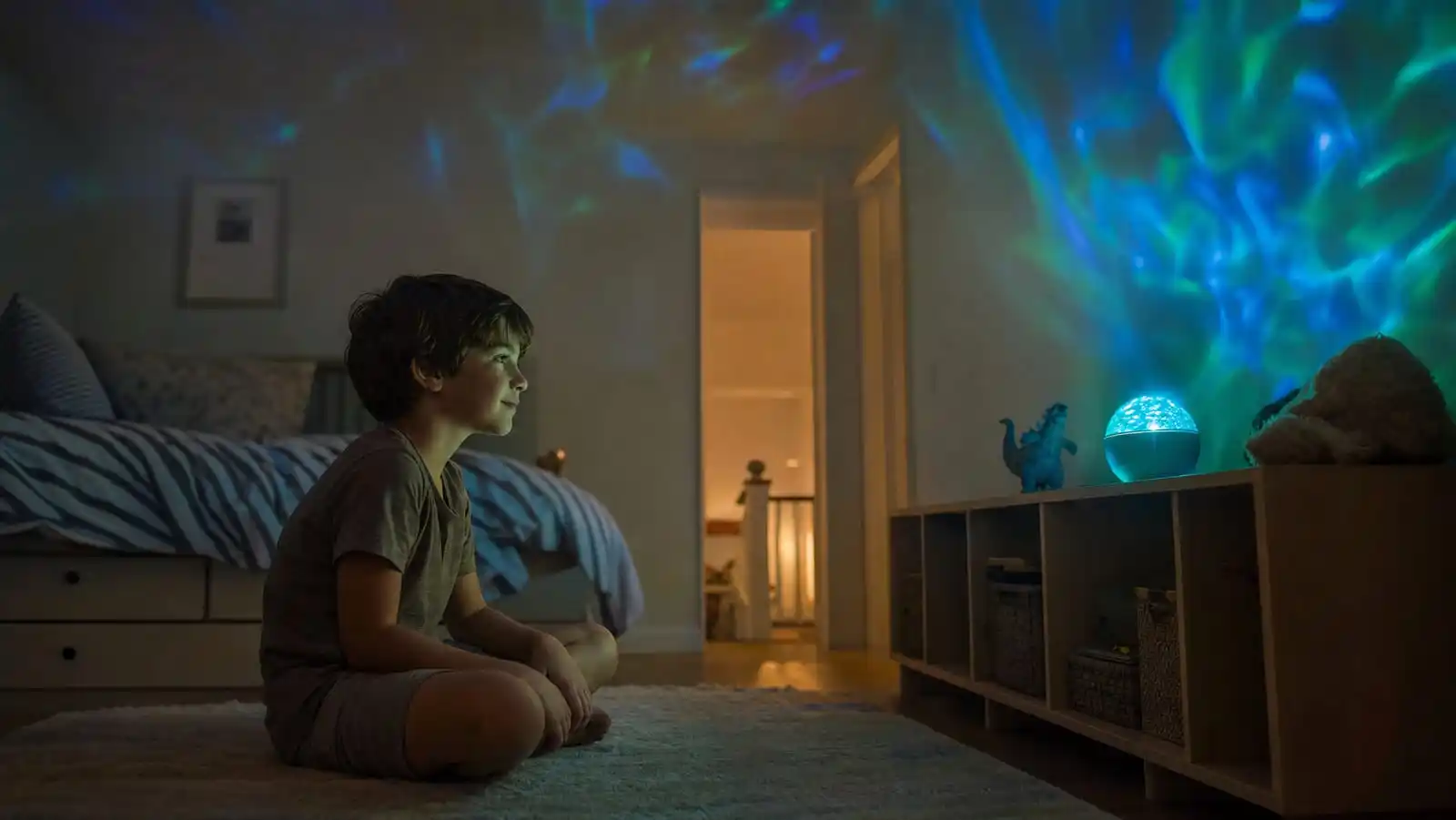
A projector does not calm a child because it is a projector. It calms because it is dim, slow, predictable and under the child's control. Those four properties are what to shop for, and they cost very little.
Picking the best sensory light projectors for autism comes down to four functional questions. Can the brightness go genuinely low, not just lower? Does the motion move slowly rather than strobing or jumping colour? Is there a timer and a remote? And is it mains or USB powered rather than battery operated, which removes a safety problem described further down this page.
Price is not the deciding factor. The Calming Sensory Lights Ocean Light Projector is $9.99 as of October 2026; according to diatomiteco it projects water-ripple and sea-wave effects onto walls and ceilings, offers 15 colour patterns selected with an included remote, and is USB-powered with no internal battery. That is most of the specification that matters, for ten dollars. We have not tested it, and neither of the listings we looked at publishes a lux figure, so brightness stays the one thing you cannot check before buying.
The limit, plainly: a projector is a wind-down tool, not a sleep aid. A 2018 study of ten children aged three to five in Physiological Reports found that one hour of bright light at roughly 1,000 lux before bedtime suppressed melatonin by a mean of 87.6 percent, and in seven of the ten children levels had not recovered to half of dim-light values fifty minutes later. Small sample, single intensity, and a dim projector is nothing like 1,000 lux — but it is why we would run any bedroom light low, warm and on a timer. Sleep and bedtime sensory solutions covers the rest of the evening.
Tinted Lenses and Light Sensitivity Glasses
This is the most oversold category in visual sensory support, and the one where the published evidence and the marketing are furthest apart.
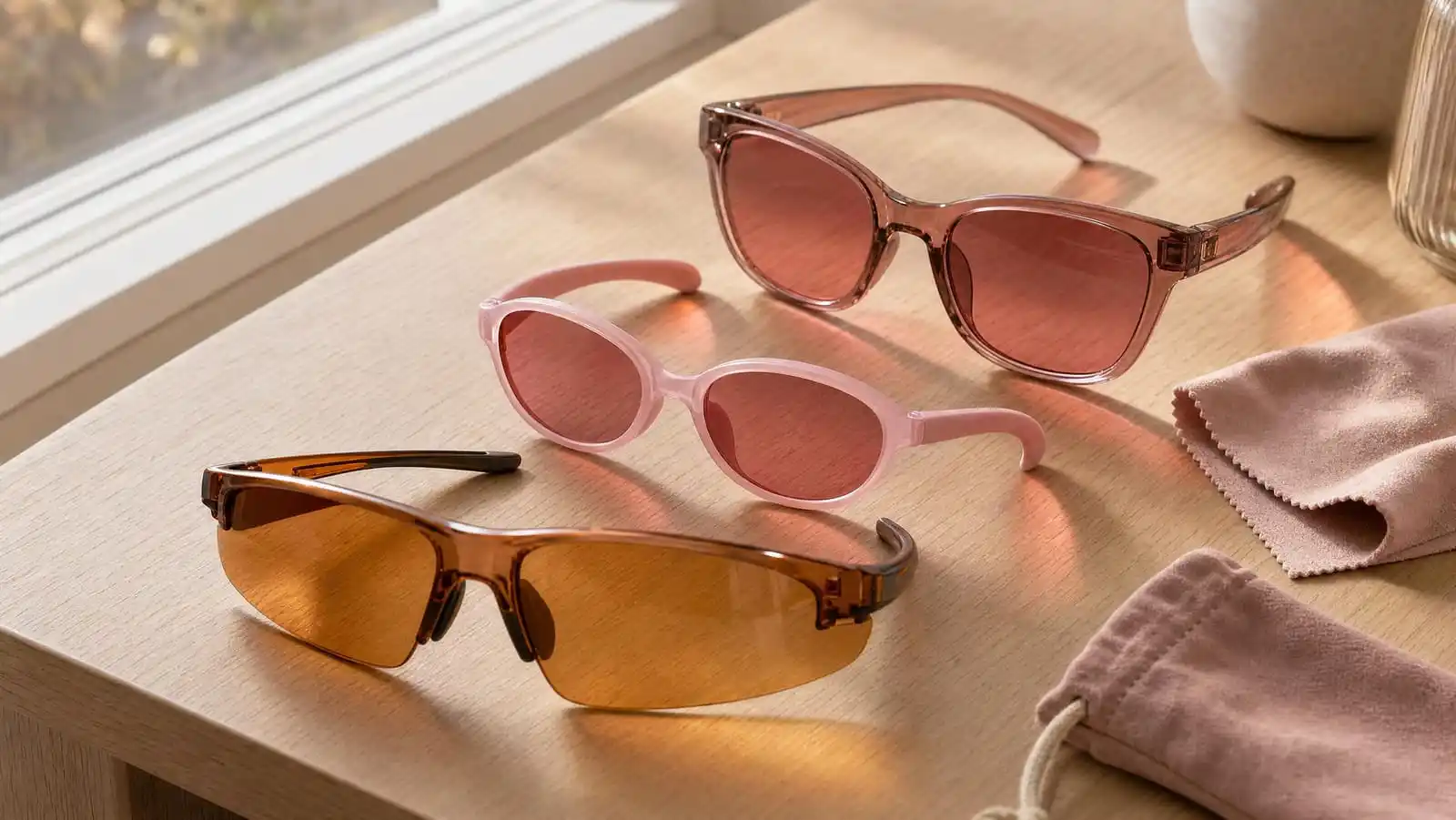
The honest summary of light sensitivity glasses and tinted lenses is that two claims get sold together. Claim one: a tint improves reading or learning. Claim two: a tint reduces discomfort in bright or flickering light. The first is not supported. The second is plausible and under-studied.
On reading and learning the major bodies are unambiguous. The joint statement on learning disabilities, dyslexia and vision from the American Academy of Ophthalmology, the American Academy of Pediatrics and AAPOS — revised in 2009 and reaffirmed in 2014, published by the AAO — states that "scientific evidence does not support the efficacy of eye exercises, behavioral vision therapy, or special tinted filters or lenses for improving the long-term educational performance in these complex pediatric neurocognitive conditions," and its eighth recommendation says such approaches "are not endorsed or recommended." A 2011 study of 61 children aged 7 to 12 with reading difficulties in Pediatrics gave its result in the title: Irlen colored overlays do not alleviate reading difficulties. The same group's one-year follow-up found no reading advantage after a year of filter use, and a 2016 systematic review in Ophthalmic and Physiological Optics concluded that coloured lenses and overlays cannot be endorsed, with reported benefits likely attributable to placebo, practice or Hawthorne effects. The RANZCO position statement, reconfirmed in 2025, says there "remains no reliable evidence to support the claims that Irlen lenses are beneficial in improving reading ability", that the studies claiming positive results have been criticised for small samples and inadequate placebo controls, and that the interventions known to improve reading remain phonics and phoneme awareness.
Comfort is different territory. The University of Utah Moran Eye Center explains that the FL-41 tint filters certain wavelengths of blue and green thought to be particularly bothersome in light sensitivity, that it was developed for people sensitive to fluorescent lighting and for migraine, and that most patients in comparison testing preferred it to grey sunglasses and standard rose tints. The page is candid that "we are not completely sure why FL-41 improves light sensitivity." Note what is absent: that work concerns photophobia and migraine, not autism, and no sample sizes are given.
The honest argument about tinted lenses
Nobody has shown that a tint changes reading, learning or autism. That question is settled, and the answer is no. Whether a tint makes a bright classroom more bearable for an individual child is not settled: the FL-41 literature is small, mostly old, and barely touches autistic children. Get a full eye examination first, be sceptical of any assessment sold as a diagnosis plus a proprietary lens, and trial any tint for comfort in named situations rather than for school performance. Ordinary sunglasses and a seat away from the window cost nothing and are sometimes the whole answer.
Visual Stim Toys: Bubble Tubes, Fiber Optics and Liquid Motion
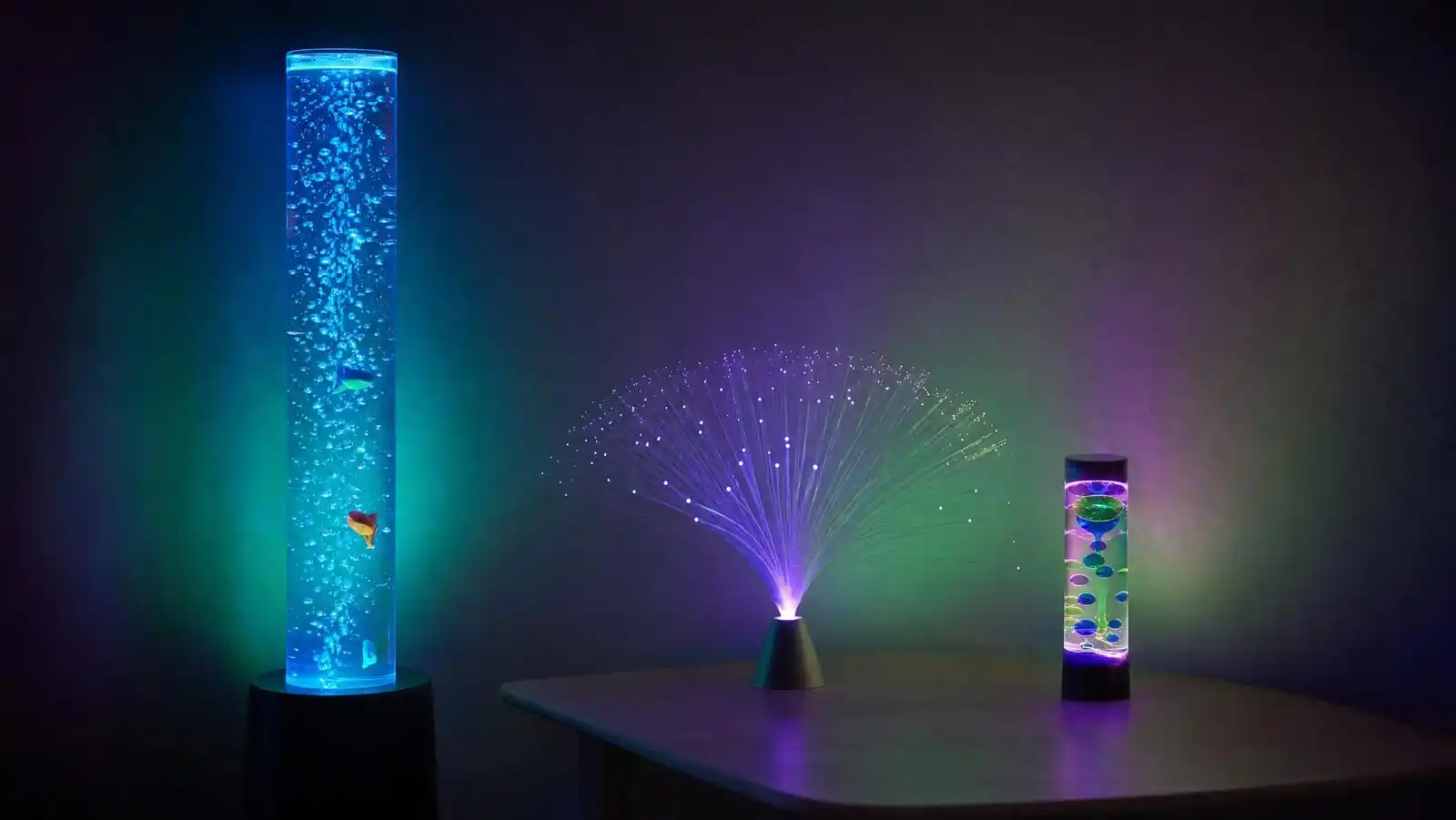
These are input delivery devices, bought for the opposite reason to tinted lenses. A bubble tube, a fiber-optic strand curtain, a liquid motion bubbler, a glitter wand: all give slow, repetitive, high-contrast movement a child can watch without having to do anything.
What makes the best visual stim toys work is predictability. Movement that repeats on a long, steady cycle gives the visual system something undemanding to track, which is why rising bubbles and dripping liquid are perennial, and why anything that flashes or changes colour abruptly tends to backfire for a light-sensitive child. Slow beats bright. One moving element beats five.
Buy by failure mode rather than feature list. Liquid-filled items leak and crack. Bubble tubes need a stable base and a cable run out of reach. Fiber optics fray, and exposed strands are sharp. Any small detachable part is a choking risk for a child who mouths objects — and a sensory seeker is more likely to mouth objects, not less. Children who chase visual input often chase touch too, and our complete tactile sensory guide covers that overlap.
Light-up toys are a button-battery category
Most small light-up sensory toys run on button cell or coin batteries, and a swallowed button battery can burn through tissue quickly. According to a 2023 US Consumer Product Safety Commission news release, CPSC is aware of 27 deaths and an estimated 54,300 injuries treated in emergency rooms associated with ingested or inserted button cell or coin batteries between 2011 and 2021. Reese's Law, enacted in August 2022, led to a federal mandatory standard for battery compartments, 16 CFR part 1263; CPSC's period of enforcement discretion for that standard ran out on 19 March 2024, so products manufactured or imported since then are expected to comply. Practically: prefer mains or USB-powered items for young children and sensory seekers, check that any battery compartment needs a tool or two simultaneous movements to open, and treat a suspected ingestion as an emergency.
Visual Stimming: The Other Half of the Picture
Staring at lights, flicking fingers in front of the eyes, lining objects up, watching a fan — these are usually regulation, not symptoms to remove. Visual seeking is one of the patterns the diagnostic criteria cover, and one of the two visual scales that held up in the 2023 Autism Sensory Research Consortium analysis.
The question of visual stimming and when to support it has a clearer answer than it used to. The National Autistic Society describes stimming as self-stimulating or self-regulating behaviour, lists "watching spinning toys, patterns, glitter, colours or lights" among sight-related examples, and states that "if stimming is harmless, there is no reason to prevent an autistic person from doing it." Where stimming is linked to distress its guidance is to address the cause of the distress; where a stim is genuinely harmful, to help find a safer alternative serving the same purpose.
The lived-experience research points the same way. Kapp and colleagues' 2019 interview study of autistic adults, published in Autism, found that participants met accepting attitudes more often in private than in public, that repression of stimming tracked whether people felt understood, and that they did try to suppress stims causing self-harm. Several substituted rather than stopped — one replaced arm stims with dancing. Qualitative work with adults, not a trial in children: read it as testimony rather than effect size.
Two situations warrant attention rather than acceptance. Eye-pressing or eye-poking can damage the eye — the American Printing House's FamilyConnect lists retinal detachment and corneal scratching or thinning among the possible harms — and deserves a prompt ophthalmology opinion, and a sudden change — new squinting, a head tilt, one eye closing — is a reason for an eye test, not a new toy. Parents of children who seek sound rather than avoid it will recognise the strategy: route the input somewhere safe rather than switching it off.
Fluorescent and LED Lighting at Home and School
Flicker is real, measurable and almost certainly uncomfortable for some people. The claim that it specifically affects autistic children is weaker than the internet suggests. Most writing on fluorescent light sensitivity merges those two sentences.
The best evidence is not about autism at all. In a double-blind crossover study in a UK government legal department, published in Lighting Research and Technology in 1989 by Wilkins, Nimmo-Smith, Slater and Bedocs, the average incidence of headaches and eyestrain was more than halved under high-frequency fluorescent lighting compared with conventional low-frequency ballasts, and occupants chose to switch the high-frequency lighting on for around 30 percent longer, with the effect concentrated in people already prone to headaches. That is an adult office population. A 2025 migraine case report in Cureus similarly notes that imperceptible oscillations of around 100 to 120 Hz can induce discomfort and attacks, particularly in those with pre-existing migraine — though it is a single case and measured no flicker itself.
For autistic children specifically the evidence is thin and old rather than absent. Two small studies did measure it: Colman and colleagues, in the Journal of Autism and Childhood Schizophrenia in 1976, observed six autistic children under fluorescent and equal-intensity incandescent light and found significantly more time spent in repetitive behaviour under fluorescent, and a 1985 replication by Fenton and Penney reported the same pattern in five autistic children but not in an intellectually disabled comparison group. Neither study isolated flicker — the 1976 authors proposed it as the explanation and called for further work to test it. Six children and five children settle nothing, and we found no modern controlled trial. The widely repeated figures — a sixty-cycle flicker autistic people supposedly see, or claims that half react to fluorescent tubes — we could not trace to any study at all; they appear in first-person accounts, advocacy writing and product marketing. Those accounts are consistent and worth taking seriously, but they are not a demonstrated effect, and we would rather say so than hand you a statistic you could not defend to a head teacher.
The practical response is still reasonable, because the downside is small. Modern LED fittings on good drivers flicker far less than old magnetic-ballast tubes, warm colour temperatures of 2700K to 3000K are usually easier than cold white, and dimmable fittings give a child control. In a bedroom, blackout solutions for light-sensitive kids do more than any lamp: the cheapest way to reduce light at night is to remove the light already there.
Visual Sensory Support in the Classroom
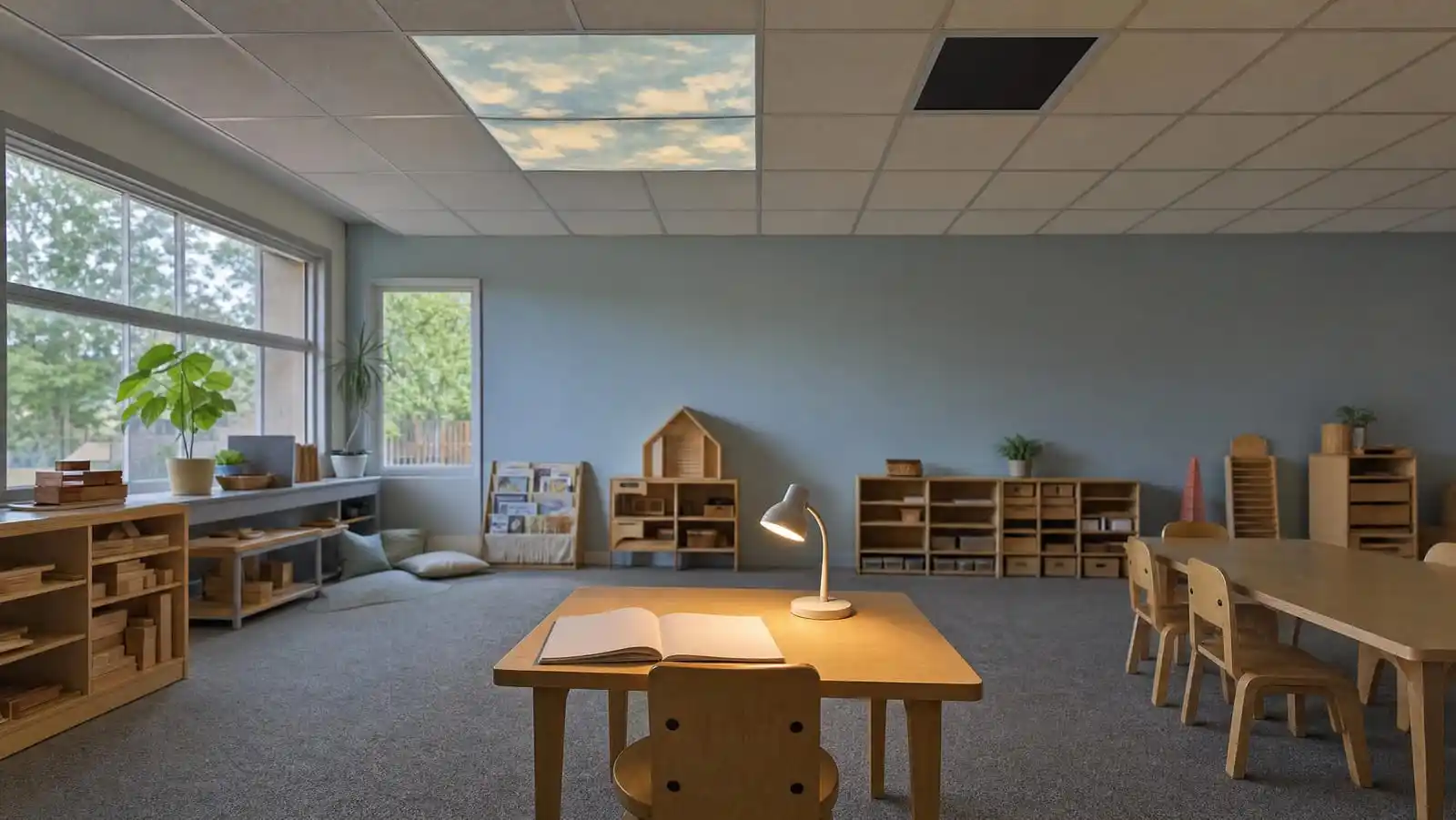
Fix the room and the eyes before you equip the child. Classrooms are visually noisy in ways adults stop noticing: full-wall displays, overhead strip lighting, window glare across a whiteboard, an interactive screen at factory brightness.
The eye examination comes first, and it is skipped alarmingly often. A 2025 cross-sectional screening study of 210 autistic children, published in Medicina, identified refractive errors in 22.3 percent and strabismus in 11.9 percent, found that nearly half could not complete stereopsis testing, and reported that 50 children — 23.8 percent — had never had an eye examination before the study. The authors also cite Autism Treatment Network Registry data in which only 57 percent of school-aged autistic children had had an eye exam within two years. That study had no control group and came from a single specialist centre, so the rates are not population estimates. The service gap is the point: a child who squints at the board may need glasses, not a sensory tool.
After that, the useful visual sensory tools for the classroom are mostly environmental and mostly free. Ask for them in writing, in the IEP, 504 plan or equivalent, because an undocumented arrangement lasts until the first supply teacher.
Changes worth requesting
- Seating out of glare: away from the window line, not facing the projector
- Blinds that work, actually used, with someone responsible for closing them
- Dimmable or zoned lighting, or permission to teach with half the lights off
- Display boards thinned out, especially the wall the child faces
- Screen brightness lowered, and matte paper instead of glossy worksheets
- A cap or sunglasses permitted in the corridor and dining hall
- A named plan for assemblies and discos, which for a light-sensitive child are what a fire drill is for a sound-sensitive one
- Visual stimming not treated as off-task behaviour
Strategies That Need No Equipment
The highest-value interventions in this guide cost nothing, and most are about control and position rather than light levels. A child who can turn a light down, close a blind or move seats is in a different situation from one who can only endure.
The visual sensory strategies that need no equipment start with where a body is placed. Turn a child away from the window rather than closing the curtain. Sit with your back to the bright aisle in a cafe. Then reduce what competes for attention: clear one surface, not the whole room, where the child spends the most hours.
Give the child the switch. Being the person who dims the lamp is processed differently from having it dimmed for you, and the habit transfers to school and adult life. Pair it with warning before predictable change — walking into the shop, the lights going up at the end of a film, a camera flash — because the startle is often worse than the brightness. Then budget the day rather than the moment: visual load accumulates like auditory load, which is why a child copes at nine and falls apart at three over nothing.
A starter list
- Move the body first: a seat change is instant and free
- Hand over the dimmer, the blind cord and the lamp switch
- Warn before every predictable change in light
- Use a brimmed hat and ordinary sunglasses before buying specialist lenses
- Build a low-light retreat: a corner, a den, a blanket over a table
- Shorten exposure rather than cancelling the activity
A bedroom is the easiest place to get all of this right at once, and a sensory-friendly bedroom is where most families see the quickest change.
Light Sensitivity in Teens and Adults
It does not reliably fade. It becomes less visible, which is not the same thing. The 2022 parent-interview study in the Journal of Autism and Developmental Disorders in which 58 percent of parents named sight as a sensitivity was specifically a study of adolescents and young adults — well past the age at which families are told a child will grow out of it.
What changes is the cost of coping. In practice, light sensitivity in teens and adults stops looking like eye-shielding and starts looking like fatigue, headache, avoidance of specific venues, a hood up indoors, or a flat refusal to go where everyone else is going. The hand over the eyes disappears. The exhaustion does not.
Masking is part of this. Kapp and colleagues, in Autism, reported that autistic adults found acceptance more readily in private than in public and that repression tracked whether a person felt understood. A teenager who has learned that staring at a reflection draws comment will stop doing it in the corridor, do it at home, and spend energy on the suppression in between.
What tends to help from adolescence onwards
- Discreet tools: ordinary sunglasses, a cap, a screen on night mode
- Environment control handed over, including the right to work with the big light off
- One sentence of self-advocacy practised in advance for a tutor or manager
- Formal accommodations: a seat away from the window, permission to wear a cap, a different exam room
- A proper eye examination, including a question about headache and migraine
- Naming the pattern, so a three-o'clock collapse reads as accumulated load rather than personal failure
Hand over ownership early. A teenager who chooses their own supports keeps using them; one who has them imposed stops the moment nobody is watching.
Toddlers and Babies: Starting Early
Under-threes are the group where the products are least suitable and the environment matters most. They cannot tell you the light hurts, they cannot leave the room, and most of what is marketed for this age is battery powered and small enough to mouth.
So visual sensory toys for toddlers are a safety decision before they are a sensory one. Prefer large, sealed, mains or USB-powered items over small battery-operated ones, for the button-battery reasons above. Avoid detachable parts, loose glitter and liquid fill for any child who still puts objects in their mouth. And treat flashing, strobing or rapid colour-change items as unsuitable at this age regardless of marketing: slow and dim is the whole brief.
Light at night deserves particular care here. The 2018 study in Physiological Reports that found a mean 87.6 percent melatonin suppression after an hour of bright light before bed was conducted in children aged three to five — exactly this group. Ten children is a small sample, and a dim nightlight is nothing like the 1,000-lux exposure used. But the direction of the finding argues for a warm, very low nightlight on a timer rather than a bright colour-cycling one left on until morning.
Watch, finally, for the signs that need a clinician rather than a purchase. Persistent squinting, a head turn or tilt to look at things, one eye drifting, holding objects extremely close, eye-pressing, or no interest in faces and high-contrast patterns are all reasons to seek a professional eye assessment rather than a product — Michigan Medicine's paediatric ophthalmologists list squinting, pulling objects closer and head tilting among the signs a child's vision needs checking, noting that a tilt can be a way of compensating for eye misalignment.
Photophobia, Migraine and ADHD: What is the Difference?
Four different things get called light sensitivity, and they respond to different support. Precision here saves money and sometimes catches something medical.
Pulling light sensitivity, migraine and ADHD apart is worth the effort:
- Sensory over-responsivity to light is a processing difference: more input gets through, for longer, and it accumulates across the day. This is the pattern the autism sensory literature measures.
- Photophobia is the clinical term for abnormal discomfort or pain in response to light. It has medical causes, including eye disease, so it is a symptom to be examined rather than accommodated blindly.
- Migraine-related light sensitivity tracks headache, can persist between attacks, and has flicker as a recognised trigger — the 2025 case report in Cureus cited above notes oscillations of around 100 to 120 Hz inducing attacks in those with pre-existing migraine.
- Visual overload is cumulative rather than brightness-specific: too many moving, patterned, competing things rather than too much light.
ADHD belongs in this conversation. A 2014 online survey of 494 adults, published in Frontiers in Neurology by Kooij and Bijlenga, found self-reported photophobia in 69 percent of the ADHD group against 28 percent of controls, with ADHD associated with roughly six-fold higher odds in a regression model. The authors are explicit about the limits: an online survey, a short non-validated questionnaire, and a control group that may not represent the general population. Read it as a strong signal that light sensitivity is common in ADHD, not as a precise prevalence.
The same problem shows up in hearing, where telling hyperacusis and misophonia apart changes what helps. Vision has fewer agreed labels and more marketing, which makes the distinction harder and more valuable.
When to see a professional rather than buy a product
Book an eye examination if light sensitivity is new, worsening, one-sided, painful, or accompanied by headache, nausea, visual disturbance, redness or any change in vision. Ask for a GP or paediatrician review if headaches are frequent, and for an occupational therapist when visual load is limiting daily life. Nothing on this page is a diagnosis, and no light, lamp or lens substitutes for an examination.
Calming Visual Input: Using Vision on Purpose
Vision is not only something to reduce. Used deliberately, it is one of the cheapest regulation tools in the house. Deliberate calming visual input works in two directions: it lowers the amount of competing information, and it gives the system one slow, predictable thing to settle against.
The principles are consistent across every product in this category. Dim rather than bright. Warm rather than cold. Slow rather than fast. One element rather than many. Predictable rather than random. Child-controlled rather than parent-controlled. A $10 projector meeting those six criteria will do more than a $90 one that strobes.
In practice the sequence matters more than the device: lights down across the whole house rather than one lamp changed, the same order of events each evening, and a timer so the light goes off without a negotiation. On the Bright Autism Calming Sensory Sea Lamp, $42.97 as of October 2026, the maker states auto-off timers of one, two or four hours, seven flowing colour modes, four nature sound modes and an AUX input for your own audio; the timer is worth more than the colour modes. Pairing dim light with calming sounds and auditory input is how most families build a wind-down.
Here is the limit, stated plainly. These tools do not change the underlying sensory difference. A projector lowers and organises the input in one room. It does not alter how your child's nervous system processes what gets through, and we found no robust trial evidence that light-based equipment produces lasting change beyond immediate comfort. Comfort is a reasonable thing to buy. It is not a treatment, and anything sold to you as a treatment for autism, ADHD or SPD is being misdescribed.
Options worth trying
- One dim lamp instead of the ceiling light, after dark
- A slow projector or bubble-style item on a timer, in a quiet corner
- A low-light den: blanket over a table, pop-up tent, cleared wardrobe floor
- Dimming the whole house in the last hour, not just the child's room
Frequently Asked Questions
Why does my autistic child stare at lights?
Usually because it regulates or pleases them. The National Autistic Society describes stimming as self-stimulating or self-regulating behaviour used for sensory stimulation, to keep calm or to express joy, and lists watching spinning toys, patterns, glitter, colours or lights among sight-related examples; its position is that harmless stimming need not be prevented. The exceptions are behaviour that could damage the eye, such as eye-pressing, and any new change such as staring combined with squinting or a head tilt, which is a reason for an eye examination.
Is light sensitivity a sign of autism?
It can be one feature among several, and on its own it is not diagnostic. The DSM-5 includes hyper- or hyporeactivity to sensory input within the restricted and repetitive behaviour domain, as summarised by CHOP's Center for Autism Research, and vision is one of the modalities covered. But light sensitivity also occurs in ADHD, migraine, eye disease and in children with no diagnosis at all, and diagnosis requires the full criteria assessed by a qualified clinician.
Do blue light glasses help autism?
There is no good evidence that they do, and we would not buy them for that reason. The joint statement from the American Academy of Ophthalmology, the American Academy of Pediatrics and AAPOS says scientific evidence does not support special tinted filters or lenses for improving long-term educational performance, and explicitly does not endorse coloured filters and lenses, per the AAO. Comfort in bright light is a separate, less-studied question, and the FL-41 evidence discussed above concerns photophobia and migraine rather than autism.
Can sensory lights help my child sleep?
They can help a child settle, and they can work against sleep if they are too bright or left on. The 2018 study of ten preschoolers in Physiological Reports cited above found an average 87.6 percent suppression of melatonin after an hour of bright light at about 1,000 lux before bedtime. Keep any light warm, very dim and on a timer, and treat a projector as part of a wind-down routine rather than as a sleep aid.
Does my autistic child need an eye test?
Almost certainly, and sooner than you think. A 2025 screening study of 210 autistic children in Medicina found refractive errors in 22.3 percent and strabismus in 11.9 percent, and reported that 23.8 percent had never had an eye examination; it also cites Autism Treatment Network Registry data in which only 57 percent of school-aged autistic children had had an eye exam within two years. Ask for an optometrist or ophthalmologist experienced with autistic children, and say in advance what will be difficult: nearly half the children in that study could not complete one of the standard tests.
Conclusion
Vision is the sensory system this field has studied least and marketed most. The research is reasonably clear that visual sensory differences are common and persist into adulthood. It is much less clear about products — and on coloured lenses for reading, it is clear in the opposite direction from the advertising.
Our position: get the eyes examined first, because a correctable refractive error is both commoner and cheaper to fix than anything else here. Change the room before you equip the child. Hand the switch to your child. Buy dim, slow, timed and mains-powered rather than bright, fast, battery-operated and flashing. Be sceptical of any lens sold alongside a proprietary diagnosis. And leave visual stimming alone unless it is unsafe.
The first step is the smallest one. Book the eye test, keep a two-week note of which rooms and times actually go wrong, and change one thing about the lighting where your child spends the most hours.
Explore the full series
- Why Light Feels Painful: Light Sensitivity in Autism, ADHD & SPD Explained — What is actually happening in the nervous system when ordinary light becomes painful.
- Best Sensory Light Projectors for Autism (2026): Calming Visual Input That Works — How to choose a projector or calming lamp by brightness, motion and noise, with in-stock picks compared.
- Light Sensitivity Glasses and Tinted Lenses for Autism: What the Evidence Says — FL-41, Irlen and plain sunglasses: what tinted lenses can and cannot do, and how to trial them.
- Best Visual Stim Toys: Bubble Tubes, Fiber Optics and Liquid Motion Bubblers — Visual stim toys by type and price tier, from $10 bubblers to sensory-room bubble tubes.
- Visual Stimming in Autism: What It Is and When to Support It — The other half of the visual picture: children who seek visual input rather than avoid it.
- Fluorescent and LED Light Sensitivity: Fixing the Lighting at Home and School — Flicker, colour temperature and glare: the lighting changes that cost least and help most.