This article contains affiliate links. We may earn a commission if you make a purchase through our links, at no extra cost to you.
Key Takeaways
- Three classes, not one list. A bubbler at $7.99, a fiber optic light at $14.99 to $93.59 and a four-foot bubble tube at $79.99 to $99.99 answer different questions.
- Only two of the six dim. AKEPO states stepless dimming at $93.59, OUTREE adjustable brightness at $99.99; the other four publish no brightness control.
- A bubble tube is furniture. Dreamtrue's listing tells you to check for leaks and supplies fixers to secure its four-foot water column to a wall edge.
- The pump hum is what nobody warns you about. Dreamtrue states it is normal for the product to make white noise in use — a motor a metre from a child's head.
- The evidence is thin. A 2025 review in Autism included 10 studies and found insufficient evidence beyond stereotyped and challenging behaviours.
- Leave flash and strobe off. The Epilepsy Society names 16 to 25 flashes per second as the rates most likely to trigger a seizure.
The best visual stim toys for autism are the ones you can dim, stop and put down — and the three classes here, at $7.99, $14.99 and $99.99, are not substitutes for each other. Choose the class first, and if you are unsure whether your child seeks visual input or escapes it, start with visual sensory toys for autism, which covers both sides.
The price ladder is not a quality ladder: a $7.99 bubbler is a pocket object, a $99.99 bubble tube needs a wall fixing, a socket and a bucket.
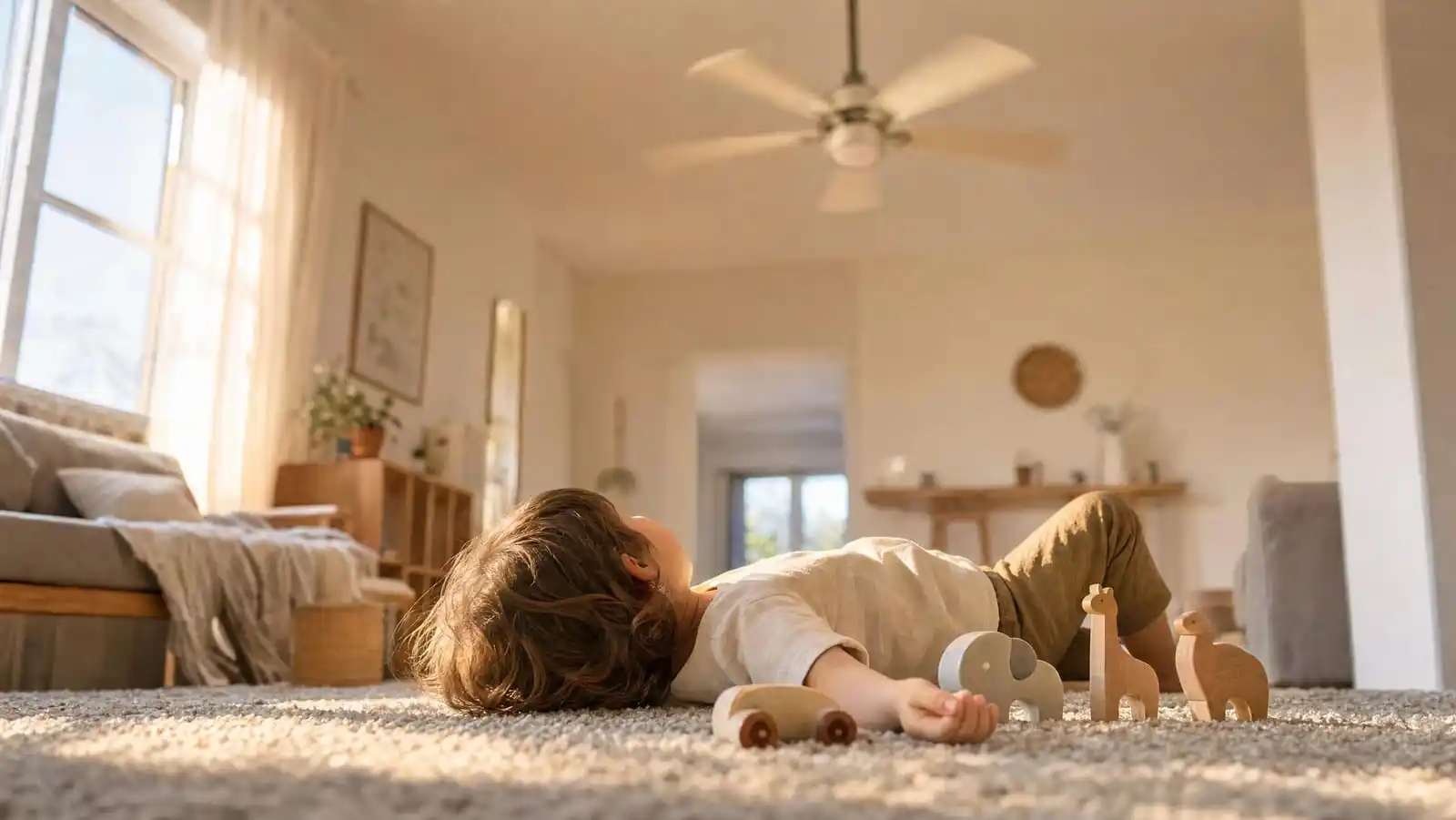
If you have ever found a child lying with their cheek on the carpet, watching the way the radiator catches the window, you have seen visual seeking without buying anything.
The Three Classes, and Which One You Actually Want
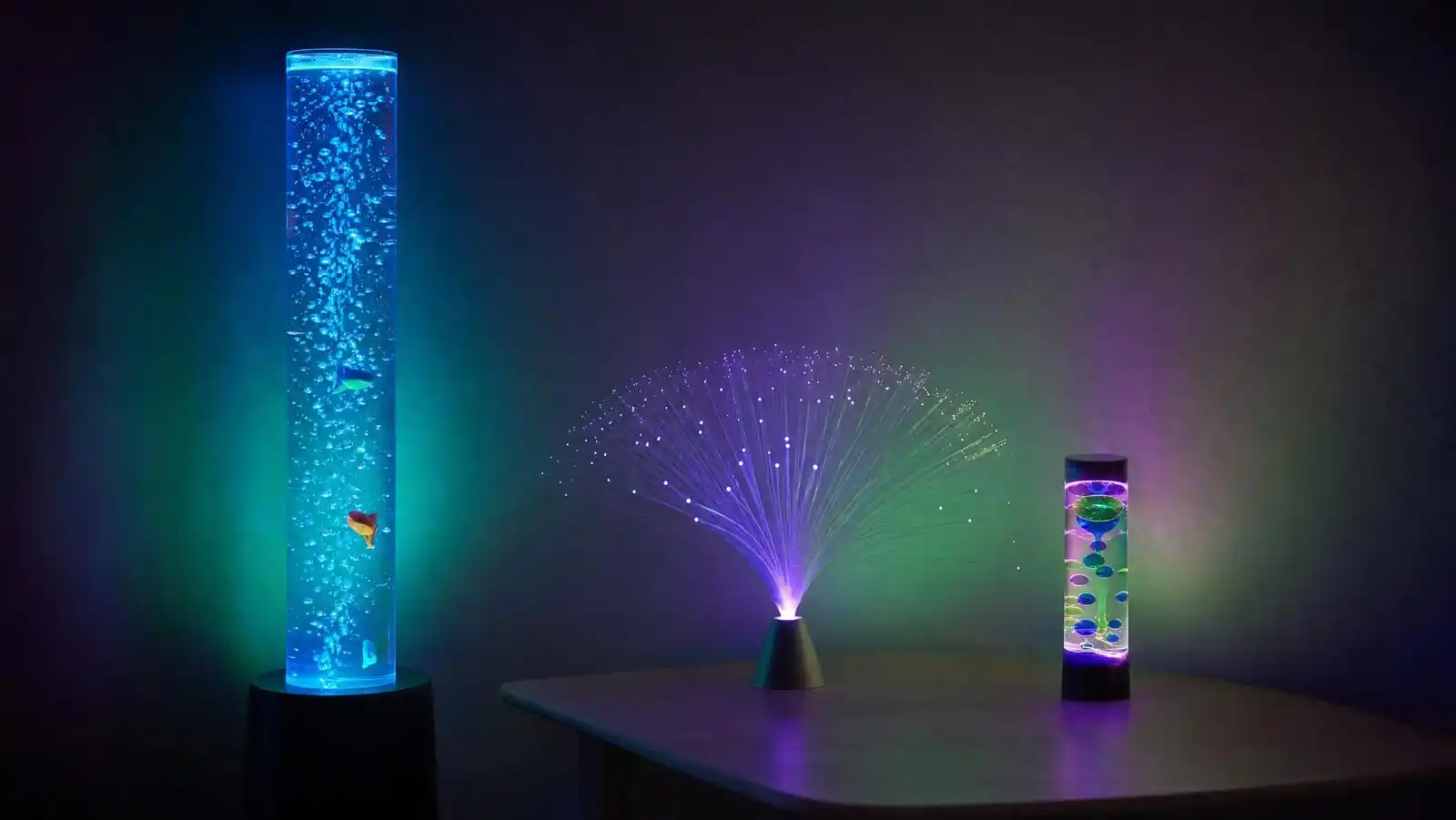
A liquid motion bubbler is a handheld object, $7.99 to $9.99. Coloured oil and water in a sealed tube, 2 inches by 5.75 inches on the cheaper of the two, no power and no switch. It stops by itself and your child flips it to restart. It emits no light, which makes it useless in the dark and the least intrusive thing here.
Fiber optics are handleable light, $14.99 to $93.59. The LED stays in a base or engine box and the light travels out along plastic strands that makers state stay cool. That is the reason usually given for fiber optics appearing in clinical sensory rooms: this is the only class where a child holds the light itself.
A bubble tube is furniture, $79.99 to $99.99. Four feet tall, water-filled, mains-powered, audible, strapped to a wall. Buying one is a decision about a room.
All three serve the seeking side of the picture: visual stimming and when to support it is the question underneath this article. A fourth option none covers is light thrown onto a ceiling — sensory light projectors, from under $10.
What do children actually pick? A 2024 study in Autism by Unwin, Powell, Price and Jones (PMC) watched 41 autistic children aged 4 to 12 in a room with a bubble tube, fiber optics, a tactile board and a touch, sound and light board. The bubble tube drew significantly more visits and longer duration than the fiber optics and tactile board, the study's "least popular items"; the touch, sound and light board was almost as popular, with the tube only marginally ahead of it. That is preference, not outcome, data, and the authors say the findings "require replication".
What Actually Matters in a Visual Stim Toy
Can you dim it?
The most useful control, and the one most makers skip. Of the four items here that emit light, only AKEPO states stepless dimming and only OUTREE adjustable brightness. PEN&H and Dreamtrue publish none: you get the brightness the maker chose.
Can you stop the motion, or hold one colour?
Auto-cycling colour is the common failure mode: a child who wants one steady blue cannot get it from a lamp that insists on seven. PEN&H states seven auto-changing colours and no way to hold one. AKEPO states over 16 million static colours and OUTREE 20 colour options, so one colour is selectable on both.
Is it silent?
A bubble tube has a pump. Dreamtrue states it is normal for the product to make white noise during use; OUTREE publishes no noise figure. A hum that drives a sound-sensitive child from the room cancels whatever the light was doing.
Can your child work it alone, and will it survive them?
PEN&H is the only light-emitting pick stated to run on batteries with no cable, so the only one that can go on a bed. No remote is listed for the Dreamtrue, so its settings live where the unit is; OUTREE and AKEPO need a remote or an app. A bubbler's seal is the part that must not fail, and BUNMO's sleeve is the only drop guard here.
Flash and strobe modes
OUTREE names flash and strobe among its four dynamic modes. Leave them off: a strobe gives nothing a steady colour does not, and there is a seizure consideration sourced below.
Does 'autism' on the box mean anything?
Three of these six listings put the word autism in the title, and one claims emotional-regulation benefits. None of it is a certification: the mandatory rules for children's products cover physical safety, like the CPSC's small parts ban at 16 CFR part 1501, not benefit.
1. Super Z Outlet Liquid Motion Bubbler — $7.99
The Super Z Outlet liquid motion bubbler is $7.99 as of October 2026 — the cheapest entry, and the right first purchase for most families.
From the maker: 2 inches wide by 5.75 inches long; one per order, two colours inside, the colour selected at random from stock; no power, gravity only. Super Z Outlet states the slow descending droplets can help improve visual tracking skills, and that it helps children with sensory or hyperactivity issues stay soothed and focused.
Those two sentences are marketing copy, not findings: we found no study testing a liquid motion bubbler on visual tracking or attention.
What it does not do. The colour arrives at random, a real problem for a child specific about colour, and there is no stated age rating. Check the current price on Amazon.
2. BUNMO Liquid Motion Bubbler — $9.99
The BUNMO liquid motion bubbler is $9.99 as of October 2026, list $11.99 — the one built for being dropped.
From the maker: a soft silicone casing with a textured surface; double-sealed; BPA-free and non-toxic; age guidance of 3 and over.
The $2 premium buys the seal twice over. The sleeve is also a second channel: many children want something to feel as well as watch, which is where textured sensory toys come in.
What it does not do. No light, and the 3-and-over guidance is BUNMO's own — a floor, not a target. Check the current price on Amazon.
3. PEN&H Sensory Fiber Optic Lamp — $14.99
The PEN&H sensory fiber optic lamp is $14.99 as of October 2026 — cordless, so it can go on a bed.
From the maker: battery powered with no cable required; seven auto-changing colours; a cone base with an LED source; and that it creates "a stimulating and a calming environment". Needing no mains lead is the real feature.
That quote is the category's incoherence in one sentence. Stimulating and calming are opposite outcomes, and which you get depends on the child, the hour and the room, not the lamp. The listing publishes no brightness figure, no dimming and no way to stop the cycle. Check the current price on Amazon.
4. Dreamtrue 4FT Sensory LED Bubble Tube — $79.99
The jump from $14.99 to $79.99 is where you stop buying a toy and start committing floor space, a socket, a wall fixing and a filling ritual. Before crossing it: does your child already seek slow repetitive visual motion, and is there a wall you will drill.
The Dreamtrue 4FT sensory LED bubble tube is $79.99 as of October 2026, list $89.99 — the entry price for a full-height tube.
From the maker: 4 feet tall, water-filled, colour-changing LEDs and small plastic fish. Dreamtrue instructs you to fill it leaving space at the top, soak the fish for five to six hours, then plug it in; states it is normal for the product to make white noise during use; and instructs checking for leakage, supplying fixers to secure it to a wall edge against collapsing on impact.
The most useful content in that listing is its own precautions. They describe what arrives: a column of water you fill yourself, beside a mains adapter, in a room with a child in it. Read "white noise" as a pump you can hear.
Dreamtrue also claims the tube helps children with autism and seniors with dementia focus and relax, promotes sensory development, reduces anxiety and improves emotional regulation. Treat every word as unsupported marketing copy: no regulator certifies a lamp as autism or dementia equipment, and the nearest evidence is a category review, not a product test.
What it does not do. Our data states no remote, so no brightness control and nothing changeable from across the room. The fish are small parts. Check the current price on Amazon.
5. AKEPO Fiber Optic Light Engine with 50 Strands — $93.59
The AKEPO fiber optic light engine is $93.59 as of October 2026 — handleable strands rather than a fixed object, and the pick we would choose if the budget reaches.
From the maker: a 10W RGBW engine driving 50 strands of 6.5 ft / 2 m each, described as 3 x 0.75 mm flash-point cables inside a soft 3.8 mm silicone tube, heat-sealed, waterproof and non-conductive; remote plus Bluetooth app control, stepless dimming, over 16 million static colours and 20 dynamic modes; and a sound-activated mode.
Two specs carry the recommendation, and neither is the colour count. Stepless dimming is the only continuous brightness control any maker here states, and because the LED stays in the engine box what reaches your child is cool silicone-sleeved strand rather than a light source. Switch the sound-activated mode off: it hands control to the room instead of the child.
What it does not do. This is a kit, not an object: 50 loose two-metre strands must be mounted, and app control means a phone. "Safe in a child's room" is AKEPO's own wording. Check the current price on Amazon.
6. OUTREE 4FT Bubble Tube with Wall Bracket and Remote — $99.99
The OUTREE 4FT sensory bubble tube is $99.99 as of October 2026 — the one with a bracket and a brightness control.
From the maker: 4 feet tall in durable acrylic with 12 LED light heads; a wall bracket, an adapter, 10 fish with swingable tails and 2 jellyfish; a remote with adjustable brightness and four dynamic modes named flash, strobe, fade and smooth; 20 colour options.
The $20 premium buys two unglamorous things. The bracket is supplied rather than improvised, and the remote carries a brightness control — on a four-foot lit column in a small bedroom, the most important setting on the device.
What it does not do. No noise figure is stated, it is still a four-foot water column someone must fill and fix, and the 12 fish and jellyfish are 12 small parts. Check the current price on Amazon.
What Visual Stim Toys Cannot Do
They do not treat autism or ADHD. The nearest evidence is a 2025 systematic review of multisensory environments in autism by Leonardi and colleagues in Autism (PMC), which screened 1,247 records and included 10 studies. It concluded that "MSE appears to be a useful tool for intervention in ASD", particularly for stereotyped and challenging behaviours, while reporting "insufficient evidence due to the paucity of literature" and a mean of 12.75 participants per study arm, range 3 to 41. Those studies used purpose-built rooms with staff and a plan, and the review never mentions bubble tubes or fiber optics: one object is not a Snoezelen room.
Nobody has established why a bubble tube works when it works. A 2026 F1000Research paper by Su, Shen and Koyama (article) states that "the precise mechanisms by which bubble tubes promote relaxation remain poorly understood", and its own study used 50 non-clinical adults and a dot-motion display as a proxy.
A bright moving light can over-stimulate rather than settle. Colour cycling and sweeping motion are input arriving whether your child wanted it or not.
They are not a sleep intervention. Lee and colleagues, in Physiological Reports in 2018 (PMC6295443), exposed 22 children of mean age 8.9 years and 20 adults to evening LED light of about 300 lux at eye level. Melatonin suppression averaged 58.1 percent in the children under 3000 K light and 81.2 percent under 6200 K, against 30.4 percent in the adults — though exclusions cut the adult groups hard and both samples are small, and 300 lux is a lit room, not a lamp.
What these products offer is comfort and something predictable to look at — a smaller claim than the listings make, and the true one. If visual seeking is new, escalating or displacing eating, sleeping or school, that is a conversation with your GP or an occupational therapist.
Four hazards worth more attention than the colour options
A four-foot water column near a child. Dreamtrue's instructions tell you to check for leakage before use and supply fixers to secure the tube to a wall edge; OUTREE includes a bracket. The CPSC's Anchor It! guidance is blunt — "Anchor TVs and furniture, such as bookcases and dressers, securely to the wall" — and in a July 2025 release the agency said campaign efforts contributed to "a nearly 50-percent decline in tip-over-related injuries and deaths in the U.S.". That campaign is about television and furniture tip-overs rather than bubble tubes — the release does not break the figure down by product — and no mandatory stability standard covers a bubble tube.
Liquid motion bubblers and mouths. These hold coloured oil and water behind a seal, and the hazard is a cracked tube rather than the toy as sold. The CPSC bans small parts in toys intended for children under three under 16 CFR part 1501, tested with a cylinder approximating a young child's throat, and a part that breaks off during testing counts. Water-filled toys have failed that way: in a June 2005 recall of about 1,500 water-filled spinning teethers, the CPSC stated that "the plastic spinner in the center of the teether can break, causing small beads to fall out", posing "a choking hazard to young children". BUNMO states ages 3 and over; our line is no bubbler for a child who mouths objects.
Flash and strobe modes, and photosensitive epilepsy. According to the Epilepsy Society's April 2025 factsheet, around 1 in 100 people has epilepsy and of those around 3 percent have photosensitive epilepsy, most who develop it are aged 7 to 19, and lights flashing "between 16 and 25 times a second are the most likely to trigger seizures" within a wider band of "between 3 and 30 hertz". Epilepsy is also more common in autistic people: a systematic review by Lukmanji and colleagues in Epilepsy and Behavior in 2019 (PubMed) pooled 74 studies covering 283,549 patients and found a median overall period prevalence of epilepsy in autism of 12.1 percent, while warning of "significant heterogeneity between studies". Neither figure means a sensory toy causes epilepsy: photosensitive epilepsy is a minority of epilepsy, and no maker here publishes a flash rate. But a strobe setting is a pointless risk when a steady colour sits on the same remote.
Small parts inside the tubes. Dreamtrue supplies plastic fish and OUTREE 10 fish plus 2 jellyfish. They live in sealed water, but tubes get opened to be topped up.
Frequently Asked Questions
Do bubble tubes actually calm autistic children?
Some children, some of the time, and the research does not settle it. The 2025 Autism review above included 10 studies and reported "insufficient evidence due to the paucity of literature". What exists on bubble tubes is engagement data: Unwin and colleagues found it the most-visited item in a four-item room, marginally ahead of a touch, sound and light board, and observed sensory seeking tracked time at the tube. Popular is not calming.
What is the best bubble tube for a sensory room at home?
The $99.99 OUTREE, because the bracket is in the box and the remote carries a brightness control. The $79.99 Dreamtrue does the same job for $20 less, but you supply the fixing and accept the brightness as built.
Are fiber optic lamps safe for a child to hold?
That is the design intent: the LED stays in the base or engine and only cool strands reach the child. AKEPO states its strands sit in soft 3.8 mm silicone tubing, heat-sealed, non-conductive and waterproof — maker statements, not an independent test. Two-metre strands are also a tangle hazard.
What age is a liquid motion bubbler suitable for?
BUNMO states ages 3 and over; our data gives no age rating for the Super Z Outlet unit. Given the CPSC small parts ban for under-threes and the recall history of water-filled toys, we would hold to 3 and over at a minimum.
Should a light up sensory toy stay on all night?
We would not leave one running on a sleeping, unsupervised child, and none of these six publishes an auto-off timer. The Physiological Reports study above found children's evening melatonin far more suppressed than adults' by light of about 300 lux — an argument for wind-down use and darkness for sleep.
Conclusion
Start at the bottom. The $7.99 Super Z Outlet bubbler tells you within two days whether slow motion in the hand is something your child moves towards; if it is, the $9.99 BUNMO survives being dropped. For light, the $14.99 PEN&H is the only cordless pick, and the $93.59 AKEPO is the best object here on the specs that matter.
Buy a bubble tube only if you want a room feature and have a wall for it: the $99.99 OUTREE over the $79.99 Dreamtrue for the bracket and the brightness control, and accept the pump.
Judge it on the boring specifications, and give it a fortnight. For the rest of this series, start with our visual sensory and light sensitivity guide.