This article contains affiliate links. We may earn a commission if you make a purchase through our links, at no extra cost to you.
Key Takeaways
- An Amazon "FL-41" lens is not the lens in the research. Clinical FL-41 comes from eye clinics, and the Moran Eye Center says those lenses "are made by hand, which means there can be more variability."
- The strongest controlled evidence is adult. A 2009 randomised crossover trial in Ophthalmology ran 30 patients with eyelid spasm through FL-41 and grey lenses.
- The children's trial is from 1991 and had 20 participants. Rose-tint migraine frequency fell from 6.2 attacks a month to 1.6.
- No trial has tested FL-41 in autistic children. The nearest used individually chosen tints in 14 autistic children, measuring emotion recognition.
- Irlen lenses are a separate, weaker claim. Four professional bodies state "the evidence does not support the effectiveness of tinted lenses and tinted filters" for dyslexia.
- Blue-light blocking is not a reason to buy. A 2023 Cochrane review of 17 trials in 619 adults found the lenses "may not" reduce computer eye strain.
- Six picks, $22.99 to $39.99 as of October 2026 — only the $31.98 Bloomoak states a child age range, 7 to 12.
Tinted glasses are worth trying for a light-sensitive child as a cheap comfort experiment, and worth no promises: the $25 rose lens on Amazon is not the precision tint used in the published studies, and nobody selling one publishes the numbers that would let you check. Try it the way you would try a hat. For the mechanism, see light sensitivity in autism and ADHD.
Migraine research surfaces here for a reason. According to UCLA Health, which quotes pediatric neurologist Sinifunanya Nwaobi, MD, PhD, on that overlap, one study it cites but does not name reported lifetime migraine prevalence of about 42 percent in people with autism against about 20 percent in controls, and the American Academy of Ophthalmology's 2005 article on photophobia states that "about 80 percent of people who have migraines have photophobia." The populations overlap; the products do not transfer automatically.
The Three Different Things Sold as "Tinted Lenses"
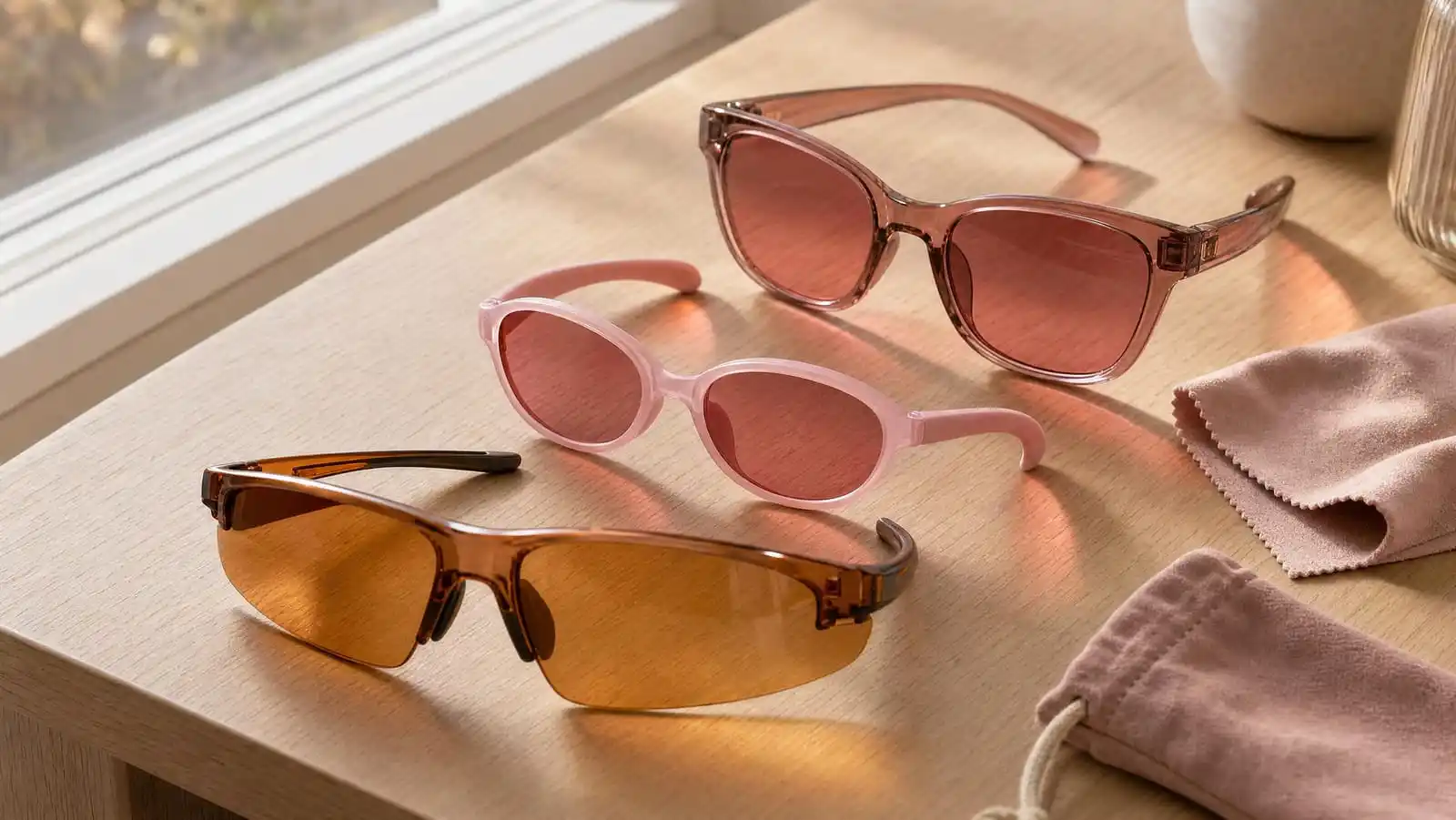
1. Clinical FL-41. A rose tint applied to lenses by an eye clinic. The Moran Eye Center at the University of Utah, which says it has studied and advocated the tint since the 1990s, calls FL-41 "a rose-colored tint first developed for patients with fluorescent light sensitivity and migraine," first described "in a research project in Birmingham, England, in the early 1990s." Per the Academy article, it "is a mixture of colors that blocks the blue-green wavelengths."
2. Amazon "FL-41". A pink lens with "FL-41" in the title. We could find no regulatory standard, specification or test method defining the term, and no listing below publishes a transmission curve. US rules for non-prescription sunglasses concern shatter resistance, not colour: 21 CFR 801.410 requires impact-resistant lenses. Nothing certifies what a tint filters, and neuro-ophthalmologist Kathleen B. Digre, MD, put it plainly: "Some lenses can look like FL-41, but they don't act like it."
3. Irlen lenses and coloured overlays. A separate commercial system sold for reading difficulty rather than light pain, with an evidence base contested in a way the photophobia literature is not — four professional bodies have said so in writing.
All three answer the same complaint, covered in why light sensitivity happens. Only one has been dyed to a spec and measured.
What the Evidence Actually Shows
FL-41 for photophobia and eyelid spasm
The best-designed study is Blackburn and colleagues' 2009 paper in Ophthalmology, on PubMed Central. A randomised crossover study put 30 patients with benign essential blepharospasm through FL-41 and grey lenses for two weeks each; a second ran electromyography on 26 patients and 26 controls. FL-41 cut mean blink rate by 7.0 blinks per minute against a rose tint built to look identical, and by 6.4 against grey.
They concluded that "FL-41 lenses provided both subjective and objective benefit to subjects with BEB" — while noting the subjective arm was unmasked, not all patients improved, and the tint is an adjunct to standard treatment.
That paper holds the one published number worth memorising. The clinical FL-41 lens transmitted 63.8 percent of visible light between 400 and 700 nm, against 58.8 percent for the lookalike rose and 51.2 percent for grey. The trial turned on a difference that small. No listing here publishes a comparable figure.
For children the trial is older and smaller. A 1991 study in Headache, indexed on PubMed, asked 20 children with clinically diagnosed migraine to wear a rose tint or a density-matched blue tint for four months. All improved at one month, but only the rose group held it: mean attack frequency fell from 6.2 a month to 1.6, tracking a fall in visually provoked beta activity on EEG. Twenty children, one centre, 35 years ago, measuring attacks rather than comfort.
The autism-specific gap
We could find no published trial of FL-41 in autistic children. Not a small one, not a negative one. That is the finding, and it should set your expectations.
The closest is Ludlow and colleagues' 2020 masked randomised study in Vision Research, archived at the University of Hertfordshire: 14 children aged 10 to 14 with autism and 14 IQ-matched controls watched social-interaction videos wearing either the colour each had chosen a month earlier as best for reading text, or a lens differing in chromaticity by 0.07. The autistic group did better on both tasks with their own optimal colour. Read what that is: 14 children, individually chosen precision tints, an emotion-recognition outcome rather than light comfort.
Coloured filters for reading: where the professional bodies stand
The joint clinical statement Learning Disabilities, Dyslexia and Vision — from the American Academy of Pediatrics, the American Academy of Ophthalmology, the American Association for Pediatric Ophthalmology and Strabismus and the American Association of Certified Orthoptists, revised in 2009 — states that "the evidence does not support the effectiveness of tinted lenses and tinted filters in these patients," and that many studies cited as proof of Irlen-lens efficacy were inconclusive.
The systematic review agrees. Griffiths, Taylor, Henderson and Barrett reviewed 51 published items containing 54 data sets in Ophthalmic and Physiological Optics in 2016, open access via White Rose. Most carried a high or uncertain risk of bias, results did not differ by system, and they concluded that "the use of coloured lenses or overlays to ameliorate reading difficulties cannot be endorsed," with benefits likely down to placebo, practice or Hawthorne effects. Note the outcome measured: reading, not pain from light.
Blue-light blocking: the claim to ignore
Most listings below also sell themselves as blue-light glasses. The 2023 Cochrane review by Singh and colleagues, in the Cochrane Database of Systematic Reviews, pooled 17 randomised trials with 619 adult participants across six countries: the lenses "may not" reduce eye strain from computer use short-term, sleep effects were indeterminate, and no trial evaluated retinal protection.
The sleep claims on these listings go well past the evidence
Solmoon states that its deep red lens blocks blue and green wavelengths up to 570 nm and supports natural melatonin production and restorative sleep. That is marketing copy, not a result. What has been measured is light, not lenses — in a 2018 study in Physiological Reports by Lee and colleagues, on PubMed Central, evening LED light at roughly 300 lux suppressed melatonin in 22 children by 58.1 percent at 3000 K and 81.2 percent at 6200 K, against 30.4 percent in 20 adults. Dimming the room at bedtime has evidence behind it. A red lens does not inherit it.
What to Look For (and What No Listing Tells You)
Two light pairs beat one dark pair. A clinic runs a tint as a trial, stepping through densities to find the lightest that helps; one blind purchase cannot.
Frame geometry matters more than the marketing suggests. Light from the side slides past a flat lens, which may be part of why a child can wear tinted glasses under a strip light and still squint.
Fit is where this category falls down. Five of six products here are adult-sized; one states a child range. Nothing in this bracket fits a four-year-old, and a pair that slides down a small nose is gone by break time.
Whether your child will actually wear them. If your child has ever worn a baseball cap through an entire indoor birthday party, you know what the tint is being asked to replace. Let it be their choice, and make the same case at school you would make for ear defenders, which is the same accommodation conversation on the auditory side.
None of these are prescription lenses, so they do not correct vision or replace an eye exam. And no maker here publishes a transmission curve — "FL-41" on these boxes is a colour description, nothing more.
1. Solmoon FL-41 and Deep Red 2-Pair Set — $22.99
The Solmoon two-pair set is $22.99 as of October 2026, the cheapest way to find out whether a rose tint does anything at all.
From the maker: an FL-41 salmon lens for daytime and a deep red lens for evening, the red one stated to block blue and green wavelengths up to 570 nm.
What it does not do. Solmoon markets it for adults, so it is not sized for children, and the melatonin claim is the maker's. Check the current price on Amazon.
2. MAXJULI FL-41 Rose Indoor Glasses — $25.99
The MAXJULI rose indoor pair is $25.99 as of October 2026 — one plain pair, nothing to keep track of.
From the maker: a rose tint stated to selectively reduce blue and high-stimulus light from fluorescent, LED and digital screens, on a non-prescription lens.
What it does not do. Adult sizing again, and it promises relief of eye strain, headache and sleep trouble in terms no eyewear maker can support — see the Cochrane review above.
3. BRADDELL FL-41 Wrap-Around Sports Safety Glasses — $27.95
The BRADDELL wrap-around pair is $27.95 as of October 2026 in Pro Medium — the only shape here for light from the side.
From the maker: a sports-grade anti-UV polycarbonate lens in a deep rose FL-41 tint with a wrap-around frame. BRADDELL states it minimises migraine light sensitivity and photophobia, which is the maker's claim and not a tested result for this lens.
What it does not do. BRADDELL gives no age range, so Pro Medium may suit an older child or a small adult — we would not assume it fits a particular age, and the wrap shape is the only part you can verify by looking.
4. Bloomoak Kids Pink Tinted Glasses — $31.98
The Bloomoak kids pair is $31.98 as of October 2026 — the only pick with a stated child age range, and where we would start for a school-age child.
From the maker: lenses Bloomoak describes as Fluorescent-41 tinted, designed to reduce visual stimulation from bright lights while maintaining natural colour perception; a lightweight flexible frame; a stated range of ages 7 to 12.
What it does not do. Bloomoak publishes no transmission curve and names no tint standard, so "Fluorescent-41" is a description, not a specification. The age range also exposes this category's gap: below about seven there is no sized option at this price — the argument for going through an optometrist. Check the current price on Amazon.
5. MOAROMAS Indoor FL-41 and Outdoor FL-60 2-Pack — $35.99
The MOAROMAS two-pack is $35.99 as of October 2026 — an indoor pair and an outdoor pair in one box, which is sensible: a tint dark enough for a playground makes a classroom gloomy.
From the maker: an indoor pink lens described as FL-41 and an outdoor brown lens described as Fluorescent-60, the pink positioned for mild sensitivity and the brown for intense light. MOAROMAS states the tints help manage photophobia and migraine-related light sensitivity, which is again the maker's claim rather than a tested result for these lenses.
What it does not do. We could find no clinical literature or lens designation using "Fluorescent-60" or "FL-60" — it appears to be this seller's own label, not a second standard. Adult sizing, no transmission data.
6. Murddoa 2-Pack FL-41 at 25% and 50% Tint — $39.99
The Murddoa two-density pack is $39.99 as of October 2026 — the nearest thing here to a clinic's step-wise trial.
From the maker: two pairs at stated densities of 25 percent and 50 percent, filtering wavelengths of 480 to 520 nm in sunlight, fluorescent light and screens, which Murddoa says "may be associated with" visual discomfort; UV400 protection; 30-day returns.
It is the most checkable listing here. A stated density lets you start at 25 percent and move up only if needed, and the 480 to 520 nm band sits in the blue-green region both the Academy article and the 2009 Ophthalmology paper describe clinical FL-41 as attenuating — same direction, no published figure for depth.
What it does not do. Adult sizing, so this is a teen or parent purchase, at roughly twice the Solmoon set for the same number of lenses. Check the current price on Amazon.
What Tinted Lenses Cannot Do
They do not treat autism, migraine or photophobia. The 2009 trial measured blink rate in adults with eyelid spasm; the 1991 trial measured migraine attacks in 20 children. Neither tested autism, and no regulator approves a tint as autism equipment. A lens can make a room more comfortable, which is a much smaller claim.
Changing the room beats filtering the child. A tint travels with your child, but it sits downstream of the problem. Moving a desk from a window or replacing a flickering tube helps everyone and never gets left in a bag — see fixing the lighting itself.
A child who refuses to wear them gets no benefit, and refusal is a common outcome parents report. Pink lenses get commented on, and a nine-year-old's willingness to look different at school matters more than tint density.
Dark tint worn constantly indoors is worth asking a clinician about
Clinicians raise the question of dark adaptation with habitual indoor tint use. In the Academy of Ophthalmology's photophobia article, Kathleen B. Digre, MD, advises against dark glasses indoors: "People who wear really dark glasses can actually dark-adapt themselves and increase their photosensitivity." Sunglasses outdoors, she says, are fine. That is a clinician's caution from 2005 rather than a measured effect in children — but if your child now wears dark lenses indoors most of the day, raise it with an eye-care professional.
Getting This Done Properly Through an Optometrist
Book the eye exam first. Light sensitivity has ophthalmic causes and some are urgent. A 2021 case report in the Australian Journal of General Practice by Ashraf and Chakrabarti, published by the RACGP, describes an eight-month-old whose watering eyes, photophobia and cloudy cornea pointed to congenital glaucoma, with intraocular pressures of 37 and 45 mmHg. The authors note that a corneal diameter above 12 mm under age one requires urgent referral.
If a tint is still the plan, ask for a trial rather than a product: can you tint my child's own lenses, what densities can we try, can we start with the lightest. Moran notes FL-41 goes on most lens materials with no prior coatings, that the lenses are made by hand, and that most plans, including Medicare and Medicaid, do not cover filters. Worth raising at the same appointment is the overlap between light sensitivity, migraine and ADHD, because an episodic pattern with pallor or nausea is a different conversation.
Signs that need an eye appointment, not a tint
The Academy publishes a four-letter checklist for parents, RSVP, credited to pediatric ophthalmologist Stephen N. Lipsky, MD: Redness, Sensitivity to light, Vision change, Pain. In the Academy's guidance for parents, Dr. Lipsky says that with any one of these "it's a good idea to make an appointment with an ophthalmologist," and with "two or more of these issues, they may need more immediate medical attention."
Frequently Asked Questions
Are light sensitivity glasses worth it?
As a cheap experiment, often yes. As the intervention in the research, no — you are not buying that lens. The support is a 2009 crossover trial in 30 adults with blepharospasm and a 1991 trial in 20 children with migraine, both using clinic-dyed tints. At $22.99 to $39.99 the downside is small; judge it on whether your child wears them.
Are FL-41 glasses from Amazon the same as clinical FL-41?
There is no way to know, which is the point. We could find no standard or test method defining FL-41, no listing here publishes a transmission curve, and Moran notes that even clinical FL-41 lenses "are made by hand, which means there can be more variability in the appearance of the lenses." Dr. Digre's warning is the one to keep: "Some lenses can look like FL-41, but they don't act like it."
Do Irlen lenses help autistic children?
The evidence does not support buying them for reading. The joint statement from the American Academy of Pediatrics, the American Academy of Ophthalmology, the American Association for Pediatric Ophthalmology and Strabismus and the American Association of Certified Orthoptists says the evidence does not support tinted lenses or filters for learning disabilities and dyslexia, and the 2016 review found such lenses "cannot be endorsed" for reading.
What are the best glasses for autism light sensitivity?
For a school-age child, the only pick here with a stated child age range is the $31.98 Bloomoak pair for ages 7 to 12. For a teenager finding their own density, the $39.99 Murddoa pack at 25 and 50 percent is nearest to a trial. If light arrives from the side, the $27.95 BRADDELL wrap-around is designed for it. Below about seven, see an optometrist.
Conclusion
Three products, three evidence bases, one shelf. Clinical FL-41 has small, genuine support in adults with eyelid spasm and older support in children with migraine. The Amazon version is a rose lens with the same name and no published spec — a $25 comfort experiment, not the studied intervention. Irlen lenses are a reading claim four bodies and a systematic review decline to endorse. Nobody has trialled any of it in autistic children.
So buy it as a hat, not a treatment: lightest tint first, your child's choice, an eye exam before any of it. For the lighting changes and routines that make bright rooms survivable, our complete visual sensory guide covers the rest.