This article contains affiliate links. We may earn a commission if you make a purchase through our links, at no extra cost to you.
Key Takeaways
- Try the free fixes first. Half the overheads off, the desk moved, one task lamp on the page: free, and reversible by Friday.
- Flicker frequencies are specific, and the modern case is under-studied. A 2016 US Department of Energy report ties 3 to 70 Hz to photosensitive epilepsy and 100 Hz to headaches; a 2026 review found no included studies on modern LED lighting or on flicker between 100 and 200 Hz.
- Glare is geometry, not brightness. Canada's CCOHS advises seating so windows and tubes run parallel to the line of sight, with no fixture in front or overhead.
- If you do change bulbs: 2700K and frosted. The Philips A19 four-packs here are $19.99 and $23.99 as of October 2026; dimmable is wasted money with no dimmer.
- At school, fire rating stops covers going up. OCTO LIGHTS states NFPA 701 certification at $36.99 as of October 2026; the $9.99 pack states no rating.
- Nothing here treats autism, ADHD or SPD. It changes the room — a smaller and more honest claim.
The lighting change that helps most often costs nothing: switch off half the overhead lights, put one lamp on the desk, and move the desk out of the window's reflection. Change the bulbs last, not first. The bulb aisle is where almost every parent starts.
Fluorescent light sensitivity in autism, ADHD and SPD gets described to us as a bulb problem, and our guide to light sensitivity in autism and ADHD covers why it rarely is. It is three problems in one coat — flicker, spectrum and glare — two of which are free to fix.
The Three Things About Light That Actually Bother People
Three complaints hide inside "the lights hurt", which is why why light sensitivity happens is worth ten minutes before you spend anything.
Flicker, and the hole in the evidence
Flicker is the mechanism everyone invokes, and the evidence is narrower than the internet suggests. The 2016 US Department of Energy and Pacific Northwest National Laboratory report Characterizing Photometric Flicker states that "light sources with low-frequency flicker, such as 3 to 70 Hz, can have serious neurological consequences, including triggering photosensitive epilepsy, for some populations," and that "frequencies of 100 Hz, which occur with 50 Hz power in Europe, are recognized as contributing to headaches and migraines." It names "autistic individuals" first among the groups most affected. In North America the equivalent figure is 120 Hz, twice the 60 Hz supply.
Writing for the Association of Optometrists in Optometry Today, Professor Arnold Wilkins of the University of Essex reports that "one study found incidences of headaches and eye strain in a London office halved when the fluorescent flicker was reduced" — adults in offices, not autistic children.
Then the gap. The 2026 systematic review of light and sound hypersensitivity in autism by Ríos Llamas, Camacho Vega and Delgadillo Ramos, published in Frontiers in Psychiatry, synthesised 29 studies, only two of them visual alone, and states that "no studies have evaluated modern LED lighting, photophobia, or flicker frequencies between 100-200 Hz."
So LED is not automatically better. The DOE and PNNL report is explicit that for LED sources flicker "is generally determined by the LED driver or by the dimmer and driver pairing," and that "manufacturers rarely report flicker characteristics". A cheap dimmed LED can modulate worse than the tube it replaced.
Colour temperature and spectrum
Schools and kitchens mostly run cool, blue-rich light at 4000K to 6500K; living rooms run 2700K. What is established is narrow. In its 2019 LED review, ANSES, the French agency for food, environmental and occupational health safety, recommended limiting "the use of LED devices with the highest blue-light content" especially for children, who it calls "a particularly susceptible population". The American Academy of Ophthalmology is the counterweight, stating there is "no scientific evidence that blue light from digital devices causes damage to your eye". For autistic pupils specifically we found no trial establishing a colour temperature at all. Warm is a comfort judgement, not a finding.
Glare and contrast
The most under-rated of the three, and the most often free. The Canadian Centre for Occupational Health and Safety separates direct glare — "very bright light from poorly positioned light fixtures" — from reflected glare, "light reflected from polished, shiny or glossy surfaces."
Read that as geometry. A bare bulb, a window reflection on the whiteboard, a downlight on a polished floor: the lamp is no brighter, but it is now pointing at a child. Moving the child or the surface fixes it; a new bulb does not.
The Fixes That Cost Nothing
Work down this list and stop when things improve.
1. Switch off half the overhead lights. Most classrooms are lit for a cleaning crew, not one child doing homework. CCOHS recommends "using several small low-intensity light fixtures rather than one large high-intensity light fixture" — in a room you cannot rewire, kill one bank and watch what happens.
2. Light the task, not the room. CCOHS lists "using adjustable local lighting with brightness controls" as a glare control. A lamp on the page lets the ceiling go dark — the opposite of the instinct to add light when a child struggles to read.
3. Move the desk out of the glare path. CCOHS advises positioning a work station "so that windows and fluorescent light tubes are parallel to the worker's line of sight" and so "that the light fixtures are NOT in the front or directly overhead." So: not under a fixture, not facing a window, not facing the brightest wall. If the window is the problem all day, that is a curtain job — see blackout solutions for light-sensitive kids.
4. Reduce the contrast before the light. Screen brightness to the lowest readable setting, and matte instead of glossy — CCOHS recommends work surfaces "that are matte (less reflective) where possible". A laminated worksheet under a downlight is a mirror; plain paper is not.
5. Let your child wear a cap or hood indoors. Free, and usually refused on grounds of appearance rather than function: a brim takes the fixture out of the field of view. If you have ever been asked to let a child read on the kitchen floor with the big light off, they had worked this out without us.
6. Replace the failing tube before you write off the room. CCOHS notes "old bulbs tend to flicker more and they are not as bright," and advises checking the fixture, especially its ballast.
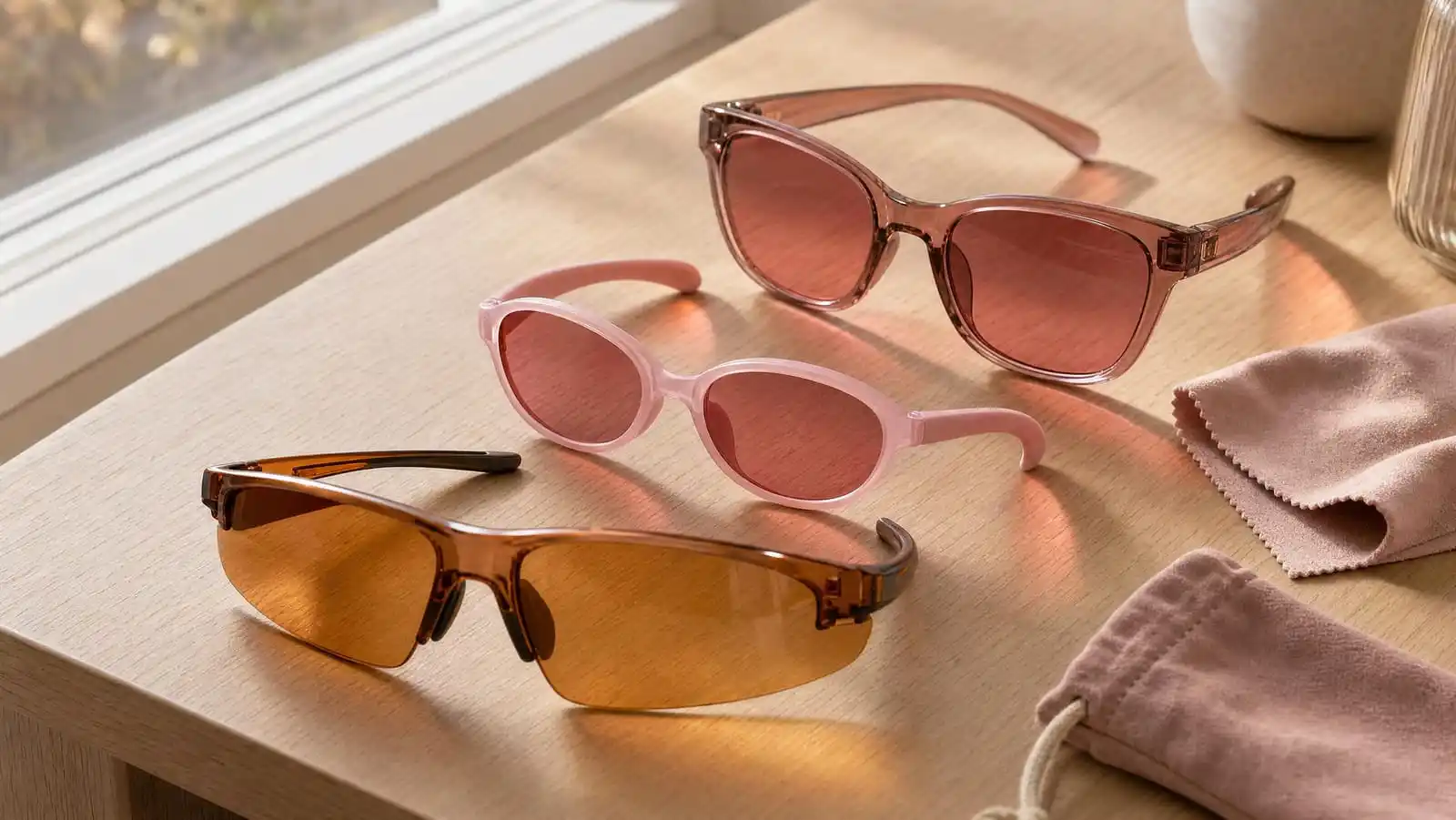
Changing the room beats filtering the child's eyes wherever you have control. Control is what you do not have in somebody else's classroom, which is where light sensitivity glasses and tinted lenses become the fallback rather than the first move. In the focus-group study by Parmar and colleagues, published in Frontiers in Psychology in 2021, where 18 autistic adults reported that "bright, flickering, fluorescent, 'strip,' and 'spot' lighting caused discomfort", the authors note that "sunglasses and photochromic lenses are helpful as they reduce light levels" while being only a partial answer.
A visibly strobing tube is a different problem
A tube that is visibly flickering or failing is worth reporting rather than tolerating. The UK Epilepsy Society lists "lights flickering, such as faulty fluorescent tubes" among possible triggers for photosensitive seizures, and states "between 3-30 hertz (flashes per second) are the common rates to trigger seizures" — well below the 100 to 120 Hz of a working tube, but a band a dying one can wander into.
Both halves matter. The Epilepsy Society states "around 1 in 100 people has epilepsy and, of these people, around 3% have photosensitive epilepsy". Epilepsy is itself more common in autistic people: a 2022 review by Zarakoviti and colleagues in the Journal of Autism and Developmental Disorders, on PubMed Central, describes it as "affecting between 12.1% and 17.2%" of autistic people "compared with 0.5-1% in the general population". Room lighting does not cause epilepsy — but new episodes of staring or unresponsiveness belong with a doctor.
Changing the Bulbs
Only now. The checkable specifications are colour temperature, the finish of the envelope, and whether the circuit has a dimmer.
Where there is a dimmer, the Philips Warm Glow dimmable A19 four-pack is the pick, at $23.99 as of October 2026. Philips states 8.8W replacing 60W, 800 lumens, a frosted 2700K soft white envelope on an E26 base and a life up to 15,000 hours. The spec that matters is the dimming curve: Philips states the light warms from 2700K down to 2200K as it dims, rather than holding a cold tone at low output the way cheap dimmable LEDs do. Philips calls the dimming flicker-free and silent and says its products meet its own EyeComfort criteria — its language, not an independent measurement.
With no dimmer, which is most rooms, buy the cheaper non-dimmable version. The Philips frosted non-dimmable A19 four-pack is $19.99 as of October 2026, same stated 8.8W, 800 lumens and 2700K. The frosted envelope does the work: it spreads the source instead of leaving a hard bright point.
Recessed cans take the BR30 shape, and a can aimed at a glossy floor is a common unrecognised glare source. The Philips Warm Glow dimmable BR30 three-pack is $18.49 as of October 2026, stated at 7.2W replacing 65W, 650 lumens and 2700K — the lower output is a feature if the goal is less light.
Covering the Fixture at School
A parent cannot rewire a classroom, so the realistic ask is fabric over the panel above one child's desk.
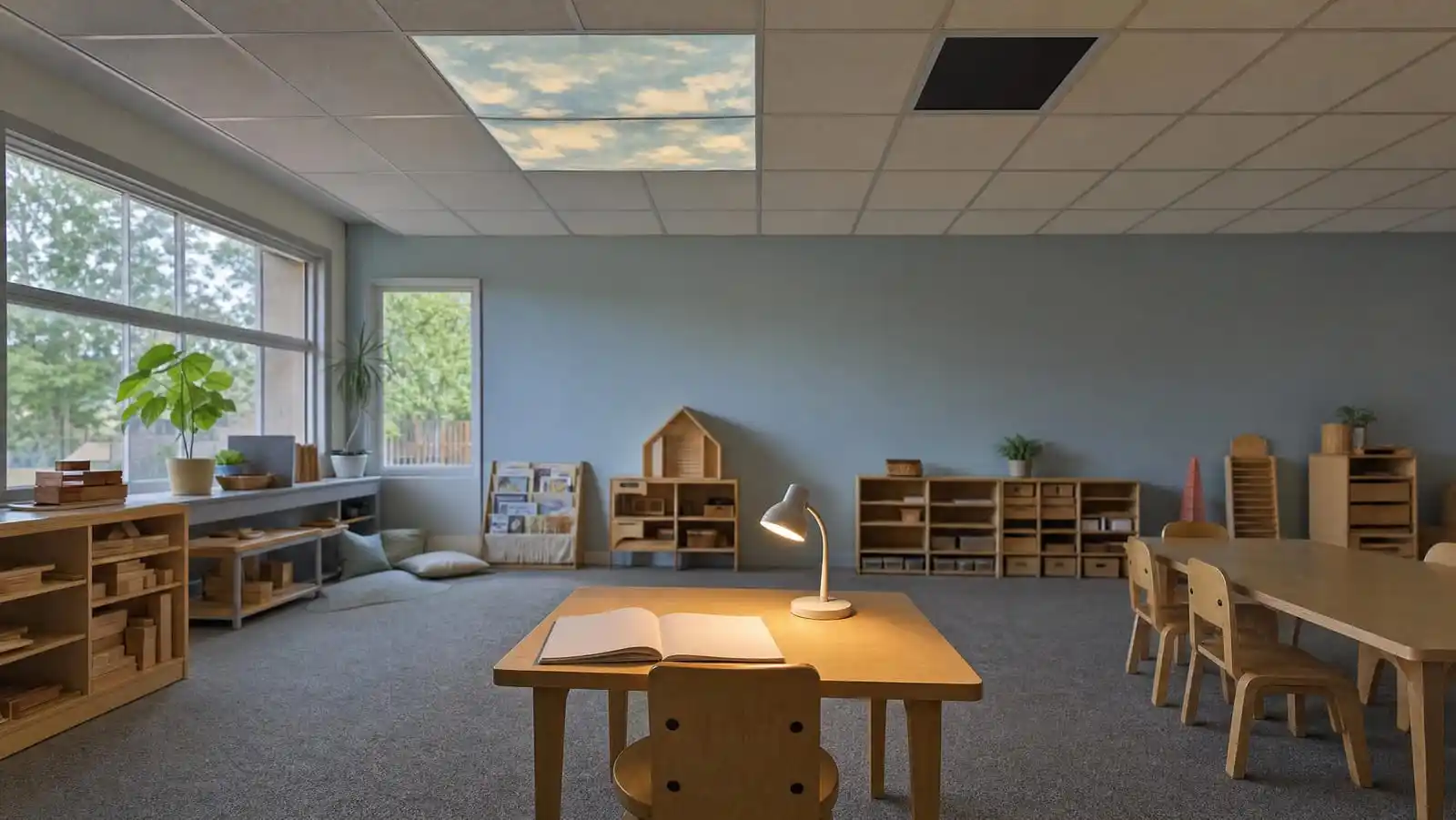
Lead with the fire rating, because that is the objection that actually stops these. The OCTO LIGHTS magnetic cloud light covers, a four-pack at $36.99 as of October 2026, are the classroom pick for one reason: the maker states the fabric is NFPA 701 certified. It also states ten sewn-in magnets per cover for a standard 2x4 fixture, and that the covers are machine washable.
NFPA 701 is the National Fire Protection Association's Standard Methods of Fire Tests for Flame Propagation of Textiles and Films — a laboratory flame-propagation test for fabrics and films, not a fire-resistance rating. Why a facilities manager cares: the California Office of the State Fire Marshal states it has authority in places of public assembly and schools "to require decorative materials and fabrics" to be "made from a nonflammable material, or treated with approved flame retardant chemicals". Requirements vary by district, and the certification is the maker's claim — ask which standard the office needs documented.
The cheaper option, with the caveat. The ANGSYLTH magnetic fluorescent light covers are a two-pack at $9.99 as of October 2026, each 4 by 2 feet — enough for the two panels over one desk. No fire rating is stated anywhere in the listing, and unrated fabric over a school fixture is what a facilities manager will take down.
What any cover does and does not do. It softens direct glare, reduces light output — the second objection a teacher raises — and does nothing about flicker, which passes through fabric. Nor is there good evidence they change behaviour: in a four-child reversal study by Pence, Wagoner and St. Peter, published in Behavior Analysis in Practice in 2019, "on-task behavior decreased and stereotypy increased with the addition of the light covers for all four participants". One small study, but the only experimental test we found. Hence two panels over one desk rather than a whole room, alongside the other visual sensory tools for the classroom.
Asking School for a Lighting Change
Ask the teacher first, then the SENCO, 504 coordinator or case manager, then facilities — who control the switches. Ask in order of how likely you are to get a yes:
- A seat move. Free, immediate, needs only the teacher.
- Switching off one bank of overheads.
- A desk lamp, or permission for a cap indoors.
- Covers over the two fixtures above the desk — slowest, because of fire-code sign-off.
None of that requires a diagnosis. If the informal route fails, a lighting or seating accommodation is the kind of thing that can be written into a plan: the US Department of Education's Office for Civil Rights FAQ on Section 504 explains that public schools must provide a free appropriate public education made up of regular or special education plus "related aids and services designed to meet the individual educational needs of students with disabilities". The same FAQ takes the case of a student who has a disability named in the IDEA but does not need special education, and answers that the student "may be eligible for services under Section 504" and "may receive adjustments in the regular classroom". Whether a change belongs in an IEP, a 504 plan or neither is for the school team to decide with you there.
A free way to guess whether flicker is the problem
Wave a pencil quickly back and forth under the fixture. Under a steady light you see a smooth blur; under a modulating one you may see a fan of separate images — what the DOE report above calls the stroboscopic effect, where flicker is "detected indirectly" because "an object lighted with flickering light is moving relative to the observer's gaze".
It is not a measurement — that report notes there is no standardised test procedure for flicker — so treat a positive result as a reason to try the fixture off for a week.
Frequently Asked Questions
Are LED lights better than fluorescent for autistic children?
Not automatically, and it depends on the driver. The DOE and PNNL report states that for LED sources flicker "is generally determined by the LED driver or by the dimmer and driver pairing", and that manufacturers "rarely report flicker characteristics". A good LED on a compatible dimmer is likely steadier than an old magnetically ballasted tube at 120 Hz; a cheap one dimmed low can be worse. Since the 2026 Frontiers in Psychiatry review found no studies on modern LED lighting, nobody has the autism-specific answer.
What are the best light bulbs for light sensitivity?
Warm colour temperature, a frosted rather than clear envelope, and dimmability only if the circuit has a dimmer — which lands on 2700K frosted bulbs such as the Philips A19 four-packs above, at $19.99 and $23.99 as of October 2026. ANSES's 2019 recommendation supports warm over cool; no published work makes a figure correct for autism.
Do fluorescent light filters for classrooms actually work?
They diffuse a bright panel, which addresses glare, and reduce light output — sometimes the point, sometimes the objection. They do nothing for flicker, and the only experimental test we found — the four-child Pence study cited above — reported on-task behaviour getting worse rather than better with covers fitted. Treat them as a comfort measure for glare, not an intervention.
How do I tell whether flicker or glare is bothering my child?
Glare is position-dependent: it changes when your child moves seat, turns around, or the sun moves. Flicker is room-dependent and worsens with time in the room — headache, eye-rubbing, a wish to leave. The pencil test above costs nothing. Persistent headaches, eye pain or any vision change belong with a GP or an optometrist.
Conclusion
Spend the free evening first. Switch off half the overheads, move the desk so the window and the tubes run alongside the line of sight rather than into it, add one lamp at the page, take the screen brightness down, let the cap stay on. Give it a fortnight and watch which rooms stop being a fight.
If anything is left over it is usually one of two things. At home, 2700K frosted bulbs: the $19.99 Philips non-dimmable four-pack, or the $23.99 Warm Glow version if there is a dimmer. At school, two covers over the panels above one desk — the $36.99 NFPA 701-rated OCTO LIGHTS pack being the version a facilities manager is likeliest to allow. All prices as of October 2026.
The evidence is thin enough that the honest version is a careful experiment on one child, not a specification. For the rest of the series, start with our complete guide to visual sensory support and light sensitivity.