This article contains affiliate links. We may earn a commission if you make a purchase through our links, at no extra cost to you.
Key Takeaways
- Buy for the floor, not the ceiling. What matters is how dim and how slow it goes, and none of these six publishes a lumen figure.
- Price does not track usefulness. The ladder runs $9.99 to $69.99 as of October 2026, and the $69.99 FELITE's projection is the most detailed here — also the most to look at.
- Only one maker publishes a noise figure. Growalleter states under 10 decibels on its $15.99 unit — its own number. Motor hum is what drives a sound-sensitive child out.
- One pick can be run by a child alone. One Fire states a 2400mAh battery, a 0.55 lb body and three labelled buttons at $22.49; the rest need a remote, a cable, or both.
- A projector is not a sleep intervention. In a 2018 study in Physiological Reports, evening LED light at about 300 lux suppressed children's melatonin by 58.1 to 81.2 percent, against 30.4 percent in adults.
- The evidence base is thin, and "autism" on the box is a marketing word. A 2025 systematic review in Autism screened 1,247 records, included 10 studies and found insufficient evidence on most outcomes; no regulator certifies a light as autism equipment.
The best sensory light projector for autism is the dimmest, slowest one your child will tolerate — not the one with the most colours, modes or discs. Sensory differences cut both ways, so start with visual sensory input and light sensitivity: the same drifting ceiling that settles one child is a reason for another to keep looking instead of sleeping.
Every listing here leads with a number — 15 colour patterns, 78 modes, 16 discs, 29 sounds — and none of them tells you the two things that decide whether a projector settles a child or winds them up: the lowest brightness it holds, and whether the motion can be stopped.
The state of the research first. Leonardi and colleagues' 2025 systematic review of multisensory environments in autism, in Autism (full text on PMC), screened 1,247 records and included 10 studies. It found they "could be a useful tool to modulate aggressive and stereotyped behaviors in autistic individuals" while stating that "there is insufficient evidence to conclude on the efficacy of multisensory environment" for other targets, and noted that "sample sizes are often small and poorly characterized". A $20 projector is not a therapy room, and we found no study testing one as an intervention.
What Actually Matters in a Sensory Light Projector
Brightness, and whether it goes low enough
A projector competing with the hall light does nothing; one that is the brightest object in a dark room at 9pm does too much. No maker here publishes a lumen output or a minimum brightness, so the only test is the real room with the lights off.
Colour temperature is the part you can control. In its 2019 review of LED lighting, ANSES, the French national agency for food, environmental and occupational health safety, recommended limiting "the use of LED devices with the highest blue-light content" especially for children, and noted that decorations and toys "may emit particularly blue-rich light and belong to risk group 2" while being "not covered by the current regulations".
Whether that threatens a child's retina is genuinely contested: the American Academy of Ophthalmology states there is "no scientific evidence that blue light from digital devices causes damage to your eye", while ANSES "confirms the toxicity of blue light on the retina" from high-blue sources. ANSES also calls children "a particularly susceptible population" because their eyes "do not fully filter blue light". On sleep the two agree — ANSES says "even very low levels of exposure to blue light in the evening or at night disrupt biological rhythms and therefore sleep". So: warm colours, lowest setting, lens out of the line of sight.
Whether the motion can be stopped
A pattern sweeping the ceiling is input arriving whether your child wants it or not — something to track rather than rest against. So look for a static mode named in the specs: Growalleter lists "Static" among four modes, Emberela lists static and dynamic settings, and One Fire has a dedicated rotation button. Where a sheet lists only patterns and colours, assume the motion is fixed. Leave flicker alone at bedtime, too: ANSES recommends minimising "the temporal modulation of the light emitted by all light sources", which it associates with headaches and visual fatigue, and Growalleter's mode list includes a Flicker setting.
Motor noise, because a hum defeats the point
A rotating projector puts a small motor a metre from your child's head. Growalleter states under 10 decibels, One Fire describes its motor as whisper-soft with no clicking or hum, Emberela states whisper-quiet operation — maker claims, unverified, only one with a figure. If noise decides it, prefer a unit you can run static — a stopped motor is silent.
Star points versus diffuse water and nebula
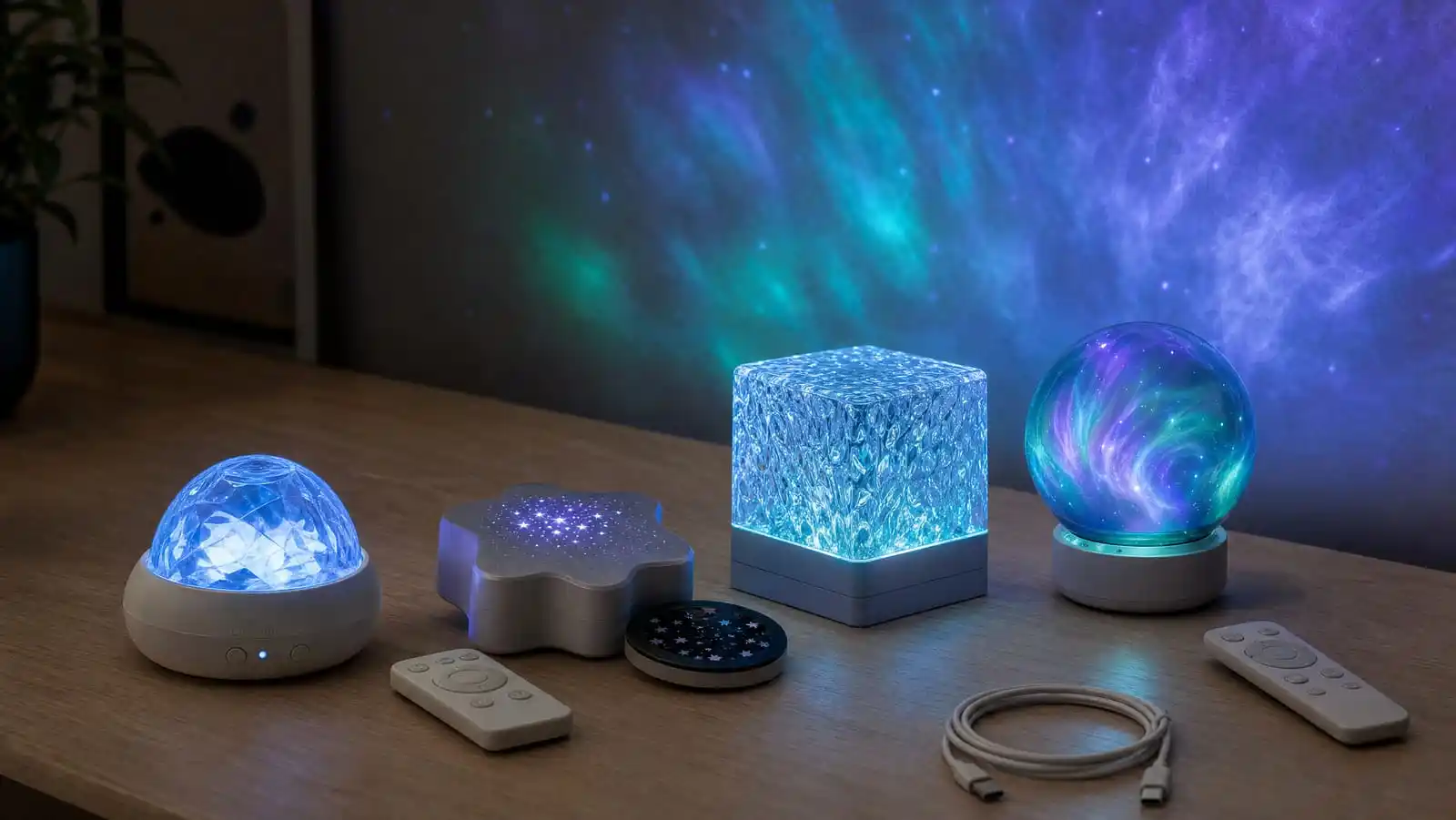
Star points are detail, and detail invites counting and scanning; a water ripple or nebula swirl gives less to fix on. Emberela's Orblux is the only pick advertising the absence of points, the maker stating it projects a swirl "without star visuals". FELITE and One Fire go the other way, at 16 discs and 6 films.
Power, timer, and whether your child can work it alone
Two picks state rechargeable batteries: One Fire at 2400mAh, Emberela at 4 to 5 hours per charge. The diatomiteco is USB-powered with no internal battery, Growalleter is corded with a 53-inch cable, and Bright Autism and FELITE are USB-powered with no battery stated. Near a cot, a cable is a safety constraint rather than an inconvenience.
Only Bright Autism and FELITE publish an auto-off timer, at 1, 2 and 4 hours. Four ship a remote, an adult's tool: it gets lost, and a child who cannot change their own light has to ask. One Fire's three buttons on a 0.55 lb rechargeable body is the only setup a six-year-old can run unaided.
Does 'autism sensory light' mean anything?
Three of these listings use the word autism and one maker is called Bright Autism. None of it is a certification: no regulator approves a consumer light as autism equipment, and the mandatory rules that do apply cover safety, not benefit. Buy on dimness, silence and stillness.
1. diatomiteco Calming Sensory Lights Ocean Light Projector — $9.99
The diatomiteco ocean light projector is $9.99 as of October 2026 — the cheapest way to find out whether your child likes projected light at all.
From the maker: water-ripple and sea-wave effects on walls and ceilings, 15 colour patterns, a remote in the box, USB power with no internal battery. The maker markets it as designed for autistic children.
What it does not do. No stated timer, noise figure, static mode or age rating, and with no battery it stays plugged into a USB supply — so it cannot be carried around or go near a cot. Check the current price on Amazon.
2. Growalleter Ocean Wave Projector Light — $15.99
The Growalleter ocean wave projector is $15.99 as of October 2026, list $17.74 — for the child whose sound sensitivity is the binding constraint.
From the maker: 16 colours and four modes named Breath, Flicker, Smooth and Static; 360-degree adjustable projection; a 53-inch cable; a memory function restoring the last setting; overcurrent and voltage protection; and ultra-quiet operation stated at under 10 decibels.
Two features beat the colour count: Static means the pattern can be stopped, and Memory means a child who found one setting tolerable gets it back.
What it does not do. Corded electric only, so the cable decides where it lives, and no timer or remote is listed. The decibel figure is Growalleter's own, with no published test conditions, and we would not use Flicker near bedtime.
3. One Fire Star Projector Night Light — $22.49
The One Fire star projector is $22.49 as of October 2026, list $24.99 — the pick we would start with for a school-age child who wants control of their own room.
From the maker: six interchangeable HD films across four colours for 78 combinations; a 2400mAh rechargeable battery over USB-C, stated at 8 to 10 hours of cordless use from a 2 to 3 hour charge; a 0.55 lb body; 360-degree rotation; three labelled buttons for power, colour and rotation. One Fire states the motor is whisper-soft with no clicking or hum, states no flickering, and markets it for ages 1 to 8.
The button layout matters more than the 78 modes. No remote, no app, nothing to lose: a child can stop the rotation, change colour and switch off without an adult.
What it does not do. No stated auto-off timer, and six loose films are small plastic parts. The quiet-motor and no-flicker statements are One Fire's own, and star points are the detail some children scan rather than settle under.
4. Emberela Orblux Aurora Light Projector 2-in-1 — $29.99
The Emberela Orblux is $29.99 as of October 2026, the one deliberately low-detail projection here.
From the maker: a nebula or cloud swirl projected "without star visuals"; a dual mode where removing the globe projects across the room and leaving it on makes a glowing lamp; a rechargeable battery stated at 4 to 5 hours per charge; 15 LED colours with static, dynamic and gradient settings; a remote. Emberela states whisper-quiet operation and says the light helps reduce visual overstimulation.
That last claim is the maker's, and the kind to be sceptical of. We found no published evidence that any projector reduces visual overstimulation. What you can check is the design: fewer points of detail, plus a setting that holds still.
What it does not do. No timer or age rating is stated, the globe-on mode is a lamp rather than projection, and operation depends on the remote — which means an adult.
5. Bright Autism Calming Sensory Sea Lamp — $42.97
The Bright Autism calming sensory sea lamp is $42.97 as of October 2026 — the only pick with an input for your own audio.
From the maker: seven flowing colour light modes projecting moving waves; four built-in nature sound modes; auto-off timer options of 1, 2 or 4 hours; an AUX audio input for your own music or stories; a remote, USB power cable and audio cable in the box.
The timer and the AUX socket are the premium. A 1-hour auto-off matches the wind-down window, and the AUX input means the audio can be a story your child already accepts rather than four fixed loops. If sound is doing the work, see calming sounds and auditory input.
What it does not do. No static mode is listed, so the waves presumably keep moving, and no noise figure, age rating or battery is stated. The brand name is branding rather than a standard. Check the current price on Amazon.
6. FELITE Star Galaxy Projector with Sound Machine — $69.99
The FELITE star galaxy projector is $69.99 as of October 2026, list $89.99 — the most capable unit here and the most to go wrong.
From the maker: 16 HD projection discs in total, one pre-installed; 29 built-in sounds including white, pink and brown noise; a Bluetooth 5.3 speaker; a remote; an auto-off timer of 1, 2 or 4 hours; 360-degree rotation; projection stated up to 16.4 feet, optimal at 9.84 feet; an adjustable focal length knob; USB power.
The focal knob is the useful part — the only published control here that changes how sharp the projection is, and a defocused star field is softer than a crisp one.
What it does not do. A detailed projection plus 29 sounds plus Bluetooth is a lot of input at once for a child you are settling; no static mode is listed, no battery is stated, and 16 discs are 16 small parts. If the noise half is what your child needs, our white noise machines for sensory-sensitive children guide covers that without a light show. Check the current price on Amazon.
What Sensory Light Projectors Cannot Do
They do not treat autism. The closest evidence is the 2025 Autism review above: possible effects on aggressive and stereotyped behaviours, mostly measured during or immediately after a session, across 10 small studies, and insufficient evidence for the rest. A light can make a room more comfortable. It does not change how your child's visual system processes input.
They are not a sleep intervention on their own. Lee and colleagues, in Physiological Reports in 2018 (PMC6295443), exposed 22 children (mean age 8.9 years) and 20 adults to evening ceiling LED light of about 300 lux at eye level. Melatonin suppression averaged 58.1 percent in the children under warmer 3000 K light and 81.2 percent under bluer 6200 K, against 30.4 percent in the adults, though the adult groups were cut by exclusions and the samples are small. And 300 lux is a lit room, not a projector — a reason to choose warm over blue and a timer over all night, not a measurement of a nightlight. If the room is too bright, that is a curtain problem — see blackout solutions for light-sensitive kids.
A moving light can overstimulate rather than calm. Sweeping patterns, colour changes and flicker are all input. Static, warm and dim first.
The staring failure mode is real. If you have ever sat on the floor of a dark bedroom at 9:40pm with a child who is now narrating the ceiling, you know it: a projector positioned where it can be watched will be watched. The fixes are mundane — run it before lights out rather than after, point it out of the line of sight, stop the rotation, or set a timer.
They do not tell you why light bothers your child. Glare at school, supermarket flicker and a bright bathroom are different problems with different fixes: why light sensitivity happens covers the mechanisms. None of this is medical advice — light sensitivity that is painful, new or worse in one eye is a conversation for your GP or an optometrist, not a purchase.
Cords, coin cells and bright LEDs: the three real hazards
Cords near a cot. CPSC and the Juvenile Products Manufacturers Association tell parents to "place cords at least three feet away from any part of the crib, bassinet, play yard or other safe sleep environment", noting that seven infants and toddlers have been strangled in baby monitor cords since 2002 (CPSC Publication 5066). Four of these picks run on a lead; nothing with a cable belongs in or on a cot.
Coin cells, usually in the remote. From 2011 through 2021 the CPSC says it is "aware of 27 deaths and an estimated 54,300 injuries treated in emergency rooms" from button cell and coin battery incidents, and warns a swallowed battery "can cause serious injuries, internal chemical burns or death" (CPSC, 11 September 2023; CPSC warning, 12 June 2025). Under Reese's Law the CPSC adopted ANSI/UL 4200A-2023 as a mandatory standard for consumer products with these batteries, and says toys "with button cell or coin batteries are required to have a secure closure". Check the remote: if its battery door opens without a tool or two simultaneous movements, keep it out of reach.
Brightness, distance and small parts. Point the unit at a ceiling or wall, never at a face, and start on the lowest, warmest setting; none of these makers publishes the spectrum of its LED. The films and discs supplied with the One Fire and FELITE units are loose plastic pieces we would not leave with a child who mouths objects.
Frequently Asked Questions
Do sensory light projectors actually calm autistic children?
Some children, some of the time, and the published evidence does not settle it. The 2025 Autism review's own conclusion is that MSE "appears to be a useful tool for intervention in ASD", while the same paper states that "there is insufficient evidence to conclude on the efficacy of multisensory environment" beyond aggressive and stereotyped behaviours. Both sentences are in the same paper. It is genuinely contested, and we found no study testing a consumer projector as an intervention at all.
Should the projector stay on all night?
We would not. Only Bright Autism and FELITE publish auto-off timers, at 1, 2 and 4 hours; with the other four, someone has to switch it off. The Physiological Reports study above found children's melatonin far more suppressed by evening light than adults', which argues for projection during wind-down and darkness for sleep.
Is a projector better than a plain night light?
Not necessarily. A night light is one dim, still, silent source; a projector adds pattern and usually motion. For a child who finds the ceiling interesting that is the point; for a light-avoidant child, a dim warm night light or plain darkness may do more.
What age are sensory light projectors suitable for?
Only One Fire publishes an age range in our data, marketing its unit for ages 1 to 8; the other five publish none. Our own line, from the CPSC cord guidance above: nothing with a cable in or near a cot, no small interchangeable parts within reach of a child who mouths objects, and for under-threes a unit shelved out of reach.
Conclusion
Start cheap: the $9.99 diatomiteco tells you within two nights whether projected light is something your child moves towards or away from. If it is, and your child is school age, the $22.49 One Fire is the one we would buy — three labelled buttons and no cable is the version a child can own. If motor noise will kill it, the $15.99 Growalleter is the only unit with a published decibel claim and a named static mode. If star points are too busy, the $29.99 Emberela projects a swirl without them. The $42.97 Bright Autism lamp earns its price only if the timer and AUX input solve a real problem, the $69.99 FELITE only if you want a planetarium and sound machine in one.
Judge it on the boring specs — dim, slow, silent, operable by your child — and give it two weeks. If the room is the real problem rather than the light, a sensory-friendly bedroom covers the environment, and for the rest of this series start with our visual sensory and light sensitivity guide.