This article contains affiliate links. We may earn a commission if you make a purchase through our links, at no extra cost to you.
Key Takeaways
- Usually a processing difference, not a fault in the eye. Light reaches the retina at ordinary brightness; the pain and alerting pathways downstream are where people differ.
- Sensory hypersensitivity is common in autism; the vision-specific numbers are not. A 2026 systematic review puts heightened sensory sensitivity at roughly 70 to 90 percent of autistic people, but only 2 of its 29 studies examined vision alone.
- The lighting evidence is thinner than the internet implies. That review found no included studies on photophobia, on modern LED lighting, or on flicker between 100 and 200 Hz.
- Migraine travels with autism, and brings photophobia. Lifetime migraine has been reported at about 42 percent in autistic people against about 20 percent in controls.
- Four signs turn this from an accommodation into an appointment: redness, sensitivity to light, vision change, pain.
The best-supported explanation is that light sensitivity in autism is a processing difference rather than an eye problem: the retina registers light at ordinary brightness, and the pathways downstream treat it as urgent or aversive instead of filtering it into the background. The classroom is not brighter for your child. It is harder to ignore, and it stays that way.
That is the honest answer to why autistic people are sensitive to light, and the version you can explain at a parents' evening is the one that gets a desk moved from the window. This explainer opens our series on visual sensory toys for autism.
What Autism Light Sensitivity Actually Feels Like
The clearest first-hand account in the literature is a focus-group study by Parmar and colleagues, published in Frontiers in Psychology in 2021. Eighteen autistic adults without learning disabilities met at the University of Manchester and were asked, in effect, what they see.
The researchers report that "bright, flickering, fluorescent, 'strip,' and 'spot' lighting caused discomfort." One participant said "flickering lights, like the sun behind trees, makes me sleepy." Another reported the opposite end of the range: "I can see very well in low light."
The cost was not a moment of discomfort but a running tax. Visual experience was described as "a gradually fatiguing thing," and one participant said of visual hypersensitivity that "it just makes me generally stressed all the time and less able to deal with other things." Some had given up driving over it.
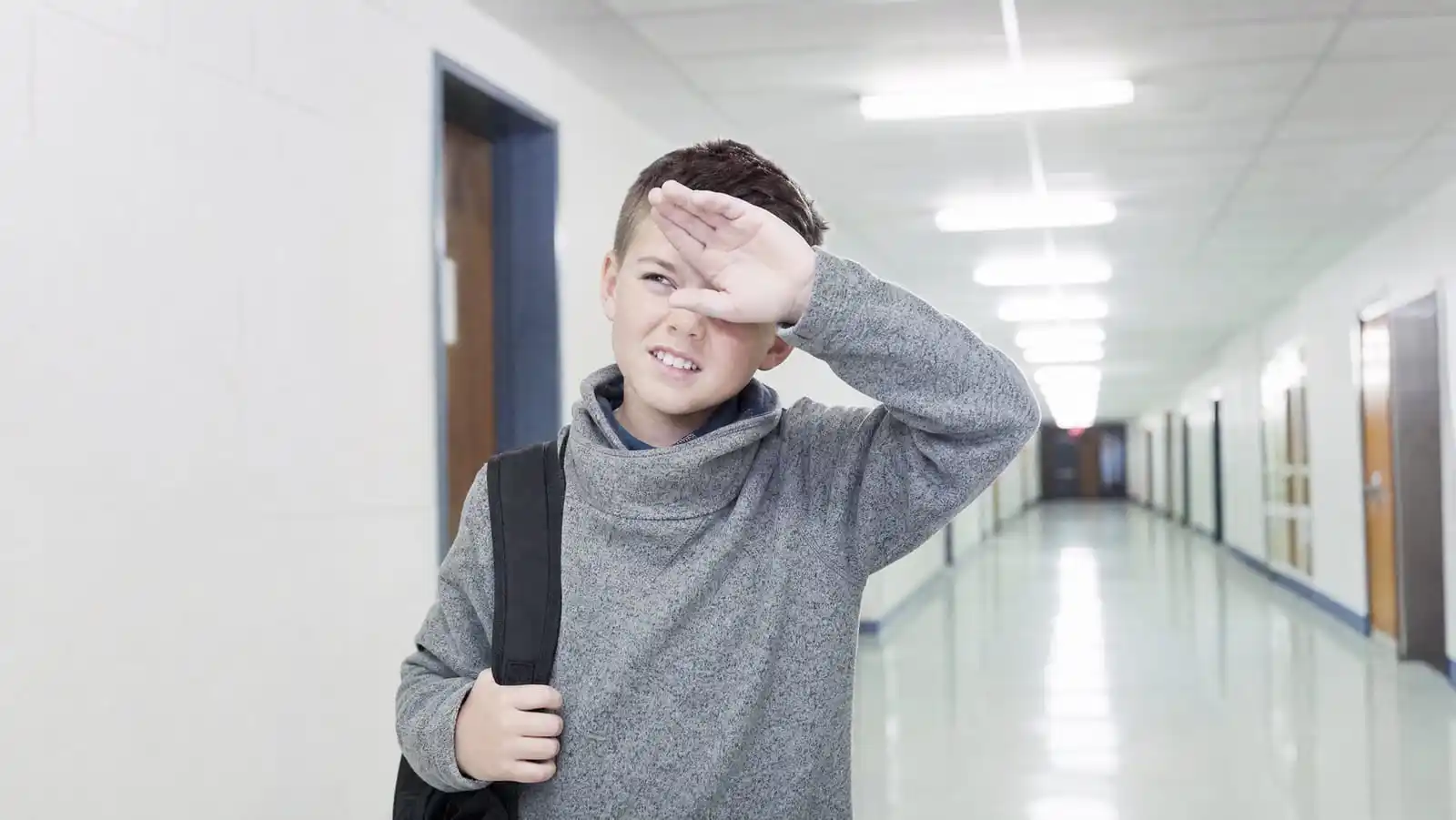
If you have ever watched a child pull a hood down over their eyes the second you walk through supermarket doors, you have seen the practical version of those sentences.
Why Are Autistic People Sensitive to Light? The Eye Is Usually Not the Problem
Light sensitivity has a name in medicine, photophobia, and it is a symptom rather than a diagnosis. A review of its neurobiology by Burstein, Noseda and Fulton in the Journal of Neuro-Ophthalmology, available on PubMed Central, describes "a novel retino-thalamo-cortical pathway that carries photic signal" from "melanopsinergic and non-melanopsinergic retinal ganglion cells to thalamic neurons" — a route by which light reaches brain cells that also handle pain, which is why light can hurt rather than merely dazzle. The authors note that the "non-image forming" part of that route, which originates in melanopsin-containing retinal ganglion cells, still carries light signals in blind migraine patients who, after rod and cone degeneration, can no longer form images but can still detect light.
Clinicians have been making this point for twenty years. In an article on photophobia from the American Academy of Ophthalmology, published in 2005, Bradley J. Katz, MD, PhD, is quoted saying: "Photophobia is not a psychological problem. It is a neurologic problem, and physicians should take it seriously." The same piece cites animal work in which cutting the trigeminal nerve, but not the optic nerve, abolished blinking at bright light.
None of that means you should skip the eye test. The Parmar study notes that autistic individuals are more likely to develop ophthalmological conditions, and a child can have both a processing difference and an eye condition. Precision matters here as it does with sound, where hyperacusis and misophonia describe different problems with different answers.
What the Research Says About Visual Hyper-Reactivity, and How Thin It Is
A 2026 systematic review of light and sound hypersensitivity in autism by Ríos Llamas, Camacho Vega and Delgadillo Ramos, published in Frontiers in Psychiatry, states that "approximately 70-90% of autistic individuals experience heightened sensory sensitivities" — a figure across all the senses, not for vision. Of the 29 studies it included, 16 examined auditory stimuli, 11 audiovisual stimuli, and two examined vision alone.
So we cannot give you a prevalence figure for light sensitivity in autistic children. Nobody can, yet.
The mechanism research is in better shape, though almost all of it used sound and touch. In a study of 42 autistic youth and 27 typically developing youth aged 8 to 17 by Green and colleagues in the American Journal of Psychiatry, available on PubMed Central, participants were exposed to pulsing noise and to scratchy sponges on the forearm. The autistic group with sensory over-responsivity failed to settle: in auditory cortex, "the SOR-high group showed no significant habituation," while the comparison groups "showed sustained amygdala decreases across the Exposure phase."
Read plainly: the stimulus keeps arriving as new, and the alerting system keeps answering the door. That is the same failure-to-habituate story behind why sound sensitivity happens, and a reasonable hypothesis for light — but it was not tested with light. The explanation one layer below it, an imbalance between excitation and inhibition in the brain, is a hypothesis rather than a finding: a critical review by Dickinson, Jones and Milne, archived at the White Rose repository, concludes that different measurement approaches yield different answers.
What the evidence does not yet cover
The same 2026 review is blunt about its gaps: "visual research is limited, with no studies on photophobia or modern lighting," and "no studies have evaluated modern LED lighting, photophobia, or flicker frequencies between 100-200 Hz." It covers autism only, and we found no comparable figure for ADHD or for sensory processing differences without an autism diagnosis. Treat the mechanism here as a description of a nervous system, not of a diagnosis.
Flicker, Glare and Fluorescent Lighting: What Is Established and What Is Not
Established: flicker, patterns and particular colours cause visual discomfort in people prone to it, and that discomfort is not fully explained by the retina. In a 2021 review in Cephalalgia, Wilkins, Haigh, Mahroo and Plant, available on PubMed Central, argue that discomfort from flicker, patterns and colour cannot be accounted for by the activity of intrinsically photosensitive retinal ganglion cells alone, and that "at least in migraine, a cortical mechanism provides a parsimonious explanation for discomfort from all forms of visual stimulation." Their case is built on migraine, where there is, they write, "a broad consensus" that the cortex is hyperexcitable — not on autism.
Also established: autistic adults in the Parmar focus groups named fluorescent, strip and spot lighting unprompted.
Not established: that swapping one bulb for another helps an autistic child. The 2026 review found no included studies evaluating modern LED lighting or flicker rates in the 100 to 200 Hz band most current lighting occupies. If a product page tells you its colour temperature is clinically proven for autism, it is inventing the evidence base.
That gap does not make the change unreasonable — it makes it an experiment you run on one child. Dim one room, keep notes for a fortnight, and let your child's behaviour settle it.
Why the Same Room Is Fine on Monday and Unbearable on Tuesday
The Parmar quote above explains most of it: "a gradually fatiguing thing." Light tolerance behaves like a budget that depletes, and a child who spent the morning under strip lights has less margin left for the supermarket at five.
Sleep sits in the same loop. Participants reported sleep difficulties, especially in summer when daylight hours are longer — one reason a sensory-friendly bedroom is a daytime intervention as much as a nighttime one.
Migraine belongs in the picture too, and it is under-recognised here. According to UCLA Health, reporting work led by pediatric neurologist Sinifunanya Nwaobi, MD, PhD, one study found lifetime migraine prevalence of about 42 percent in people with autism against about 20 percent in controls, and the UCLA group's own analysis of national survey and health-record data found the odds of severe headache roughly four-fold higher. Dr. Nwaobi describes migraine as "a sensory processing disorder at its core," and the 2005 Academy of Ophthalmology piece puts photophobia in about 80 percent of people with migraine.
If the sensitivity arrives in episodes, with pallor, nausea or a need to lie down, raise migraine with a clinician.
How Light Sensitivity Shows Up by Age
Toddlers and preschoolers cannot tell you. They show you: squinting indoors, turning from windows, crying in bright shops, covering their eyes without covering their ears. The UCLA Health piece names the cues clinicians watch for, including retreating to dark rooms and "aversion to lighted screens," and notes the detection problem directly — nonverbal or minimally verbal patients "cannot describe sensory phenomena such as light sensitivity."
School-age children convert it into behaviour. Refusing the hall, the strip-lit corridor, the gym. Hats and hoods indoors. Work avoidance that tracks the room, not the subject.
Teenagers internalise it. Sunglasses indoors, screens at minimum brightness, and fatigue rather than visible distress. Quieter is not the same as resolved.
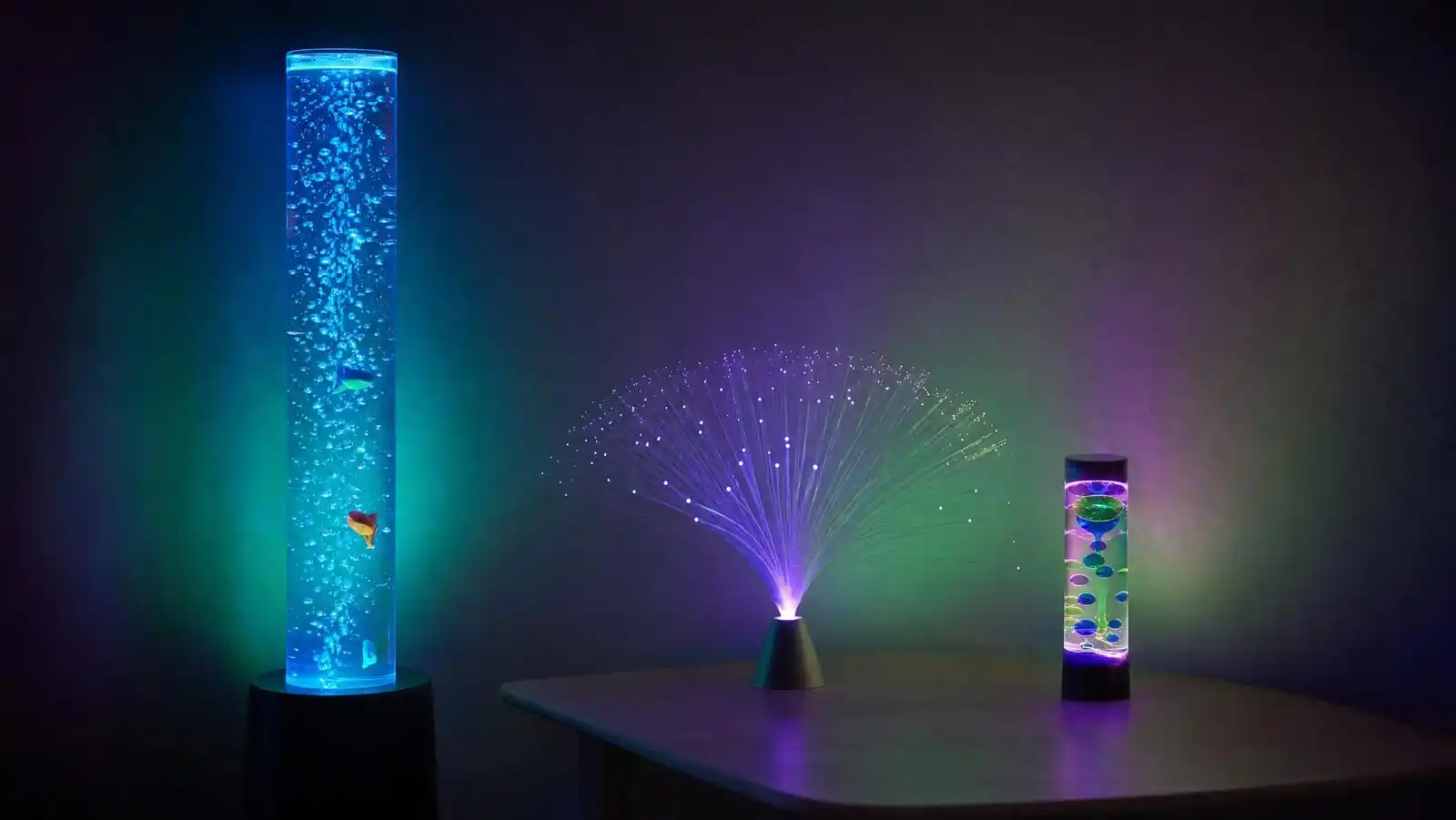
Some children chase light rather than flee it, and both patterns can appear in one child on one day. Hyper- or hyporeactivity to sensory input is one of the DSM-5 diagnostic criteria for autism, as summarised by Autism Speaks, and visual fascination with lights or movement is among the examples given. The seeking side is where sensory light projectors and calming lamps earn their place.
What Actually Helps, and What It Cannot Do
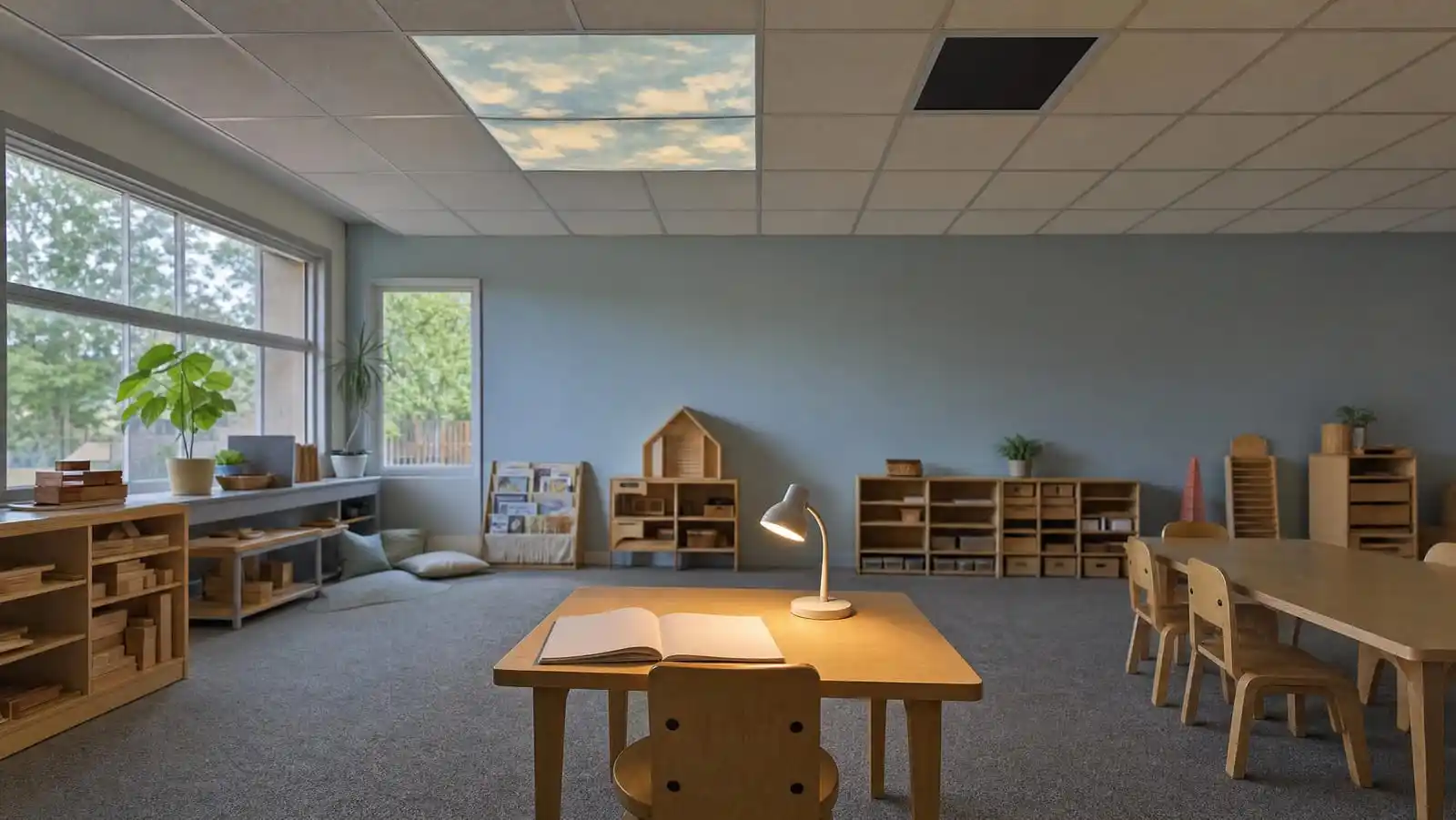
The full toolkit belongs in its own articles, but the shape is consistent. Control beats darkness: a dimmer switch the child can reach, permission to wear a cap indoors, a low-light room they can leave for without asking. Reduce glare before you reduce light: matte surfaces, blinds angled rather than closed, seating away from windows and whiteboard reflections. And budget the day — if assembly is unavoidable, the shop afterwards may not be.
None of this changes the underlying sensory difference. Dimming a room lowers the input. It does not alter how your child's nervous system handles the light that gets through, and no lamp, filter, overlay or projector treats autism, ADHD or SPD. They support comfort and regulation — a worthwhile and much smaller claim.
Dark glasses indoors can backfire
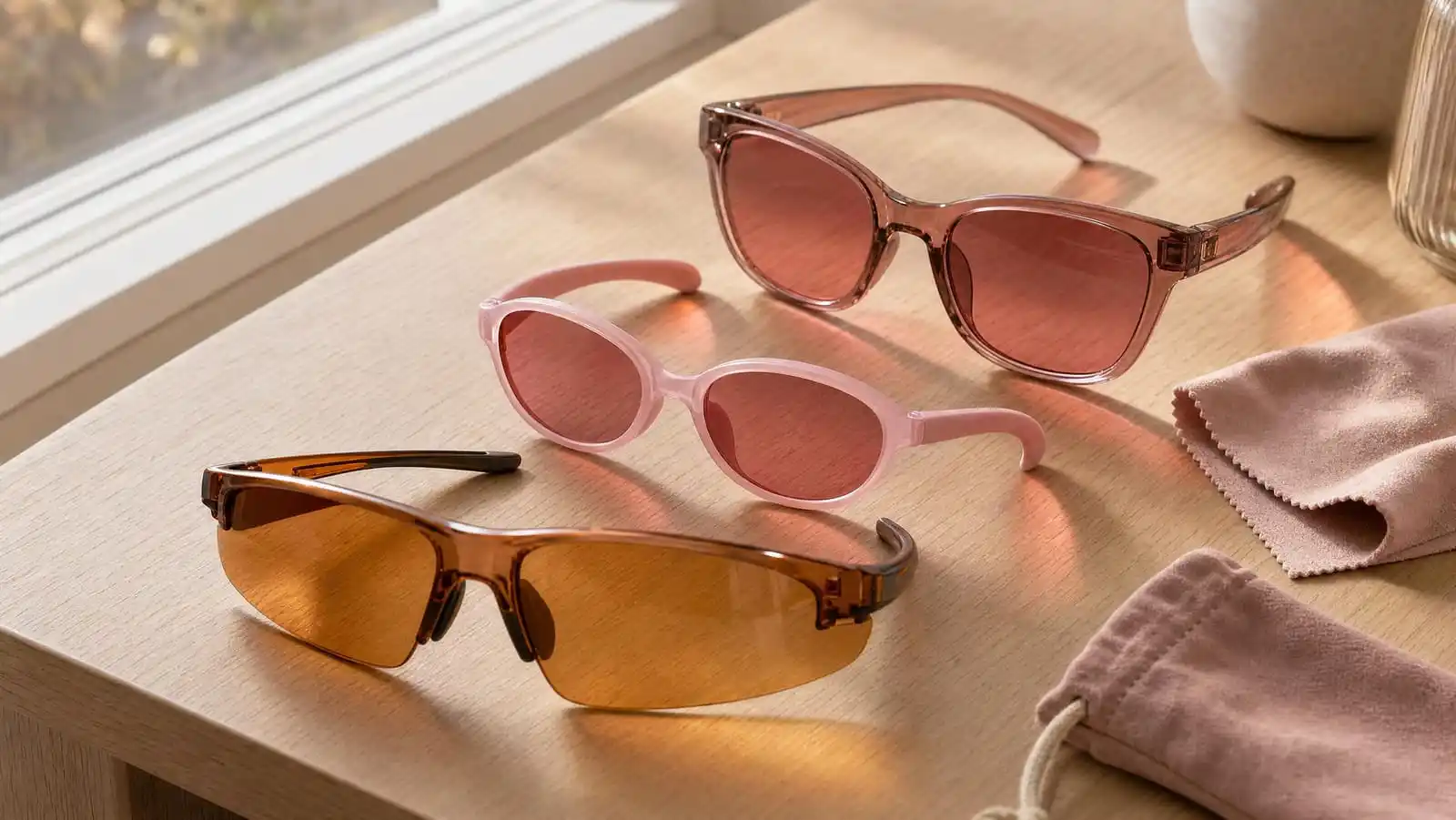
In the American Academy of Ophthalmology's photophobia article, neuro-ophthalmologist Kathleen B. Digre, MD, advises against dark glasses indoors: "People who wear really dark glasses can actually dark-adapt themselves and increase their photosensitivity," and "the darker the glasses inside, the more light-sensitive the person will become." Sunglasses outside, she says, "of course, are fine." If your child now wears dark lenses indoors most of the day, raise it with an eye-care professional rather than escalating the tint.
When Light Sensitivity Needs a Doctor Rather Than an Accommodation
Sensory light sensitivity is steady, long-standing and situational. Something that arrives suddenly, hurts, or changes vision is a different problem in the same clothes.
Signs that need an eye appointment, not a dimmer switch
The American Academy of Ophthalmology publishes a four-letter checklist for parents, RSVP, credited to pediatric ophthalmologist Stephen N. Lipsky, MD: Redness, Sensitivity to light, Vision change, Pain. In the Academy's guidance for parents, Dr. Lipsky says that if your child experiences any one of these "it's a good idea to make an appointment with an ophthalmologist," and that with "two or more of these issues, they may need more immediate medical attention."
The NHS guidance on eye pain is more urgent still. It advises asking for an urgent GP or optician appointment, or calling NHS 111, for eye pain with severe pain, sensitivity to light, changes to vision such as blurring, or a very red eye — and calling 999 or going to A&E if eye symptoms start suddenly, if there is loss of vision, if the eye has been injured or pierced, or if a red eye comes with severe headache and feeling sick.
Outside those red flags, the useful professional is often an occupational therapist: the question is function, which rooms break down and what can change about them.
Frequently Asked Questions
Is light sensitivity a symptom of autism?
A common feature rather than a diagnostic test. A 2026 systematic review in Frontiers in Psychiatry estimates heightened sensory sensitivities in roughly 70 to 90 percent of autistic people across the senses, and hyper- or hyporeactivity to sensory input is one of the DSM-5 criteria, per Autism Speaks. But light sensitivity also follows migraine and eye disease, and only a qualified clinician can diagnose autism.
What does autism light sensitivity feel like?
Fatiguing more than painful, for many people. Autistic adults in the Parmar study in Frontiers in Psychology described bright, flickering, fluorescent and spot lighting as uncomfortable, called visual experience "a gradually fatiguing thing," and reported being "generally stressed all the time" as a result.
Can an eye test detect light sensitivity?
Not directly. Photophobia is reported by the person, not read off a chart, and the review by Burstein and colleagues on PubMed Central places it in pathways between retina, thalamus and cortex. The test still matters: it rules out the eye conditions that autistic people are, per the Parmar study, more likely to develop.
Do fluorescent lights really make it worse?
Probably for some people, and nobody has measured it properly in autism. The 2021 Cephalalgia review on PubMed Central argues that, at least in migraine, discomfort from flicker and patterns points to a cortical mechanism rather than the retina alone, and autistic adults name strip lighting unprompted. But the 2026 review found no included studies on modern LED lighting or flicker between 100 and 200 Hz. Changing the lights is a reasonable experiment, not a proven fix.
Conclusion
Your child is not being dramatic, and you are not imagining the pattern. The most defensible reading of the evidence is that a light-sensitive nervous system routes ordinary brightness through pathways that make it urgent and slow to fade — a mechanism, not a choice, and one that shifts with fatigue, load and migraine. That is the sentence to hand a teacher.
It is also a field with real gaps, and we would rather you heard that from us. From here, our complete visual sensory guide covers the lighting changes, tools and routines that make bright rooms survivable. Start with the room that breaks down most often in your week.