This article contains affiliate links. We may earn a commission if you make a purchase through our links, at no extra cost to you.
Key Takeaways
- Slow and dim beats bright and busy. One thing moving predictably may give the visual system something to settle against rather than something to track.
- The evidence is genuinely thin. A 2025 systematic review of multisensory environments in autism found only 10 studies and reported insufficient evidence.
- Free comes first. A window, a dim corner and one slow object you already own show you what your child actually settles to.
- Timing beats intensity. Before a known hard transition and during recovery are the useful windows. Mid-meltdown is the worst moment for anything new.
- Dose it, and end it on a signal. Input that settles a child at two minutes can wind them up at twenty.
- None of this treats autism, ADHD or SPD. It is comfort and regulation support, which is a different claim.
Calming visual input for an autistic child is set by speed, dimness and control long before it is set by what you spend. Slow, dim, one element rather than many, started and stopped by the child, and with a clear end. Those five variables do the work. The object is almost incidental.
Nearly everything else in our series on visual sensory input and light sensitivity is about subtraction: fewer flickering bulbs, less glare, less to look at. This article runs the other way, around three questions almost nobody separates — what to use, when to offer it, and how long to let it run. First, the honest part.
What the Research on Calming Visual Tools Actually Shows
The closest thing to a formal evidence base is the literature on multisensory environments, and it does not carry much weight. In a 2025 systematic review in Autism, Leonardi and colleagues found 10 studies of multisensory environment interventions in autism; four reported reductions in stereotypic behavior. Their verdict: "Overall, there was insufficient evidence due to the paucity of literature," with "few studies, and sample sizes are often small and poorly characterized." They also note that "none of the studies explicitly monitored or reported adverse outcomes."
The picture outside autism is harsher. Stephenson and Carter's 2025 review in the Journal of Developmental and Physical Disabilities found the research "predominately of very poor quality," with "better quality studies more likely to report no effects," and concluded that multisensory environments "cannot be recommended as an intervention option for individuals with developmental disabilities, but they may have a limited role as a leisure option."
Even the background numbers are soft. A 2015 commentary in the Yale Journal of Biology and Medicine, noting that small studies report hyper- or hyposensitivity in "more than 90 percent of children with autism," adds that "there have been no epidemiological studies to prove this."
Our position, plainly: these are cheap tools that many families report finding useful, on an evidence base thin enough that the free version deserves a real try first. A leisure option a child enjoys and controls is worth owning. It is not therapy, and nothing here treats autism, ADHD or SPD.
Why Vision Can Regulate as Well as Overload
The variable that separates soothing input from assaulting input appears to be predictability, not brightness. Research on uncertainty points that way. In a study of 64 autistic and 85 typically developing children aged 6 to 14, published in the Journal of Autism and Developmental Disorders in 2016, Neil, Choque Olsson and Pellicano found that "intolerance of uncertainty and anxiety explained approximately half the variance in autistic children's sensory sensitivities, but only around a fifth of the variance in typical children's sensory sensitivities."
Its limits are real: cross-sectional, parent-reported, and the authors say "we must be cautious" about reading a causal account into it. It is about sensitivity, not about watching a bubbler. It supports a principle, not a product: input a child can anticipate is a different object from input that arrives at them.
Which is why the same criteria keep reappearing. Dim, slow, one element, predictable, child-controlled. A free object meeting all five usually beats an expensive one that strobes.
What to Use: Free and Environmental, Before Anything Purchasable
Start with what already exists in your house. The free options meet those criteria better than most products do.
- A window. Rain, branches, distant traffic, washing on a line. Slow, unrepeating, free.
- Running or settling water. A tap, a filling bath, a bowl with something floating in it.
- A dim corner. A blanket over a table, a cleared wardrobe floor, a tent with the light off.
- Shadows from one warm lamp, ceiling light off.
- One slow object you own. A snow globe, or a sealed jar of water and a spoonful of glitter.
Our fuller list of visual sensory strategies that need no equipment is the place to start, and for babies and toddlers it is the only part of this article that applies: the purchasable items below are all rated for ages 3 and over. For lamps and projectors, see sensory light projectors and calming lamps.
When to Use It: Timing Beats Intensity
The useful windows are before a known hard moment and during recovery after one. Both are predictable, so you can set up calmly rather than scrambling: leaving the park, bath to bed, the ten minutes before school, or the quiet stretch afterward.
Mid-meltdown is the worst moment to introduce something new — a novel object at peak distress is one more thing to process. An already-familiar item the child reaches for themselves is different, and worth following.
The distinction that matters most is seeking versus avoiding. A child who stares at lights and asks for the sparkly thing is likely a visual seeker, and slow added input is reasonable to try. A child who squints, hides from bright rooms and dreads the supermarket may be light-sensitive, and adding light may be the wrong direction entirely. For that child a channel that is not already overloaded is the better bet: calming sounds and auditory input applies the same logic to the ears, and tactile toys for calm-down and regulation covers substituting touch. Many children are both, in different senses or at different times of day.
How Long: Dosing and Ending on a Signal
There is no dosing research for calming visual input. None. What follows is our working practice, not a finding.
We would start short, around two to five minutes, and stop while it is still going well rather than waiting to find the ceiling. The same input changes category with time: a settling object at two minutes can become an absorbing, winding-up one at twenty, and that second state is much harder to leave.
| Signs it is still calming | Signs it has tipped to stimulating | |---|---| | Breathing and body slowing | Movement and vocalizing increasing | | Loose posture, soft gaze | Face close to the object, body tense | | Can be spoken to, answers | Cannot be interrupted without distress | | Leaves it willingly | Protests hard at any suggestion of ending |
Those are observations, not criteria. Two weeks of your own notes will tell you more than any list we publish.
The ending is the part worth engineering. A visible countdown turns "time is up" from an announcement into information the child has had all along. Visual supports as a category do have a real evidence base: the AFIRM team at the University of North Carolina at Chapel Hill reports that, based on the 2020 National Clearinghouse on Autism Evidence and Practice review, they meet evidence-based practice criteria with 104 single case design studies and 2 group design studies.
The caveat is specific. A 2025 review in Behavioral Interventions by Mouzakes and Thompson examined the visual schedule component on its own and found "insufficient evidence that the VS component of the intervention contributed to improved transitions with individuals diagnosed with ASD," because schedules are usually delivered alongside other components with documented efficacy. A timer is a sensible tool, not a proven one.
Building a Visual Calm-Down Corner That Is Not a Sensory Shop
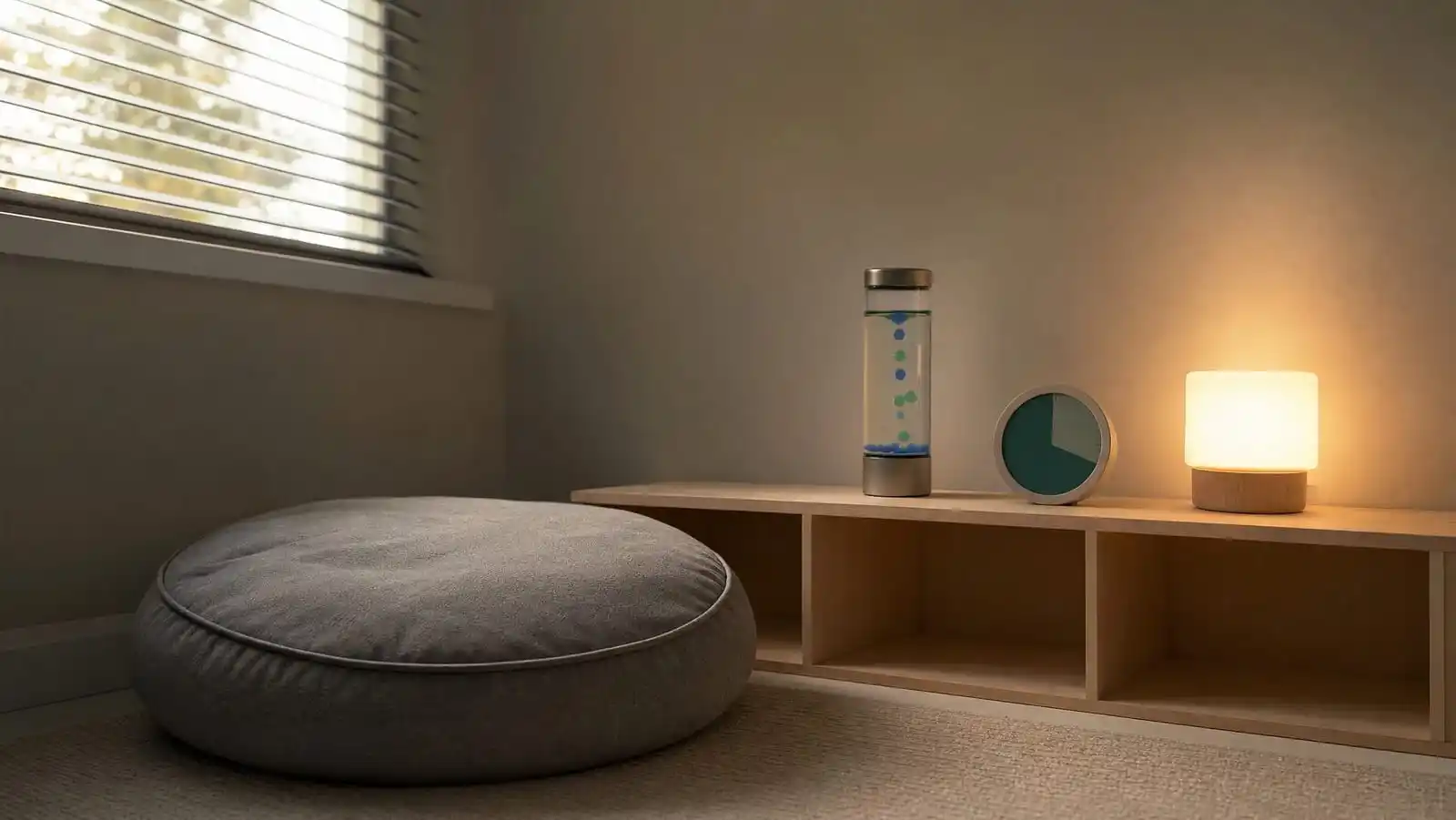
Four elements is the whole specification: low light, one slow visual object, a physical boundary, and a way to know when it ends. Everything else is decoration, and the corners that get used are the sparse ones.
It should be somewhere the child chooses to go, which means it cannot double as where they are sent when things go wrong. Dim rather than dark, so an adult can sit there too. And one object at a time: a shelf of competing options is a search task, not a rest. If it stops being used, our first guess is that there is too much in it.
The Four Things We Would Consider Buying
For each, the honest reason it earns a place and the trade-off.
The cheapest useful test. The BUNMO Liquid Motion Bubbler is $11.99 as of November 2026: slow, predictable, single-element motion in a soft silicone casing, and the cheapest way to find out whether your child settles to watching or actually needs to touch and squeeze. BUNMO states that it is double-sealed, BPA-free and non-toxic, and rates it for ages 3 and over. The trade-off: one object, one behavior, so if watching is not the thing, twelve dollars is all you spent finding out.
Letting the child choose the duration. The hand2mind Sensory Fidget Tubes four-pack is $19.99 as of November 2026, down from a $36.99 list price. hand2mind states that each of the four sealed tubes requires a different amount of time to settle, and frames the set around the child picking a tube. That choice of duration is the part that matters in a calm-down corner. The trade-off: four objects where we just argued for one, so keep three out of sight and rotate.
The light-up version, with the caveat that defines this article. The Special Supplies Light-Up Glitter Sensory Tubes four-pack is $19.99 as of November 2026. The manufacturer states that each sealed, leakproof tube lights up in multiple colors, and positions them as calm-down bottles or visual timers. Be clear what that means: these add their own light. That makes them reasonable for a visual seeker and poor for a light-sensitive child, which is the opposite of what "calming" on the packaging implies. If your child squints in bright rooms, buy a non-illuminated version.
The ending tool. The Time Timer Original 12-inch visual countdown timer is $31.95 as of November 2026. A high-contrast disk depletes as the 60 minutes elapse, it runs silently with an optional audible alert, and the manufacturer describes it as a classroom and therapy tool. Making elapsed time visible is exactly what the "how long" problem needs. The trade-offs: it is by far the most expensive item here, and a kitchen timer does the same job free if your child reads numbers comfortably.
Safety and the age question
The three sensory items state ages 3 and over, and that rating is doing real work. Retail listings put the Time Timer at 3 years and up with a small-parts choking warning as well. The US Consumer Product Safety Commission's small parts rule covers products intended for children under three and exists to prevent "deaths and injuries to children under three from choking on, inhaling, or swallowing small objects." A part counts as small if it fits a test cylinder approximating "the fully expanded throat of a child under three years old."
Sealed liquid-filled items deserve a second thought for any child who mouths or bites objects, at any age. Health Canada recalled water-filled teethers in August 2022 after testing found the liquid filling contaminated with bacteria, telling families to "immediately stop using the recalled teethers and dispose of the product." Those were teethers rather than sensory tubes, but they illustrate why a liquid-filled toy becomes a different object once punctured. Inspect sealed items for cracks before use, and for under-threes stay with the free strategies.
What We Would Not Buy
- Anything that strobes, flashes or cycles colors fast. It fails the slow-and-predictable test by design, and the Epilepsy Society notes that "flashing, flickering, or patterned effects can make people with or without epilepsy feel disorientated, uncomfortable, or unwell."
- Anything sold as a treatment for autism, ADHD or SPD. On the evidence above, that claim is not available to anyone selling a bottle of glitter.
- Homemade glitter bottles for a child who mouths objects. A craft-store bottle is not a sealed toy.
- An expensive bubble tube as a first purchase. If a twelve-dollar bubbler does not hold your child's attention, a three-hundred-dollar one probably will not.
Frequently Asked Questions
What is calming visual input?
Visual stimulation offered deliberately to help a child settle rather than to entertain or alert them: liquid settling through a tube, rain on a window, shadows from one lamp. The defining feature is the quality of the input and who controls it, not the object.
How long should a child use a sensory bottle or visual timer?
No research answers this, so treat any number, ours included, as a guess. We would begin at two to five minutes, watch for the shift from settling to absorbing described above, and end on a signal the child can see coming.
Can calming visual input replace therapy?
No. Nothing here is a treatment, and the reviews cited above are explicit that multisensory environments cannot currently be recommended as an intervention. If regulation is a daily struggle, an occupational therapist who knows your child is a better investment than any product on this page.
Conclusion
Vision is not only a hazard to be managed. For some children it is one of the cheapest regulation tools in the house; for others it is the sense that most needs protecting. Which child you have decides everything else, and the free strategies answer that question for nothing.
So: start with a window and a dim corner. Watch whether your child settles to looking or needs to touch. Keep the dose short and end it on something visible. Buy one small thing, if anything, and read the rest of our work on calming visual input and light sensitivity for the wider picture.
Then the smallest first step: pick one predictable hard moment this week and try two minutes of something slow beforehand. Write down what happened. That note is better data about your child than anything we have cited.