This article contains affiliate links. We may earn a commission if you make a purchase through our links, at no extra cost to you.
Key Takeaways
- Nothing here needs buying. Fifteen strategies, no products named: the only cost is rearranging what you own.
- Visual clutter has a measured cost to attention — in typically developing kindergarteners. In a 2014 Psychological Science study of 24 children, off-task time was 38.6 percent in a decorated lab classroom against 28.4 percent in a sparse one.
- Vision is the under-researched sense in autism. A 2026 systematic review of 29 studies found only two that examined visual stimulation alone.
- 74 percent is the autism figure, and it covers every sense. US surveillance records on 25,627 autistic 4- and 8-year-olds documented sensory features in 74 percent of them.
- Glare is geometry, not brightness. Moving the chair two feet often beats moving the lamp, and costs nothing.
- Bare is not the goal, and none of this treats autism, ADHD or SPD. These strategies lower what one room asks of a child — a smaller claim.
The fastest reduction in visual load in most homes is subtraction, and all of it is free: clear one surface, turn one shelf to face the wall, tilt the blinds instead of shutting them. That is the cheap half of visual sensory input and light sensitivity, and the half most families skip on the way to the shops.
Then the complication. Subtraction is not a bare room: an empty white box can be glary and gives the eyes nothing to settle on. Leave less to process, not less to live with.
The honest part first: almost nothing below has been tested as a discrete intervention. These are accommodations drawn from what is known about sensory processing differences and from what autistic people report about their own environments. A 2025 systematic review of sensory-based interventions in Frontiers in Pediatrics notes that the sensory environmental modifications in Bodison and Parham's 2018 American Journal of Occupational Therapy review "included only one study" — a dental clinic — and reaches the same verdict on the 2015-2024 literature it covers itself: "There is not enough evidence to conclude the effectiveness of sensory environmental modifications".
The differences themselves are not in doubt. The 2026 review of light and sound hypersensitivity in autism by Ríos Llamas and colleagues, in Frontiers in Psychiatry, states that "approximately 70-90% of autistic individuals experience heightened sensory sensitivities" — all senses, not vision alone. Of its 29 studies, "only 2 exclusively examined visual stimulation", and the authors report that "visual research is limited, with no studies on photophobia or modern lighting". Where a strategy has no support, we say so.
Less to Look At
Visual clutter is the one lever with a number attached. In a 2014 study by Fisher, Godwin and Seltman in Psychological Science, summarised by the Association for Psychological Science, 24 kindergarten children took six science lessons in lab classrooms, three heavily decorated and three sparse. Off-task time ran at 38.6 percent against 28.4 percent, and test accuracy at 42 against 55 percent. Those were typically developing kindergarteners in a lab, not autistic children at home over a term.
1. Clear one surface, then one wall — never one room. Pick the surface your child looks at most and take off everything not in use today. Then strip the wall in front of where they work. A whole-room declutter costs a weekend and is reversed by Wednesday; one surface costs four minutes and gives the eyes somewhere to stop.
2. Put a cloth over the open shelving. Open shelves are efficient storage and a wall of competing detail — forty spines, twelve colours, nothing grouped. A sheet or an old curtain over the front of the unit removes all of it in thirty seconds, and comes off as fast when the toys are wanted. Closing cupboard doors does the same.
3. Turn the toy shelf to face the wall. The one most people have not tried. Rotating a free-standing unit so the open side faces the wall turns a display into a blank panel; the toys are still there, but reaching round takes intent rather than filling the edge of vision all evening. Anchor a tall unit to the wall first.
4. Box up what is not in use today. Not a storage system. One box, one lid: the half-built model, three library books, the bag for school tomorrow. It lives out of the sightline and gets emptied eventually. What it buys is a room cleared in two minutes at 7pm, which is the only decluttering that survives a real week.
Less Glare and Less Contrast
Glare is geometry, not brightness. A lamp is no brighter when it starts bothering a child; it has come into the line of sight, or the sun has moved. In focus groups run by Parmar and colleagues, in Frontiers in Psychology in 2021, participants — 18 autistic adults across four groups — reported that "bright, flickering, fluorescent, 'strip,' and 'spot' lighting caused discomfort" — self-report, from adults, and the best evidence these strategies have. For a room you do not control, visual sensory tools for the classroom is the school version.
5. Tilt the blinds rather than shutting them. Shutting a blind trades a glare problem for a dark room, the big light goes on, and you are worse off. Angling the slats upward bounces daylight off the ceiling: the room stays lit, the bright patch leaves the wall, the sky leaves the eye line. Judge it at the hour the room is used.
6. Move the chair before you move the lamp. When a child complains about a light, the instinct is to change the light. Move the child two feet, or turn the chair ninety degrees, first. Much glare is a reflection — a window on a screen, a downlight on a glossy table — and reflections are about angle.
7. Take the screen brightness down and swap glossy for matte. A tablet at full brightness in a dim room is the brightest object in the house, held a foot from a face. Then drop it to the lowest readable setting and leave it there. A laminated worksheet under a ceiling light is a mirror, and plain paper is not.
8. Let the cap or the hood stay on indoors. Usually refused on grounds of manners rather than function. A brim takes the ceiling fixture out of the upper field of view; a hood narrows the sides. One of Parmar's participants, describing their own children crossing the living room, said "they need to be on one side, not going across my field of view all the time".
Less Movement in the Corner of the Eye
Movement at the edge of vision is harder to ignore than movement in front of you, and it is the load families notice last. One of Parmar's participants described being "surrounded by buildings and people like it's all too much visual information", and the authors note that participants "minimized the time they had to experience visual clutter". It rarely arrives alone, which is why noise sensitivity strategies that need no equipment is the companion to this list.
9. Draw the blind on the busy window, not the quiet one. Most homes have one window doing the damage: onto the street, the drive, the neighbour's security light. Identify it and treat only it — a net curtain, a blind at half height, a tall plant on the sill. Daylight stays, the traffic goes, and the quiet windows stay as they are.
10. Turn the television off rather than muting it. Muting solves the sound and leaves a changing rectangle of light and motion in the room, which for a visually sensitive child is the half that mattered. The same goes for a paused video or a laptop open on a bright page. If nobody is watching, off is a materially different room.
11. Put a sticker over the blinking standby light. A router with a pulsing LED, a charger that breathes, a device flashing every forty seconds. In daylight they are invisible; in a dark bedroom they are the brightest thing present. Masking tape ends it in five seconds. Two limits: never a smoke or carbon monoxide alarm, and never a light you need to watch.
12. Sit your child with their back to the room. In a cafe, a waiting room or a school hall, the seat facing the room delivers every person, door and screen in it; the seat with its back to it delivers a wall. Take the wall, every time. Asking for a corner table is an ordinary request rather than a disclosure.
Somewhere for the Eyes to Rest
Subtraction has a floor, and below it you are not reducing load — you are removing anywhere to look. Anna Fisher, lead author of that classroom-display study, was explicit that bare walls were not the point: teachers should consider whether some displays are distracting "instead of removing all decorations". What eyes need is somewhere low-contrast and uneventful. Deliberately calming visual input is the other route, and it costs money. This is the free one.
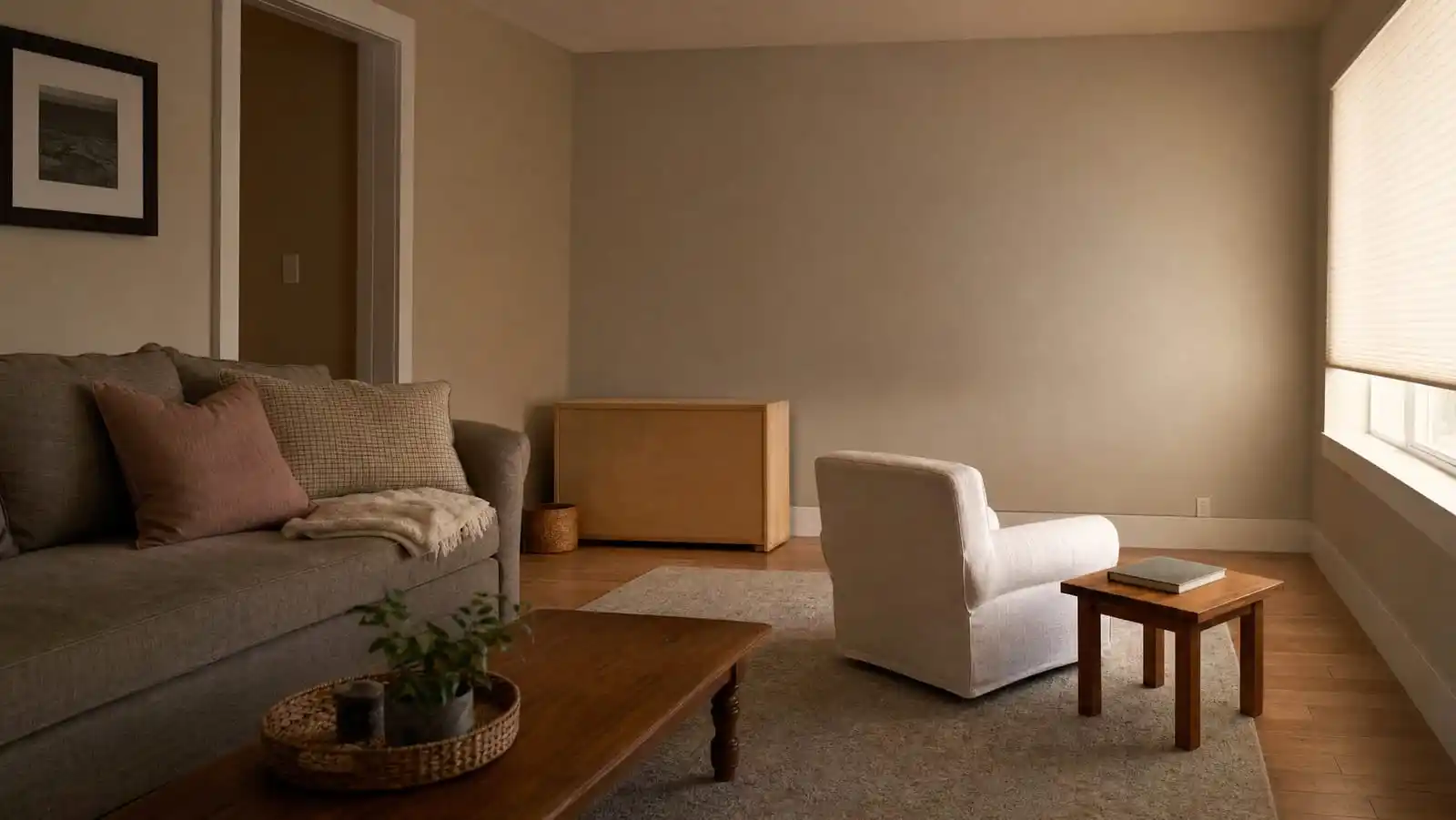
13. Build a low-stimulus corner out of what you already own. Dim and plain, not dark and empty. A corner, the end of a bed, the gap behind a sofa; one soft light rather than the overhead; nothing on the walls within view. If you have ever found a child sitting in the bathroom at their own birthday party with the light off, they had worked this out without us.
14. Look at something far away. When a child is coming apart over a worksheet or a screen, send the view long: the window, the garden, the end of the street. A far view is wide, low in detail and slow-moving, the opposite of a tablet at arm's length. Whether that does anything measurable for autistic children we do not know.
15. Let them close their eyes. Closing your eyes in company reads as rude or bored, and for a child carrying too much visual input it is the most direct tool there is: input to zero, and needing nobody's permission. Say out loud, at home and at school, that eyes closed is a strategy, not a refusal. Parmar's paper is blunt that when strategies run out "the last resort is to endure these".
See the room the way your child does
Sit in their seat, at their height, at the time of day they are actually in it. Not in the doorway at 9pm — on the chair, eyes at their level, at 4pm when the sun is where it will be.
Then look slowly left to right, naming every bright thing, every moving thing and every reflection. Most people find two or three they never noticed, because at adult height they are not in the line of sight.
Two free changes that need care, and one that needs reporting
Window cords are the exception to "just adjust the blinds". The US Consumer Product Safety Commission reported in 2023 that between January 2009 and December 2021 it counted more than 200 incidents involving corded window coverings and children aged 8 and under, and that a child died in 48 percent of them. Its advice: the safest window coverings with young children in the house are cordless.
Nothing goes over a light. A cloth over a shelf is fine; a cloth over a lamp, bulb or light fixture is not, even for fittings that run cool.
A visibly flickering fixture is worth reporting rather than tolerating. The UK Epilepsy Society lists "lights flickering, such as faulty fluorescent tubes" among possible triggers for photosensitive seizures. Both halves matter: the same charity states that "around 1 in 100 people has epilepsy and, of these people, around 3% have photosensitive epilepsy", and epilepsy is more common in autistic people — a 53-study review by Zarakoviti and colleagues in the Journal of Autism and Developmental Disorders, on PubMed Central, found 7 percent of 257,892 autistic individuals had "co-occurring epilepsy". A failing tube does not cause epilepsy, but a new episode of staring or unresponsiveness belongs with a doctor.
Frequently Asked Questions
How do I reduce visual clutter for autistic kids without stripping the room?
One surface and one wall at a time, starting where your child spends longest; stop as soon as things improve. Cover open shelving rather than emptying it, box what is not in use today, leave the rest. The 2014 Psychological Science study compared a decorated room with a sparse one, not an empty one.
Is a bare or all-white room better for a sensory-sensitive child?
No, and it may be worse. White surfaces reflect more of the light that falls on them, the opposite of what a child troubled by glare needs, and a room with nothing in it gives the eyes nowhere low-contrast to rest. That is design reasoning rather than trial evidence — the 2014 study compared a decorated room against a sparse one, not against an empty one. Aim at dim and plain, not bare and bright.
How can I tell visual overload from tiredness, hunger or anxiety?
Often you cannot in the moment, so make the comparison positional. Visual load changes when the conditions change: move the seat, dim the lights, draw the blind, step outside, and watch whether the state shifts in the next minute or two. Tiredness, hunger, pain and anxiety tend to travel with the child from room to room. Treat that as a rough guide rather than a test: it cannot rule anything out. Any new eye-rubbing, headache or vision complaint belongs with your GP or an optometrist.
Do these visual calming techniques work for ADHD and SPD too?
Parents report that they do and the research has not kept up. Almost all published work here comes from autistic samples: the 70-90 percent figure above is autism-specific, as is the 74 percent of 25,627 autistic 4- and 8-year-olds with documented sensory features in the 2022 surveillance analysis by Kirby and colleagues in Autism Research. We found no equivalent figure for ADHD.
Conclusion
Three to try tonight. Clear the one surface your child looks at most. Turn the television off instead of muting it. Move their chair rather than the lamp. All three are undone by morning if they do nothing, and a week is usually long enough to get a sense.
The evidence here is thinner than the confidence of most advice about it, which is the honest reason to prefer free changes: they cost nothing to get wrong. For the rest of the picture, start with our complete guide to visual sensory strategies and light sensitivity.