This article contains affiliate links. We may earn a commission if you make a purchase through our links, at no extra cost to you.
Key Takeaways
- The tools that help most are free. A seat out of the glare path, one bank of overheads off, the wall in front of one child cleared: no budget, reversible by Friday.
- Heavy decoration has a measured cost, in one small study. 24 kindergarten children were 38.6 percent off task in a decorated lab classroom against 28.4 percent in a sparse one, scoring 42 percent correct against 55.
- Children do not simply get used to it. A 2022 follow-up found partial habituation over two weeks in the lab, none across 15 weeks in six real classrooms.
- Visual supports are well evidenced, almost entirely by single-case research. The 2020 NCAEP review counted 104 single case and 2 group design studies; countdown timers are not a listed type.
- You hold the ask, not the lever. What gets granted is one desk, one wall, one bank of lights — one at a time, with a review date.
- The hardware is cheap — $17.99 for a desk timer, $31.95 for the wall version, $16.99 for either schedule set, as of October 2026 — and none of it treats autism, ADHD or SPD.
The visual sensory tools that help most in a classroom cost nothing: move the desk out of the glare path, switch off one bank of overheads, and clear the wall in the child's line of sight. The timer and the schedule strip come third.
Then the hard half. Every item on that list needs somebody else's yes, which is what makes school unlike the rest of our guide to visual sensory toys for autism. You can buy a timer tonight; you cannot move a chair in a room you are not in. So this is ordered by who grants a change, not by product category.
Start With What the Teacher Can Change for Free
Each item below can be acted on inside a day, costs nothing, and is reversible.
1. Move the desk out of the glare path. The Canadian Centre for Occupational Health and Safety names two kinds: direct glare from "poorly positioned light fixtures" and sunlight, and reflected glare from "polished, shiny or glossy surfaces". It advises positioning a work station "so that windows and fluorescent light tubes are parallel to the worker's line of sight" — as a request: the window alongside the child rather than in front, and not under a fixture.
2. Ask for one bank of overheads to be switched off. CCOHS recommends "several small low-intensity light fixtures rather than one large high-intensity light fixture" and "adjustable local lighting with brightness controls". Classrooms rarely have a dimmer, so the switch bank by the door is it.
3. Clear the wall in the child's eyeline — that wall, not the room. A child faces one direction most of the day, and what hangs in that view works harder than anything behind them. "Could the space above the whiteboard stay clear?" is answerable; "could the displays come down?" is not.
4. Matte beats glossy, and costs a sheet of paper. CCOHS advises work surfaces "such as the desk or documents" that are matte. A laminated worksheet under a downlight is a mirror at reading distance.
5. Let the cap or hood stay on indoors. A brim takes the ceiling fixture out of the field of view, and is often refused on appearance rather than function — so ask explicitly.
6. Lower the screen and move it off the window. The American Optometric Association advises a screen sit "15 to 20 degrees below eye level" and be positioned "to avoid glare, particularly from overhead lighting or windows".
7. Expect the visual ask to arrive with an auditory one. A child who finds the lights hard often finds the room loud too, and both are granted by the same person in one conversation — auditory sensory tools for the classroom is the companion list.
If you have ever watched a child read with their head flat on the desk and one hand over their eyes, they had found the glare path without any of this. Do the home version first, where you control the room: visual sensory strategies that need no equipment.
Visual Clutter: What the Research Actually Says
There is a real finding here, and it is smaller than the internet makes it. Fisher, Godwin and Seltman published it in Psychological Science in 2014 (on PubMed): kindergarten children taught six science lessons in laboratory classrooms, three in a heavily decorated room and three with the displays removed. Carnegie Mellon University's summary gives the numbers — 24 children, 38.6 percent of time off task in the decorated room against 28.4 percent in the sparse one, and test accuracy of 42 against 55 percent.
The limits matter more than the headline. Twenty-four children, in a laboratory classroom rather than their own. The paper's framing is young children "with immature regulation of focused attention", and neither its abstract nor the university's own summary mentions autism, ADHD or SPD anywhere in the sample, so it is not a finding about autistic pupils.
It is also contested. In a Frontiers in Psychology commentary, Imuta and Scarf (on PMC) argue "it may have been the novelty that detracted children's attention away from the lesson" — these decorations were new, as a child's own walls are not.
Habituation has since been tested, and the answer is awkward for both sides. Godwin, Leroux, Seltman, Scupelli and Fisher, in Cognitive Science in 2022 (on PubMed), found only partial habituation in the lab — "the environment remained a significant source of off-task behavior even after 2 weeks of exposure" — then followed six genuine classrooms for 15 weeks and found none at all. A separate analysis by the same group coded 58 real classrooms and found "on-task behavior declined in classrooms containing greater visual noise".
For autistic pupils the evidence is thin, and the honest word is guidance rather than findings. Tola and colleagues' 2021 scoping review of autism and the built environment in the International Journal of Environmental Research and Public Health (on PMC) included 21 studies of the 801 it identified — a "relatively limited number", in its authors' words, which they say shows the topic "need to be further explored" — and it offers design guidance such as eliminating "nonessential visual materials" rather than measured outcomes.
Then be fair to teachers, because it is their room. Most of what is on those walls went up on a weekend, often paid for personally. The 2014 study's lead author did not ask for bare walls, only that teachers "should consider whether some of their visual displays may be distracting to young children". The realistic ask is the wall in front of one child, not a redecoration.
Tools That Live on One Child's Desk
Visual supports are among the better-evidenced practices in autism education, with caveats. UNC's Autism Focused Intervention Resources and Modules team, whose 2024 evidence brief follows the 2020 review by the National Clearinghouse on Autism Evidence and Practice, reports that visual supports meet evidence-based practice criteria "with 104 single case design and 2 group design studies", for ages 0 to 22 and outcomes from academic to social.
Two caveats, both from that brief. The base is almost entirely single-case design, 104 of the 106 studies. And it warns that "individual types of visual supports might not have been shown to be as effective" — its categories are visual boundaries, cues and schedules, and a timer is not among them, so a case for a schedule is not a case for a timer.
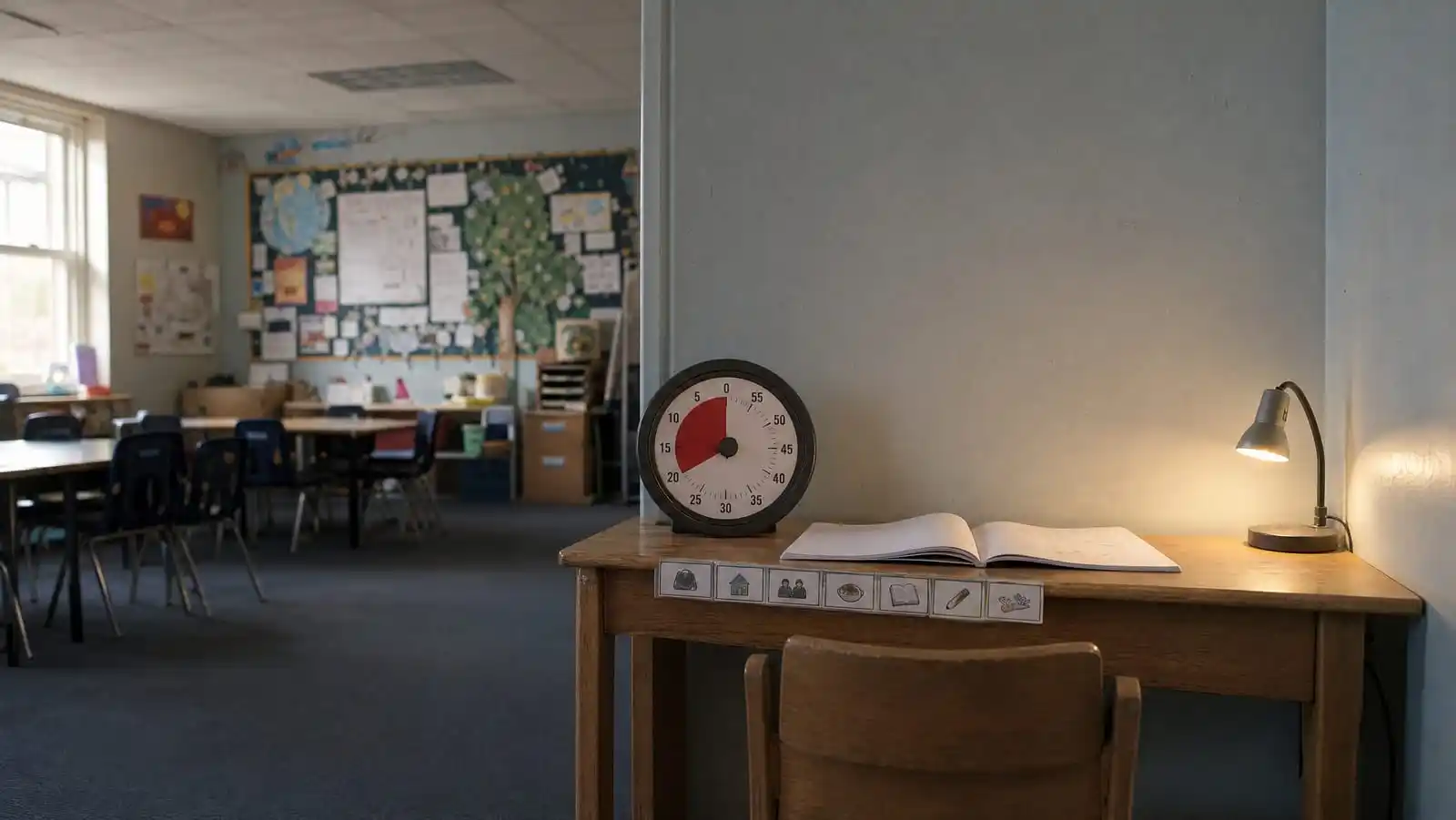
The desk-sized timer is the one most children should get. The LIORQUE 7.5-inch visual timer is $17.99 as of October 2026: a 7.5-inch 60-minute disc, two AA batteries included, three mounting options. The spec that earns it a place in a sound-sensitive room is the alarm — three volume levels including mute, and modes of sound, light or vibration. One quirk: under three minutes, the maker says to set the dial to five and back.
The 12-inch version is for the wall, and it is the expensive pick. The TIME TIMER 12-inch visual timer is $31.95 as of October 2026 — 12 inches across, a 60-minute disc, two AA batteries not included, a magnetic back, wall mounting, foldable feet and a dry-erase activity card. Its audible alert is optional and can be left silent. TIME TIMER states the size "is ideal for medium and large groups"; its listing's claims about easing transitions for autism and ADHD are marketing, not evidence.
For schedules the question is scale: whole room, or one child. The SchKIDules 48-piece classroom set is $16.99 as of October 2026 — 48 precut, laminated 4.75-inch cards, dry-erase friendly, for a pocket chart, velcro or a keyring. The selling point is boring: nobody has to print, cut and laminate, the step that quietly kills most classroom schedules. SchKIDules states the cards "reduce anxiety, forgetfulness and promote redirection and independence" — a listing claim, not what the evidence establishes.
The individual board is the version that goes home and comes back. The ALSLEA visual schedule board is $16.99 as of October 2026: 27 inches by 9.5, flannel on nylon, four grommets, foldable, stands on a desk. Of its 124 cards, 12 are blank — the useful part, because no card set contains your child's Tuesday.
What Needs the School to Act
Covering a light fixture is the slowest ask here, and the objection is usually fire code. Fabric over a school fixture generally needs facilities sign-off against a flame-propagation standard, and the requirement varies by district — which is why rated covers exist and unrated ones tend to come down. The standards and products are in our guide to fluorescent light sensitivity. Bulbs and tubes are a work order too, not a conversation.
If the informal route stalls, a seating or lighting accommodation can be written into a plan. The US Department of Education's Office for Civil Rights FAQ on Section 504 states that under Section 504 a free appropriate public education "consists of the provision of regular or special education and related aids and services designed to meet the student's individual educational needs". It also takes the case of a student with a disability named in the IDEA who does not need special education, and answers that they "may be eligible for services under Section 504" and "may receive adjustments in the regular classroom".
Who decides is not you. That FAQ cites the Section 504 regulation at 34 C.F.R. 104.35(c)(3), which requires districts to ensure the eligibility determination is made by "a group of persons, including persons knowledgeable about the meaning of the evaluation data and knowledgeable about the placement options" — so whether a change belongs in an IEP, a 504 plan or neither is that team's call.
How to Ask So the Answer Is Yes
Ask in order of who controls the thing. The teacher owns the seating plan, the switches and the wall; the SENCO, 504 coordinator or case manager owns what gets written down; facilities owns the ceiling.
One thing at a time, and name the smallest version. "Could he sit at the end of the second table, away from the window?" gets a yes. Six changes at once gets a meeting, in March.
Frame it as an experiment with a review date. Two weeks, then a two-line email on whether it helped. Yes comes easier for something reversible than for a permanent change on a parent's theory.
Get it in writing once agreed. A sentence in the one-page profile or the plan survives a supply teacher, a room change and next September.
Find the glare path in thirty seconds
Ask to sit in your child's chair, at roughly the time of day they are in it. Look straight ahead, then down: is a window or lit fixture in front of you rather than beside you, is there a reflection on the desk or whiteboard, does the laminated page shine?
The time of day is the trick: a seat that is fine at 8am can face a low window at 2pm, and the geometry moves as the sun drops.
Frequently Asked Questions
What are the best visual sensory tools for the classroom?
In order of how often they help: a seat out of the glare path, a bank of overheads off, a cleared wall in the child's line of sight, matte paper instead of laminated, and only then a timer and a schedule. All but the last two are free.
Does reducing visual clutter in a classroom actually help?
Yes, with caveats. Fisher, Godwin and Seltman recorded 38.6 percent of time off task in a heavily decorated laboratory classroom against 28.4 percent in a sparse one, with 24 kindergarten children and no autism, ADHD or SPD mentioned in the published report, and a commentary argues novelty explains it. Clear the wall in front of one child rather than stripping a room.
How do we deal with screen glare at school?
Position first, filter second. The American Optometric Association advises positioning the screen "to avoid glare, particularly from overhead lighting or windows", and adds that "if there is no way to minimize glare from light sources, consider using a screen glare filter". Persistent headaches, eye pain or any vision change belong with an optometrist.
Do visual schedules work for autistic children?
As a category they meet evidence-based practice criteria in the 2020 NCAEP review, on 104 single case design and 2 group design studies. That is a strong base for this field, still almost entirely single-case research, and not a guarantee that a schedule will fix transitions for a particular child.
Conclusion
Spend nothing for a fortnight. Ask for the seat move, the lights above the table off, the wall in front of your child clear, and an unlaminated worksheet. Four requests, all free, all inside one teacher's gift.
If anything is left over, the hardware is cheap and narrow in what it claims: the $17.99 desk timer with its mute and vibration alarm, the $31.95 wall version if a whole class reads it, and either $16.99 schedule set. All prices as of October 2026.
The evidence is better for visual schedules than for anything else here, thinner than you would hope on decoration, and close to absent for autism-specific classroom design. So treat it as a careful experiment on one child with a review date, not a specification. For the rest of the series, start with our complete visual sensory guide.