This article contains affiliate links. We may earn a commission if you make a purchase through our links, at no extra cost to you.
Key Takeaways
- The toy a toddler switches on beats the toy that switches itself on. A 13-switch board at $22.99 as of October 2026 does more than a projector in the corner.
- High contrast is optics, not brain training. A 1998 paper in Nature reports contrast sensitivity is poor in newborns, approaching adult levels by about 8 months.
- Repetitive looking is common at this age. In 679 typically developing 2-year-olds, "repetitive behaviours of every type were frequently reported". Not a diagnosis.
- A 3-plus label is usually a batteries-and-small-parts label. The CPSC's test cylinder "approximates the size of the fully expanded throat of a child under three".
- Button batteries are the real hazard. A 2022 Pediatrics study estimated 70,322 battery-related US paediatric ER visits from 2010 to 2019, average age 3.2 years.
- Some signs belong with an eye professional, not a toy. The AAP lists misaligned eyes, a white or greyish pupil, fluttering eyes and eyes "overly sensitive to light".
- None of this treats autism, ADHD or SPD. These toys give visual input and let a child make something happen.
For a 1 to 3 year old, the visual sensory toy worth buying is the one your child switches on and off themselves: a board of real switches with LEDs behind them, a pop-up toy with five catches, a high-contrast book propped where they can look without being held. Our guide to visual sensory toys for autism sorts that shelf by the input it delivers; this is its youngest end.
Then the harder half, and most of why parents search this: at one to three the question is less which toy than which toy is safe, and what your toddler's reaction to light is telling you.
What a Toddler's Vision Is Actually Doing
Newborn vision is not a scaled-down version of adult vision, and the gap closes fast. The American Optometric Association states that "at birth, babies can't see as well as older children or adults" and that "during the first months of life, the eyes start working together and vision rapidly improves". Newborns "may look intently at a highly contrasted target", and the AOA says "it is generally believed that babies have good color vision by 5 months of age."
Contrast is the part with numbers on it. Skoczenski and Norcia, writing in Nature in 1998, report that visual contrast sensitivity "is poor in newborn human infants" but improves rapidly, approaching adult levels by about 8 months of age.
So high-contrast black and white is a baby product, honestly labelled. A bold two-tone shape is easier for a young infant to resolve than a pastel one, and that is the whole mechanism. By the first birthday the argument has largely expired. Our reading is that at one to three the pull towards lights is less about what a child can resolve and more about cause and effect: press, and the world answers. A judgement about play, not a finding.
The AOA also recommends a first thorough eye examination "at about age 6 months".
When Light Love or Light Hate Means Something (and When It Does Not)
Intense, repetitive looking is common in toddlers who turn out to be neurotypical, and that is the most useful thing to know. Leekam and colleagues, in the Journal of Child Psychology and Psychiatry in 2007 (record at Durham University), surveyed the parents of 679 typically developing 2-year-olds. "Repetitive behaviours of every type were frequently reported", one of the four resulting subscales was "unusual sensory interests", and the authors concluded that such behaviours "represent a continuum of functioning that extends to the typically developing child population".
Read that for what it is. A parent-reported community sample at one age, with no vision breakdown. It does not tell you your child is fine; it tells you the behaviour alone carries little information, either way.
A toddler who screams under supermarket strip lights is reporting discomfort, not a condition. Our explainer on why light sensitivity happens covers the candidate mechanisms, and the accommodation does not depend on which applies: fewer overheads, a hood allowed indoors, a seat out of the glare path, a shorter trip.
What warrants a professional look is narrower, and mostly about the eyes. The AAP's warning signs of vision problems in children notes that while occasional misalignment is common in newborns, "after 4 months, inward crossing or outward drifting that occurs regularly typically is not normal". At any age it lists misaligned eyes, "white or grayish white color in the pupil", "eyes that flutter quickly from side to side or up and down", "drooping eyelids" and "eyes that often appear overly sensitive to light". Light distress that is new, severe or one-sided belongs in that call too, as does a skill your child had and lost.
Eye-rubbing is not on that list, but persistent eye-poking deserves an appointment: MedlinePlus Genetics describes "poking, pressing, and rubbing their eyes with a knuckle or finger" as a characteristic feature of Leber congenital amaurosis, a retinal condition causing severe early visual impairment.
For developmental rather than ocular worries, the CDC's Learn the Signs, Act Early guidance for concerned families is to tell your child's doctor and not wait, ask about developmental screening, and ask for a referral if a delay is suspected. Its How to Get Help for Your Child handout goes one step further: if the doctor has said "wait and see" and you feel uneasy, "talk with another doctor to get a second opinion" and call for a free evaluation anyway, because "you do not need a doctor's referral to have your child evaluated for services". Under 3, that call goes to your state's early intervention programme. We cannot diagnose from here, and nor can any article.
Toys That Let a Toddler Control the Light
Four products. The first two are the one-to-three picks; the two high-contrast items are stated from birth and start younger.
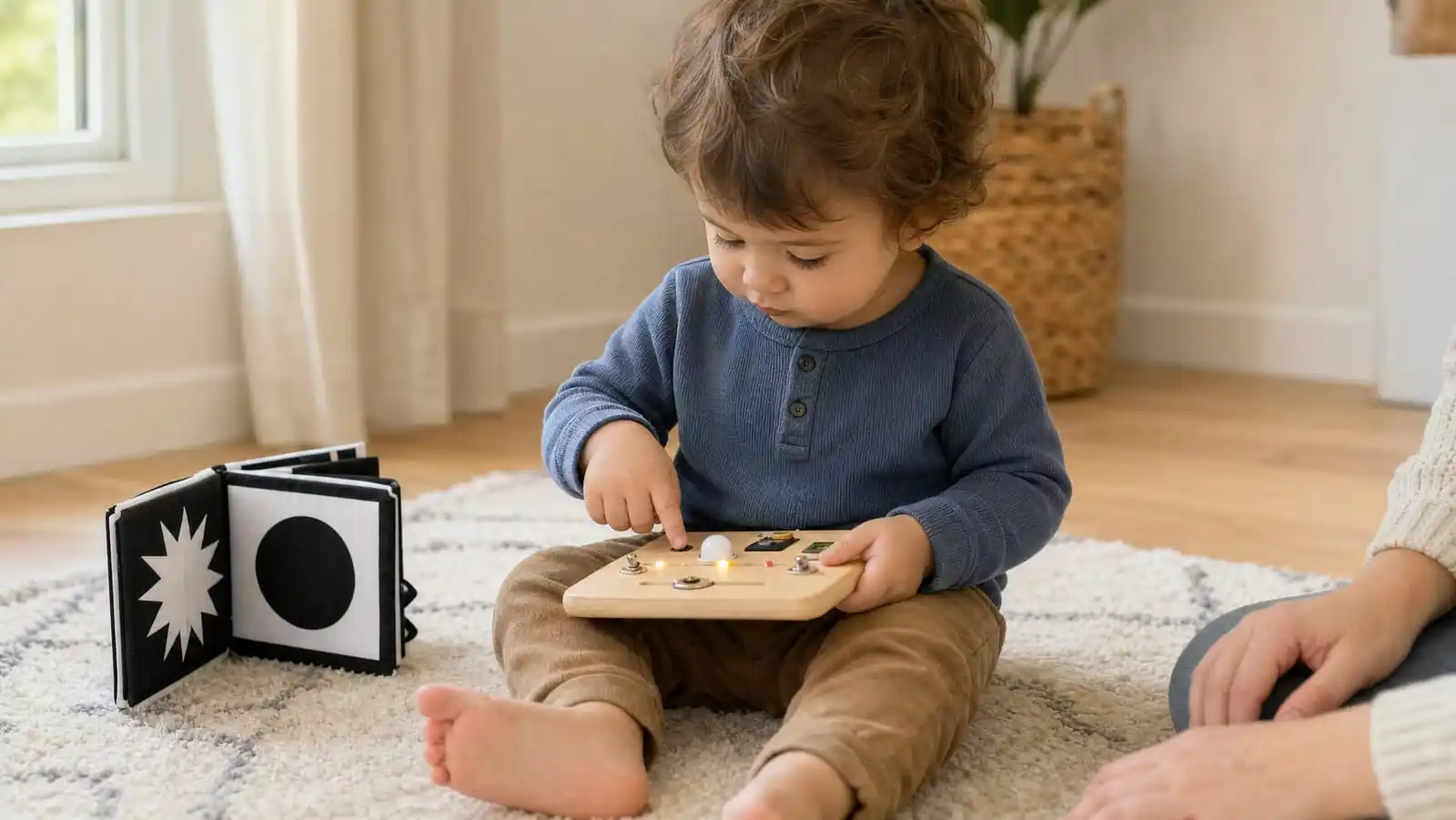
The lead pick is a switch board, because it puts the light under the child's thumb. The HarVow Busy Board with LED Light Switches is $22.99 as of October 2026, and HarVow states it is for 1 year olds and up, titling it for 1, 2 and 3 year olds. Thirteen switches drive 24 LEDs on a solid wood board 6.7 by 5.3 by 1.1 inches, with letters and numbers on the reverse and 2 AAA batteries, not included. The quietly important feature is the master switch, which kills it in one press: the parent keeps an off, the child keeps the on. HarVow states it enhances colour recognition and fine motor skills, and that each LED's brightness is "carefully calibrated - safe for delicate eyes" — HarVow's phrase, with no published measurement behind it.
If you have ever watched a 14-month-old flick the hall light switch forty times while you stood holding the shopping, you know what this category is for.
The second pick is for the child who wants the looking without the noise. The Hieoby Baby Pop Up Toy with Music and Light is $26.99 as of October 2026, and Hieoby states 12-18 months and age 1-2. Five animals pop up behind five actions — push, turn, flip, press, slide — in non-toxic, BPA-free ABS. The feature that earns its place is subtraction, not addition: Hieoby states three modes, and that quiet mode works with no batteries in it at all, learning mode adds an animal sound and game mode adds music and light. Leave the batteries out and the cause and effect survives.
The two high-contrast items are for the youngest end. The beiens High Contrast Baby Flashcards are $8.99 as of October 2026, down from a $9.99 list price: 20 double-sided cards, 40 pages, soy-based ink, and a matte anti-glare surface, with beiens stating sets designed for 0-3, 3-6, 6-12 and 12-36 months. The matte finish is worth having, because glare is what this series keeps returning to. Ignore the marketing. beiens states the cards "activate right brain development" and "cultivate instantaneous memory". No such effect is established.
The soft version is the Infinno High Contrast Baby Book with Mirror, $8.99 as of October 2026 against a $12.99 list price — and Infinno states 0-6 months, so this is the baby-sibling option, not a toddler pick. Black and white on one side, colour on the other, with crinkle pages, an embedded mirror, and a cover that stands upright on a play mat — so a baby on supervised tummy time can look without being held. Infinno states it is chew- and tear-resistant, and that the mirror "aids in self-recognition and cognitive development" — Infinno's wording, not ours.
Toddlers rarely use one sense at a time, which is why tactile toys for toddlers is the companion list: a busy board gets mouthed as much as watched. For older children, the best visual stim toys is the grown-up version of this shelf.
Button batteries, small parts and what an age label actually means
Button and coin cells are the hazard that justifies a rule of its own. A 2022 study in Pediatrics, summarised by the American Academy of Pediatrics, estimated 70,322 battery-related emergency department visits among US children from 2010 to 2019, more than twice the 1990 to 2009 figure, with an average patient age of 3.2 years.
What the law requires. Reese's Law led the CPSC to write 16 CFR part 1263, and CPSC guidance states that covered compartments must "require the use of a tool or at least two independent and simultaneous hand movements to open", and that packaging must bear a warning. Those requirements apply to products manufactured or imported on or after 23 October 2023, the label rule after 21 September 2024. CPSC also states the rule exempts toys that already meet the battery requirements of 16 CFR part 1250, which incorporates ASTM F963.
If a button battery may have been swallowed, treat it as an emergency. The National Capital Poison Center's battery ingestion guideline states that "batteries lodged in the esophagus may cause serious burns in as little as 2 hours", says "do not induce vomiting" and "do not delay going to an ER", and gives the National Battery Ingestion Hotline as 800-498-8666. It describes honey only for a child 12 months of age or older, and only on the way to hospital.
And the small parts. CPSC guidance explains that the ban under 16 CFR part 1501 "prevents deaths and injuries to children under three from choking on, inhaling, or swallowing small objects", a small part being anything that fits completely into a cylinder which "approximates the size of the fully expanded throat of a child under three years old". That is why light-up toys so often carry 3-plus: it describes what could come loose and what sits behind the battery door, not whether a 2-year-old would enjoy it. Either way it is the maker's stated age, and we do not go below it.
So: open the battery door before handing a toy over. If it comes off without a screwdriver and the cells are coin-shaped rather than cylindrical AA or AAA, it does not belong with an unsupervised under-three.
High Contrast, Low Vision and CVI
If you are searching for sensory toys for a visually impaired child, the short answer is high contrast, large simple shapes and light used as a target — and the real answer is a referral. The beiens high-contrast cards at $8.99 as of October 2026 are a cheap starting point. Past that, toy choice stops being something an article can do well.
Cerebral or cortical visual impairment is why. The National Eye Institute, announcing a working definition published in Ophthalmology in November 2024, describes CVI as "a brain-based condition that has emerged as a leading cause of vision impairment starting in childhood" in the US and other industrialised nations, and states that "some estimates suggest that at least 3% of primary school children exhibit CVI-related visual problems". One of the five elements in that definition is the blunt heading that "CVI is easily missed"; the NEI adds that it "is prone to misdiagnosis and underdiagnosis in children with other concurrent neurodevelopmental disorders", autism among them.
Nor is it only a school-age finding: an NEI-sourced report on CVI and childhood vision loss notes that in a US registry of 2,155 children with visual impairment from birth to age 3, CVI was the most common diagnosis at 24 percent — a share of the children already identified as visually impaired, not a rate for all toddlers.
So: a paediatric ophthalmologist, a low-vision specialist, a qualified teacher of children with visual impairment. A functional vision assessment tells you which contrast, size and position your child uses — a specialist judgement, not a shopping decision.
What These Toys Will and Will Not Do
None of these toys treats anything. They give visual input, they let a toddler make a predictable thing happen on purpose, and a board of small switches asks fingers to work separately.
They do not treat or improve autism, ADHD or sensory processing differences, they do not accelerate development, and the brain-development marketing across this category — right-brain activation, instantaneous memory — is not supported by anything we found.
A light-up toy is also not a calming intervention. Some children settle with one and some wind up; the maker cannot tell you which, and nor can we. One toy, watched for a fortnight, receipt kept.
Frequently Asked Questions
Are light-up toys safe for a 1 year old?
A toy at or above its maker's stated age, with a battery door that needs a tool, is reasonable to hand a 1 year old. The two checks that matter are above: no accessible coin cells, and nothing that fits the CPSC's small parts cylinder. Beyond that it is about the child, not the toy: some one-year-olds love a lit switch and some turn away, and no maker can tell you which yours is.
What does it mean if my toddler stares at lights?
Usually that lights are interesting: steady, high-contrast, predictable, controllable with a turn of the head. The 2007 study of 679 typically developing 2-year-olds found "repetitive behaviours of every type were frequently reported", so staring at lights alone is weak evidence of anything. What changes the answer is company — a skill lost, no response to their name, no pointing, or an eye that turns or looks white in the pupil. Those go to a doctor or an optometrist, and the CDC's advice is not to wait.
What are the best visual sensory toys for a 1 year old?
Things with switches. The HarVow busy board at $22.99 as of October 2026 and the Hieoby pop-up at $26.99 as of October 2026 are both stated for this band and both make the child the cause. Prefer the toy your child operates over the toy that performs: a projector gives a 1 year old nothing to do.
Are high-contrast cards worth buying for a baby?
For a young infant the mechanism is real — contrast sensitivity starts poor and improves over the first months — so a bold black-and-white pattern is easier to resolve than a pastel one. The $8.99 beiens cards and the $8.99 Infinno book, both as of October 2026, are cheap enough that the question barely arises. What they will not do is the brain development on the packaging. Infinno's is stated 0-6 months; if your child is two, buy the switch board.
Conclusion
Buy the switch, not the show. At one to three the toy that does most is the one your child turns on and off: the $22.99 HarVow board for a child who wants the lights, the $26.99 Hieoby pop-up with the batteries left out for a child who wants the looking without the noise, the $8.99 high-contrast cards if there is a baby in the house. All prices as of October 2026.
Then the two things that matter more. Check the battery door and the small parts, because that is where the documented harm in this category lives. And take the worry about light to a person rather than a search box.
For the rest of the series, start with our visual sensory and light sensitivity guide.