This article contains affiliate links. We may earn a commission if you make a purchase through our links, at no extra cost to you.
Key Takeaways
- Blue-light filtering lenses are a weak bet. The 2023 Cochrane review pooled 17 randomised trials and 619 participants: the lenses "may not" reduce short-term eye strain from computer work.
- Social invisibility is a selection criterion, not vanity. A lamp, a seat change and a monitor setting draw no comment in an office. Sunglasses indoors draw one daily.
- The adult evidence base is thin, and that is the honest headline. A 2026 review of 29 studies found only two examined vision alone, and names the field's focus on childhood as a bias.
- Most adult light-sensitivity research is migraine research. Up to 80 percent of migraine patients get photophobia during an attack, per a 2012 Journal of Neuro-Ophthalmology review.
- Nothing here treats autism, ADHD or SPD. It changes the light you sit under.
The change we would try first costs nothing: switch off the overhead light, put a lamp beside the screen rather than above your head, and move the desk so no window or fixture sits in front of you. Then the real problem starts, because at work none of that is yours to decide.
The optics do not change with age, and light sensitivity in autism and ADHD covers the flicker, spectrum and glare mechanics. What changes is who decides, how the fix looks to other people, and where the light is. At eight it was overheads and windows; at twenty-eight it is those plus the screen — the American Optometric Association puts the average US worker at "seven hours a day on the computer."
What Changes After Childhood (and What Does Not)
Who decides. A teenager chooses whether the glasses come out of the bag; a thirty-year-old chooses whether an employer is told at all. Nobody is writing you a plan.
How it looks. This is why adult accommodations fail, and nobody writes it down. Sunglasses indoors read as rude; a rose tint gets remarked on at every stand-up until you stop wearing it. A plain pair of glasses, a desk lamp and a changed monitor setting are socially invisible, and that invisibility is a real reason to prefer them. You should not have to spend social credit daily to stop your head hurting.
And here is the gap we will not paper over. The 2026 systematic review of light and sound hypersensitivity in autism by Ríos Llamas and colleagues, in Frontiers in Psychiatry, synthesised 29 studies, only two of them visual alone. It states that "visual research is limited, with no studies on photophobia or modern lighting", and names the field's "focus on childhood and adolescence" as an age bias.
The adult literature on painful light sits in headache medicine instead. In their 2012 review Shedding Light on Photophobia in the Journal of Neuro-Ophthalmology, Digre and Brennan report that "up to 80% of migraine patients experience photophobia during an attack." The nearest neighbour, not the answer.
What exists for autistic adults is self-report. In the focus-group study by Parmar and colleagues, in Frontiers in Psychology in 2021, 18 autistic adults reported that "bright, flickering, fluorescent, 'strip,' and 'spot' lighting caused discomfort." Light rarely arrives alone, which is why vestibular tools for teens and adults live in the same drawer as the desk lamp.
The Screen Is the New Fluorescent Tube
The screen is the one bright surface you look directly into for hours, and the one you fully control.
1. Match the screen to the room instead of maximising it. The Canadian Centre for Occupational Health and Safety notes that a monitor "can cause glare if the brightness and contrast controls are not properly adjusted." Quick check: if white paper held beside the screen looks grey, the screen is too bright for the room.
2. Fix the geometry before anything else. The same page states that "reflections of objects, shiny walls, and any light source (specifically windows and overhead lighting) all cause glare", and advises placing the monitor "parallel (not directly below) with overhead lights" and to "angle the monitor away from lights and windows." A glossy panel facing a window is a mirror with text on it: a blinds problem, not a brightness one.
3. Make the text bigger before you make the screen dimmer. The AOA attributes part of digital eye strain to the fact that "the level of contrast of the letters to the background is reduced" on screens. Dark mode is worth trying — less light leaves the panel — but the College of Optometrists says "there is little evidence available to say whether it is effective at reducing digital eye strain." A preference, not a fix.
4. Take the breaks, and know what they are. CCOHS and the AOA both give the 20-20-20 rule — in CCOHS's wording, "at least every 20 minutes, take a 20-second break and look at something 6 metres (20 feet) away." It costs nothing. It is also not well evidenced: in 20-20-20 Rule: Are These Numbers Justified?, in Optometry and Vision Science in 2023, Johnson and Rosenfield tested 20-second breaks at three intervals against none in 30 participants, concluding that "these results do not support the proposal of using 20-second scheduled breaks as a therapeutic intervention for digital eye strain." Longer breaks may do more; nobody has tested the number.
5. Raise the light around the screen so the screen can come down. This is the move, and it is the opposite of the instinct: a bright screen in a dark room puts the panel-to-surroundings contrast at its maximum, and CCOHS names an "improper match or excessive contrast in light levels" between the screen and the paper beside it among the causes of eye discomfort at a desk. Light the wall behind the monitor and the screen can drop a long way while staying readable. CCOHS adds the companion point: "make sure that the task lamp illuminates the document and not the monitor."
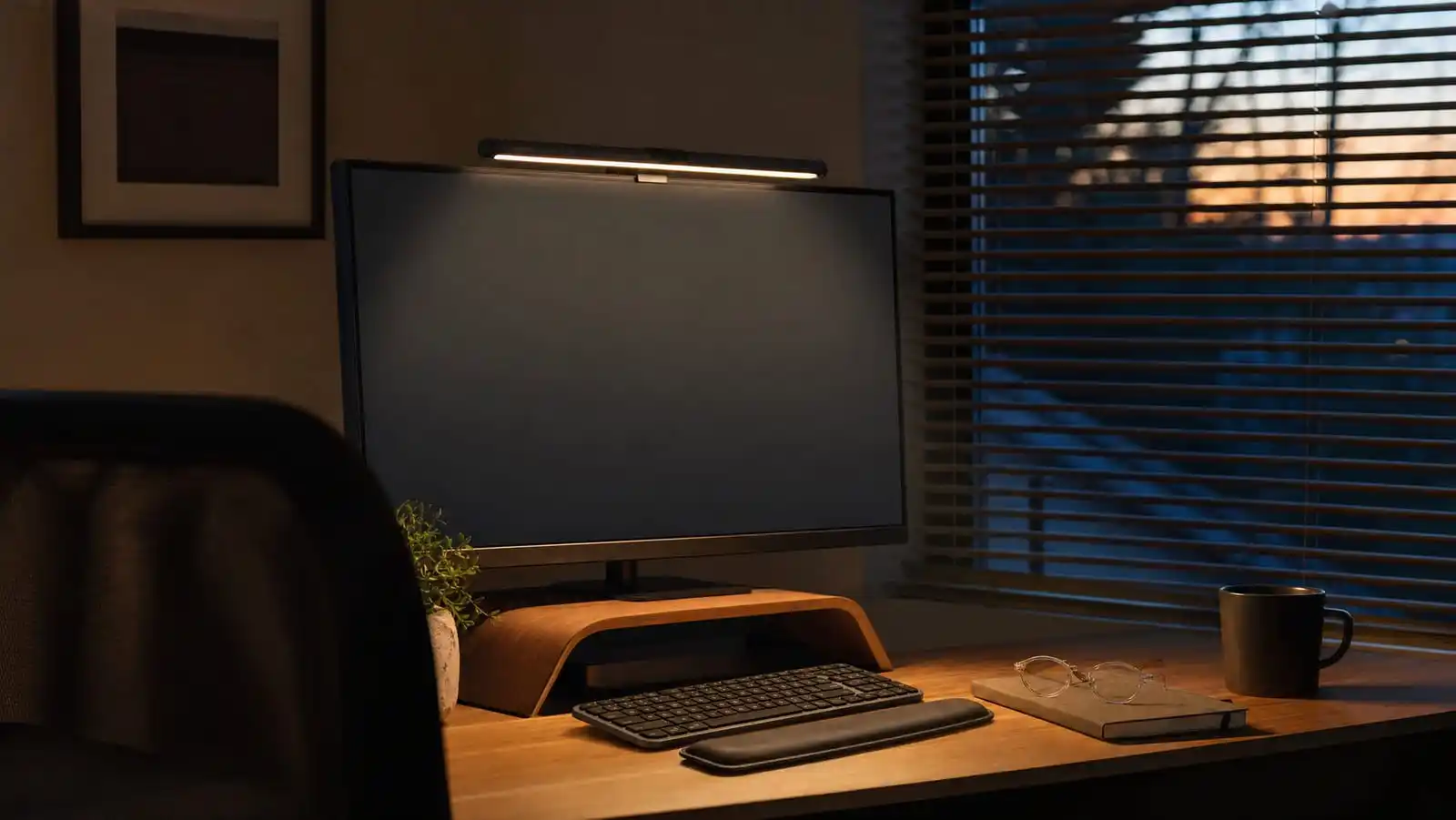
The purpose-built version is a monitor light bar, and it is the thing here we would reach for first. The YEELIGHT Monitor Light Bar is $26.49 as of October 2026: a USB-powered metal bar clipping to a flat or curved screen 0.3 to 1.1 inches thick, low enough not to block a webcam. The specification that earns its place is 2700K to 6500K with stepless dimming — it goes warm and very low, which fixed-6500K bars cannot. YEELIGHT states 250 lumens, a Colour Rendering Index of Ra95, an RG0 rating it calls the highest standard for blue light safety, and flicker-free illumination: the maker's figures, not independent measurements.
Glasses, Tints and the Indoors-Sunglasses Problem
Start with the research, because the marketing here is worse than the product. The 2023 Cochrane systematic review by Singh and colleagues, in the Cochrane Database of Systematic Reviews, pooled 17 randomised trials with 619 participants. Blue-light filtering lenses "may not" reduce short-term eye strain from computer use, sleep effects were indeterminate, and no included study measured retinal health at all.
The American Academy of Ophthalmology is blunter: "there is no scientific evidence that blue light from digital devices causes damage to your eye", and "the Academy does not recommend any special blue light-blocking eyewear for computer use."
Sensory tints are a different product with a different evidence base, covered in our guide to light sensitivity glasses and tinted lenses. Parmar's participants reported that "sunglasses and photochromic lenses are helpful as they reduce light levels" — though the study records them as a partial solution rather than a complete one.
A plain-looking pair beats a better tint in an office, because the tint comes off in the first meeting where somebody mentions it. A lens that gets worn beats a lens in a drawer.
Which is the only honest case for cheap computer glasses. The Benicci blue light blocking glasses are $21.97 as of October 2026: non-prescription, classic unisex frames, supplied with a case. The listing says they help protect your eyes from the harmful effects of blue light and that wearing them at night may encourage melatonin production. Set both aside: the Academy found no evidence of screen light damaging the eye, and Cochrane found the sleep evidence indeterminate. What a lens like this does is dim a bright screen slightly, behind a frame nobody remarks on. If nothing changes in two weeks, that is the expected result and $21.97 is the cost of knowing.
Lighting the Rooms You Do Control
The home work in this series is unchanged by age: overheads off, light the task, desk out of the glare path. Three things are adult-specific.
The overhead you never turn on. In a flat you rent, deciding one ceiling fixture is decorative is free and needs nobody's approval.
Lamps at head height, not ceiling height. CCOHS's lighting guidance recommends "using several small low-intensity light fixtures rather than one large high-intensity light fixture". Two or three low lamps light the task with nothing bright in your upper field of view.
The car at night. One of Parmar's participants described how "the headlights seem to bleed and wash out some of the rest of the visual experience." Clean glass and the mirror on its night setting are free. A tint is not what we would reach for, since it removes light when you most need it; trouble driving at night is a question for an optometrist.
New or worsening light sensitivity is a medical question, not a shopping one
New, one-sided or painful light sensitivity, and any change in vision, is not a sensory-profile question. The US National Library of Medicine's MedlinePlus entry on light sensitivity lists corneal abrasion, acute iritis or uveitis, migraine headache and meningitis among its causes, and says to contact a provider if "light sensitivity is severe or painful" or if it "occurs with headaches, red eye or blurred vision or does not go away in a day or two".
On flicker, both halves of the fact matter. The UK Epilepsy Society states that "around 1 in 100 people has epilepsy and, of these people, around 3% have photosensitive epilepsy", and lists "lights flickering, such as faulty fluorescent tubes" among triggers. Epilepsy is also more common in autistic people: a 53-study review by Zarakoviti and colleagues in the Journal of Autism and Developmental Disorders, on PubMed Central, found co-occurring epilepsy in 7 percent of 257,892 autistic individuals. Office lighting does not cause epilepsy, and most people are not photosensitive — but flickering tubes are on that trigger list for the minority who are, and an unexplained blank spell or collapse belongs with a doctor first.
Asking for an Adjustment at Work or College
Most of what you need is cheap, reversible and needs no process at all. A desk moved out of the window's reflection, a tube switched off above one workstation, a lamp instead of the overhead: these are conversations with a manager, not applications. Ask one at a time, and name the effect rather than the cause — "I get headaches under that fixture by mid-afternoon".
When the informal route fails there is a formal one. This is general information, not legal advice; processes differ by employer, country and institution. In the US, the ADA National Network describes a reasonable accommodation as "any change to the application or hiring process, to the job, to the way the job is done, or the work environment", and states that "the process must be interactive, with participation by both the person with a disability and the employer." It begins with a disclosure linking a condition to a job duty, and an employer may request medical documentation where a disability is not obvious. In the UK, Acas states that "the law (Equality Act 2010) says that employers must make reasonable adjustments", listing "changing the lighting above someone's desk or workstation" as an example.
Disclosure is a real choice with real trade-offs, and it is yours. The informal ask protects your privacy and gets you a lamp. The formal route gets an adjustment that survives a new manager, and costs you the privacy. If the room is loud as well as bright — it usually is — plan it alongside noise sensitivity in teens and adults rather than asking twice.
The two-week single-change test
Change one thing. Keep everything else constant for two weeks, and write down each evening a headache score out of ten and your hours at a screen. Then change the next thing.
It is slow, and it is the only way to know which change worked — and whether glasses did anything the dimmer screen had not.
Frequently Asked Questions
Is it OK to wear sunglasses indoors as an autistic adult?
Yes — it is your face, and Parmar's participants described sunglasses and photochromic lenses as helpful because they reduce light levels. The caveat is social, not medical: indoor sunglasses attract comment in most workplaces, so people end up carrying them rather than wearing them. Photochromic lenses are the usual compromise. If the need for them is new, one-sided or painful, though, that is a question for an eye doctor before it is a question of lenses.
What office lighting is best if you are light sensitive?
Less of it, lower down, and not in front of you. CCOHS recommends "several small low-intensity light fixtures rather than one large high-intensity light fixture", and positioning a workstation so windows and fluorescent tubes run parallel to your line of sight. In practice: overheads off, a task lamp on the paperwork rather than the monitor, a blind on the window behind the screen.
Do blue light glasses help screen light sensitivity in autism?
Probably not, for eye strain at least. The 2023 Cochrane review of 17 trials and 619 participants found the lenses "may not" reduce short-term eye strain from computer use, and the American Academy of Ophthalmology does not recommend them for computer use. No trial in it studied autistic participants. A cheap pair is a defensible experiment; the room and screen changes above have better odds.
Does autism light sensitivity improve with age?
Nobody has good data, which is itself the answer: the 2026 Frontiers in Psychiatry review concluded that "long-term studies are lacking, particularly in adults and individuals over the age of 50." What the adult self-report suggests is that the circumstances change more than the sensitivity does — more control over your home, much less over a workplace, far more screen time.
Conclusion
Work from the outside in. Move the desk and the screen first, because geometry is free and CCOHS has written the rules down. Then light the room around the screen rather than the screen itself, which is where $26.49 is well spent. If anything is left over, try a plain pair of glasses as a two-week experiment, expecting the result the research predicts. All prices as of October 2026.
And keep the social cost in the calculation. The accommodation that gets used every day is the one nobody notices, and choosing the invisible version is reasonable in a room full of colleagues who have never thought about a light fixture.
For the mechanics underneath all of this — why flicker, spectrum and glare hurt — start with our complete visual sensory guide.