This article contains affiliate links. We may earn a commission if you make a purchase through our links, at no extra cost to you.
Key Takeaways
- Heavy work is any activity that pushes or pulls against the body — carrying, lifting, climbing, squeezing, even chewing something chewy.
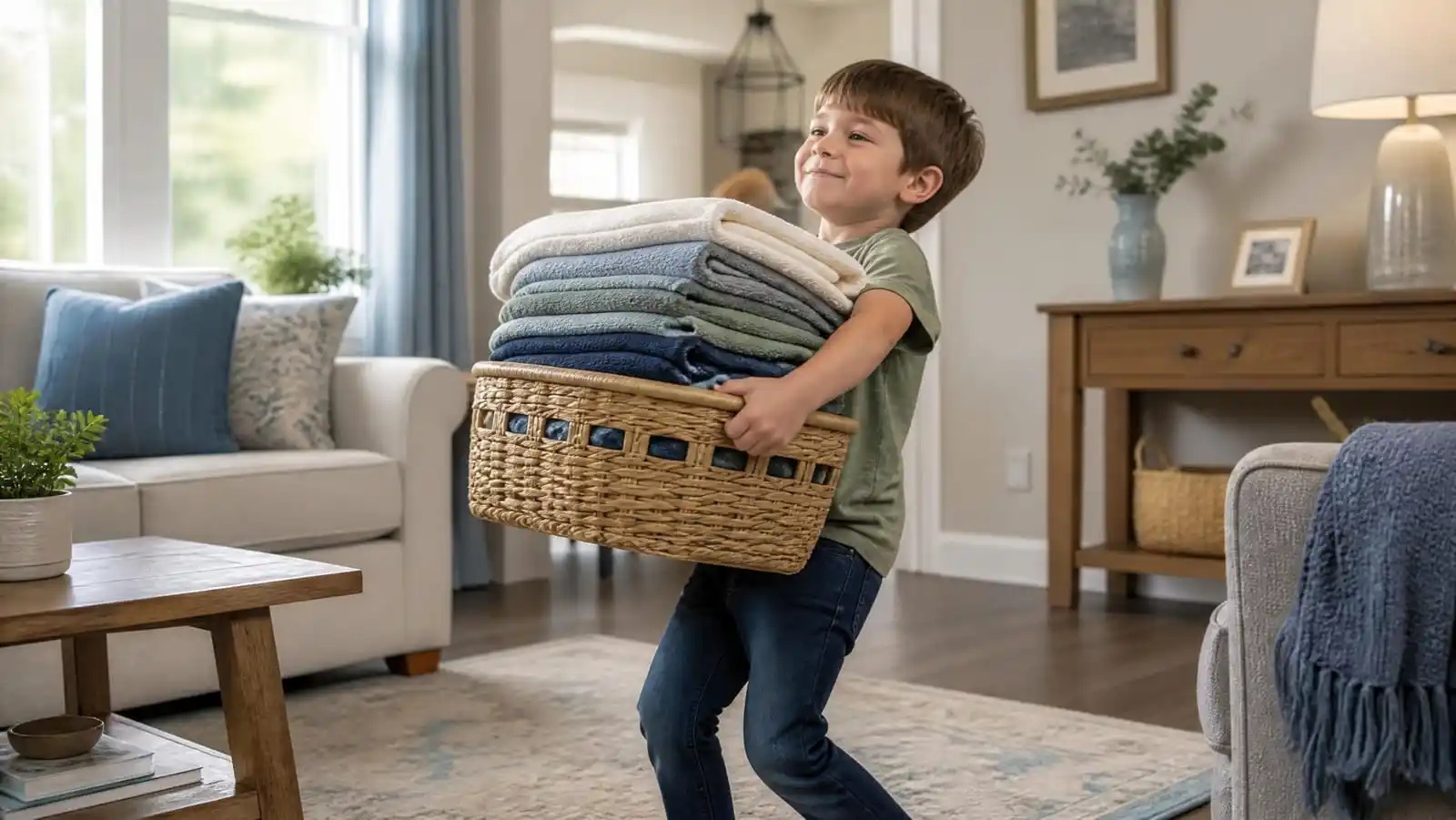
- You need no special equipment: a laundry basket, a couch cushion, two cans of soup and a wall cover most of this list.
- OTs reach for it because sensory integration theory holds that proprioceptive input is calming and organizing for the nervous system.
- Short bursts beat marathons. Two or three minutes before a hard transition often beats twenty minutes at the wrong moment.
- It is a support, not a treatment plan. If regulation or body awareness is affecting daily life, an occupational therapist can assess your child.
Heavy work activities are tasks that push, pull, lift or carry against resistance — and they are one of the simplest strategies occupational therapists suggest for a wound-up or foggy child who needs help feeling settled in their own body. According to Understood, heavy work is "any type of activity that pushes or pulls against the body," and occupational therapists use it with kids who either seek out or avoid certain kinds of sensory input.
The good news for a tired parent at 4:45pm on a Tuesday: you already own everything you need. All 20 heavy work activities for kids below run on laundry baskets, couch cushions, grocery bags and stairs. This is the hands-on companion to our guide to proprioceptive and heavy work sensory tools — read that one for the equipment, this one when you need something to do in the next ten minutes.
What Heavy Work Is and Why It Helps
Heavy work is resistance work. As pediatric occupational therapist Colleen Beck, OTR/L, describes it on The OT Toolbox, it is "activity that requires effort from our muscles," activating muscles and joints through the proprioceptive system by pushing, pulling or lifting.
That is the mechanism. Working muscles and compressed joints send clear, unambiguous signals to the brain about where the body is and how hard it is working — which is what proprioception actually is. For a child whose internal body map is fuzzy, that information can be grounding in a way verbal reminders are not.
Sensory integration theory holds that proprioceptive input helps calm and organize the brain, which is why it is so widely suggested as a regulation strategy, as pediatric OT Kim Griffin explains on GriffinOT. Parents put it more bluntly: the kid bouncing off the walls sits down at the table.
What the Research Says
A 2025 systematic review of nine randomized controlled trials covering 344 children, published in the American Journal of Occupational Therapy and indexed on PubMed, found strong evidence that Ayres Sensory Integration delivered under fidelity helps autistic children meet individualized goals — and moderate evidence of no benefit for "behaviors of concern" such as noncompliance or irritability. Movement itself also has a track record: a 2023 meta-analysis of 10 randomized controlled trials in Frontiers in Physiology, via PubMed Central, reported a moderate effect of physical activity on attention problems in school-age children with ADHD.
Do not try all 20. Pick two or three that fit your house and your child, then repeat them until they are predictable — a child who knows "we do wall pushes before homework" gets a routine, not a correction. Watch what follows: some kids come down, some ramp up first and settle later, a few need something quieter.
Push and Pull Activities
The fastest to deploy, and most work in a hallway.
1. Wall push-ups. Palms flat on the wall at shoulder height, feet an arm's length back, bend the elbows until the nose nearly touches, push away. Ten slow reps — the most portable heavy work there is.
2. Laundry basket bulldozer. Put two or three thick hardcovers in a laundry basket and have your child push it down a carpeted hallway. The carpet supplies the resistance; add or remove a book to change it.
3. The couch push. Your child sits on the floor, back against the couch, feet planted, pushing as if to shove it through the wall. Nothing moves. Everything works. A thirty-second reset when there is no room to run.
4. Towel tug-of-war. Roll a bath towel lengthwise, take an end each, pull with slow steady tension — no jerking, no sudden releases. Sustained effort, not competition.
Carry and Lift Activities
Carrying loads the shoulders, arms and core at once, and it comes with a job attached.
5. Grocery unload relay. Hand over cans and boxes one at a time to carry from door to pantry. A can of beans is heavy to a five-year-old.
6. Book stack shuttle. Move picture books from a low shelf to one across the room, three or four per trip. Then move them back and call it reorganizing the library.
7. Water bottle delivery. Fill a one-liter bottle and have your child carry it to every bedroom. Stairs make it harder.
8. Backpack walk. A few books in a backpack, straps tightened, one lap around the block. Keep the load light — see the safety section below.
Whole-Body Heavy Work
Usually the biggest hit with sensory seekers: input to everything at once.
9. Animal walks. Bear walk on hands and feet with the bottom in the air, crab walk belly-up, frog jumps from a deep squat. One lap of the living room per animal.
10. Cushion crash pad. Stack couch cushions into a pile and let your child jump in from standing, or from a low step with you right there. It gives the crashing child a safe target instead of furniture.
11. Cushion squish. Your child lies face-down while you press a couch cushion firmly and evenly along their back, arms and legs, a few seconds at a time. Never over the head or face; the child controls "more," "less" and "stop."
12. Blanket burrito. Lay a blanket out, have your child lie at one edge, roll them up snugly with the head out. Unroll, repeat. Many kids ask for this by name.
13. Stair climbing on all fours. Crawling up a flight of stairs is serious work for shoulders and hips. Give it a purpose — deliver folded socks to the top — and it stops feeling like exercise.
Hands and Mouth Heavy Work
The small joints of the hands and the muscles of the jaw respond to resistance too — invaluable when a child needs to stay seated.
14. Stiff dough digging. Knead a ball of cold, firm play dough until it softens, then press beads in and have your child dig them out. Cold dough is harder than warm — a free difficulty dial.
15. Chewy and crunchy snacks. A bagel, dried mango, carrot sticks, or a thick smoothie through a narrow straw all make the jaw work. Many OTs suggest oral heavy work for kids who chew sleeves and pencils.
16. Sponge squeeze station. Two bowls, one full of water. Your child soaks a large sponge and wrings it into the empty bowl until the water has moved across. Hand strengthening disguised as water play.
Chore-Based Heavy Work
Real jobs are the sleeper hit: resistance, a visible result, and they help you.
17. Vacuuming. Pushing and pulling a vacuum across carpet is textbook heavy work, and it leaves a strip of clean floor as proof.
18. Table scrubbing. A spray bottle, a cloth, and the instruction to press hard enough to make it squeak. Big circles, whole arm, shoulders engaged.
19. Recycling run. Carry a bag of cans to the curb, then drag the empty bin back. The bin is awkward as well as heavy, which adds motor planning.
20. Yard and garden work. Raking leaves, digging with a trowel, shoveling snow off the step, or watering plants with a full can — about as much resistance as a child can get without equipment.
When in the Day to Use Heavy Work
Timing matters. The highest-value slots are just before something hard: homework, getting in the car, a haircut. Two minutes of pushing or carrying gives the nervous system something concrete to organize around.
Many families also use it in the wind-down after a big day, alongside deep pressure and proprioceptive input for calming and self-regulation. What we would not suggest is introducing a brand-new activity mid-meltdown — practice these when everyone is calm, so they are familiar later.
Movement and resistance pair well, too. If your child is a climber or a spinner, mixing heavy work with vestibular activities is often more satisfying than either alone. And because none of this needs equipment, it travels: heavy work at school can help a child hold it together rather than unravelling at pickup.
How Often and How Much
There is no universal dose, and be skeptical of any source that hands you one as a rule. Colleen Beck, OTR/L, puts it plainly: "How often you use heavy work input will depend on the individual child. Be guided by the child's enjoyment and response to the activity that you introduce." Her suggested starting point is one activity in the morning before school and another on arriving home.
Scheduled more formally, heavy work becomes part of a sensory diet — which the NAPA Center describes as "the use of individualized activities or tools at specified frequencies throughout the day to support your child's regulation," with your OT recommending dosages to trial. Any "every 90 minutes" or "every two hours" figure online is a starting point an OT sets with you, not a fact about all children.
On length, Understood notes that "the most effective heavy work activities only last for a short time." Two to five focused minutes, repeated at useful moments, is realistic.
Doing Heavy Work Safely
- Supervise, especially with crashing and climbing. Cushion piles slide, and enthusiasm outpaces judgment.
- Let your child stop whenever they want. Heavy work only works with a willing participant. Never force resistance, never push through a "no," and treat "stop" as final.
- Keep carried loads light. GriffinOT's guidance is that weights a child carries should not exceed about 5% of the child's body weight, and that weight training equipment calls for professional advice. For a 40-pound child that is roughly two pounds — a couple of library books, not a loaded backpack.
- Watch for pain. Joint pain, soreness lasting into the next day, or a child guarding a limb are reasons to stop and check with a professional. Effort should feel like effort, not hurting.
- Never apply pressure to the head, neck or face. Keep squishing and wrapping to the trunk and limbs.
- Check with an OT or physician first if your child has low muscle tone, joint hypermobility, a heart or respiratory condition, a seizure disorder, or any diagnosis affecting bones, joints or muscles. This is not boilerplate: a randomized controlled trial in Pediatric Rheumatology Online Journal, hosted on PubMed Central, found that a "physiotherapist prescribed, supervised, individualised and progressed exercise programme effectively reduces knee pain in children with JHS" — the operative words being prescribed, supervised and individualized.
Scaling Heavy Work by Age
The same activity works across a decade of childhood if you adjust the load and the language. A four-year-old carries one water bottle; a ten-year-old carries the case.
Younger children need shorter, lighter, more playful versions with closer supervision. Our guide to proprioceptive activities for toddlers and preschoolers covers that age band, including which ideas adapt down safely.
Older kids often reject anything that feels like a therapy task. Route the input through something with status: hauling firewood, carrying the shopping, helping a neighbor move boxes, or a sport with a lot of pushing in it.
Frequently Asked Questions
How often should my child do heavy work activities?
There is no evidence-based universal schedule. The OT Toolbox suggests starting with one session in the morning and one after school, guided by your child's response. If heavy work is part of a formal sensory diet, the NAPA Center notes that your OT sets the frequencies and dosages after assessing your child.
How long does the calming effect last?
Nobody can give you a reliable number, and the figures circulating online are not well supported. What is documented is that short bursts tend to be the effective ones — Understood notes that the most effective heavy work activities only last a short time. So place it before demanding moments rather than doing it once and expecting it to hold all day.
Does heavy work help children with ADHD, or only autistic kids?
Both, plus children with sensory processing differences generally; Understood frames it as a strategy for sensory processing challenges, which cut across diagnoses. There is separate evidence that physical activity supports attention in ADHD: the 2023 Frontiers in Physiology meta-analysis found a moderate improvement in attention problems in school-age children.
Is heavy work actually evidence-based?
Partially, and it is worth being precise. It sits inside sensory integration practice, where the 2025 AJOT review of nine randomized controlled trials found strong evidence that Ayres Sensory Integration under fidelity helps autistic children reach individualized goals — and moderate evidence of no benefit for behaviors of concern. Heavy work as an isolated home strategy has not been tested that way. Low-cost, low-risk when done safely, widely recommended by OTs: that is a fair summary.
What age can we start heavy work?
Toddlers are already doing it — carrying, climbing, pushing chairs around — so the real question is how you structure it. Scale the load and duration down, keep it play-based, supervise closely. For any medical or musculoskeletal condition, check with an OT or physician first.
The Bottom Line
Heavy work costs nothing, travels everywhere, and many parents notice a change in their child within minutes. Start with three ideas — one push, one carry, one chore — attached to moments you already have: before homework, before dinner, before bed. Watch for a week, then adjust.
When you are ready to go deeper on the tools behind this input, our complete proprioceptive input guide is the next stop. And if body awareness or regulation is affecting your child's daily life, an occupational therapist can build a plan around the child you actually have.