
This article contains affiliate links. We may earn a commission if you make a purchase through our links, at no extra cost to you.
Installing a Sensory Swing: It's Easier Than You Think
Staring at that sensory swing still in the box? You're not alone. Many parents feel intimidated by installation—but with the right guidance, you can have your child swinging safely within an hour.
The key is choosing the installation method that matches your living situation. You have three main options:
- Ceiling mount – Most secure, allows full motion, requires drilling
- Doorway bar – No drilling, great for renters, limited motion
- Swing stand – Completely portable, no installation at all
Each method works. The best one depends on your home, your lease, and how much swinging space you need.
Proper installation isn't optional—it's what keeps your child safe. A sensory swing supports dynamic movement, which creates forces significantly higher than static weight. That's why we'll walk you through every step with safety as the priority.
For a broader overview of swing types and benefits, see our complete guide to sensory swings. This article focuses specifically on getting your swing installed correctly.
Before You Begin: Choosing Your Installation Method
Your living situation determines which method makes sense. Here's how to decide.
Ceiling Mount
Best for: Homeowners who want a permanent installation with full swinging and spinning motion.
A ceiling mount offers the most versatility. Your child can swing in any direction, spin, and move freely. It's also the most secure option when installed correctly.
Requirements:
- Access to ceiling joists (solid wood beams behind drywall)
- Ceiling height of 6-9 feet
- 6+ feet of clearance from walls and furniture
- Basic tools: stud finder, drill, wrench
Consider this if: You own your home, have accessible ceiling joists, and want the full sensory swing experience.
Doorway Bar
Best for: Renters, apartments, or anyone who needs a removable option.
Doorway bars mount with screws into the door frame—no ceiling drilling required. The tradeoff is limited motion (mostly front-to-back swinging rather than full rotation).
Requirements:
- Doorway 26-36 inches wide
- Solid wood door frame (not metal or drywall)
- 2.25 inches of flat space for brackets
Consider this if: You rent, can't drill into ceilings, or need to remove the swing easily.
Swing Stand
Best for: Maximum portability, outdoor use, or when you can't modify your home at all.
Freestanding swing stands require zero installation—just assemble and use. They work indoors or outdoors and can be moved or stored as needed.
Requirements:
- Floor space of approximately 8.5 x 8.5 feet
- Level ground
- No additional tools beyond what's included
Consider this if: You rent with strict no-modification rules, want to use the swing outdoors, or need to move it between locations. For more on placement options, see our guide to indoor vs outdoor swings.
Tools and Materials Needed
Gather everything before you start. Nothing derails a project like a mid-installation hardware store trip.
For Ceiling Mount Installation
Tools:
- Electronic stud finder (magnetic works but electronic is more reliable)
- Power drill with pilot drill bit
- Wrench or adjustable pliers
- Measuring tape
- Pencil
- Step ladder
Hardware (often included with swing, but verify):
- Eye bolt OR swing hanger plate
- Lag screws (sized per manufacturer instructions)
- Locking carabiners (screw-lock or auto-lock type)
- Daisy chain or adjustable strap for height adjustment
For detailed guidance on hardware ratings and what to look for, see our sensory swing buying guide.
For Doorway Bar Installation
- Doorway swing bar kit (includes bar, brackets, screws)
- Screwdriver or drill
- Measuring tape
- Pencil
- Optional: foam padding or pool noodles for door frame edges
For Swing Stand Setup
- Swing stand frame (all hardware typically included)
- Usually no additional tools required—most use snap-button or hand-tight bolt assembly
How to Install a Ceiling-Mounted Sensory Swing
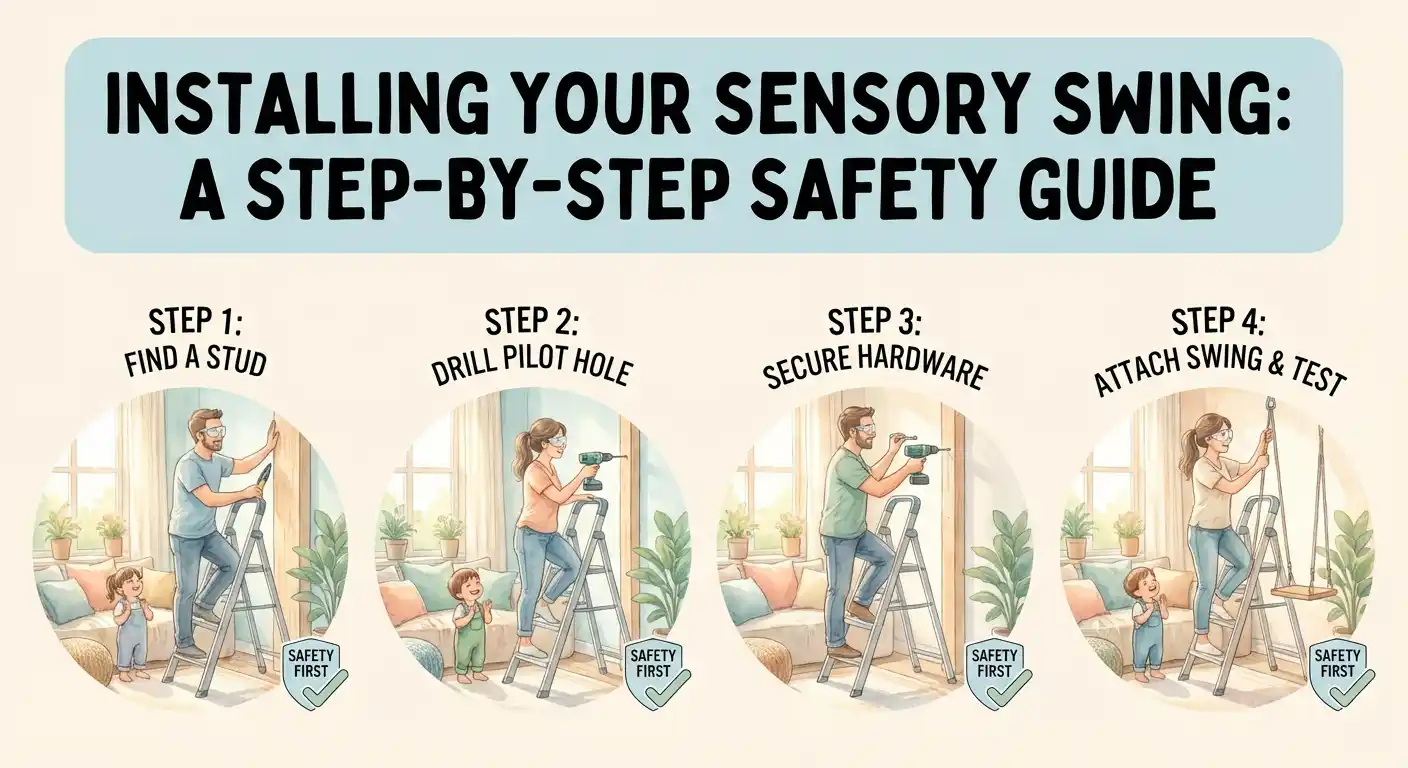
Ceiling mounting provides the best experience but requires the most careful installation. Follow each step—skipping ahead invites problems.
Step 1: Find Your Ceiling Joists
This is the most critical step. Sensory swings must mount into solid wood ceiling joists, never into drywall alone. Drywall cannot support the weight and dynamic forces of swinging.
Use your stud finder to scan across the ceiling where you want to install:
- Turn on the stud finder and calibrate it against a section of ceiling
- Move slowly across the ceiling, marking where it indicates a joist
- Mark both edges of the joist with pencil—the joist runs between those marks
- Drill a tiny test hole (1/16 inch) in an inconspicuous spot to confirm solid wood
Pro tip: Ceiling joists typically run perpendicular to floor joists and are spaced 16 or 24 inches apart. Once you find one, you can often predict where others will be.
Step 2: Choose Your Location
Finding a joist is step one. Making sure the location works for swinging is step two.
Check for:
- 6 feet minimum clearance from walls, furniture, and other obstacles in all directions
- Clear floor space where the swing will move
- Adequate ceiling height (6-9 feet ideal—lower ceilings work but limit swing motion)
- No overhead hazards like ceiling fans, light fixtures, or exposed beams in the swing path
Walk through the swinging motion in your mind. Picture your child swinging forward, backward, spinning. Will they hit anything? Move your mounting point if needed.
Step 3: Drill Pilot Holes
Once you've confirmed your joist location and cleared the surrounding space:
- Mark the exact center of the joist where you'll install hardware
- Select a pilot bit slightly smaller than the diameter of your eye bolt or lag screw (check manufacturer instructions)
- Drill the pilot hole straight up into the joist
Pilot holes serve two purposes: they make driving the hardware easier, and they prevent the wood from splitting under stress.
Step 4: Install the Hardware
Now you'll attach either an eye bolt or a swing hanger plate, depending on what came with your swing or what you purchased.
For eye bolts:
- Thread the eye bolt into the pilot hole by hand as far as it will go
- Insert a screwdriver or rod through the eye for leverage
- Continue turning until the eye bolt is fully seated against the ceiling
- The eye should be snug but not over-tightened (over-tightening can strip threads or weaken the connection)
For swing hanger plates:
- Position the plate centered over the joist
- Drive lag screws through each hole using your drill or wrench
- Tighten until snug—again, don't over-torque
Step 5: Attach the Swing
With hardware secure, you're ready to hang the swing:
- Thread your daisy chain or adjustable strap through the eye bolt or hanger ring
- Attach the swing's loop or strap to the daisy chain using a locking carabiner
- Important: Use only rated carabiners with screw-lock or auto-lock gates—not basic spring-gate clips
- Double-check that all carabiner gates are fully closed and locked
Adjust the height using the daisy chain. The bottom of the swing should be approximately 2 feet from the floor—low enough for your child to get in and out, high enough to swing freely.
Step 6: Load Test
Before your child uses the swing, test it yourself:
- Apply weight gradually—sit slowly rather than jumping in
- Listen for any creaking, popping, or signs of movement at the ceiling
- Gently swing and spin, checking stability
- Inspect the hardware after testing—look for any loosening or shifting
- Check the hardware again after the first few real uses
If you hear concerning sounds or see any movement at the mounting point, stop immediately. Reinstall or consult a professional.
How to Install a Doorway Sensory Swing
Doorway installation is simpler but still requires attention to safety details.
Step 1: Choose the Right Doorway
Not every doorway works. Check for:
- Width between 26 and 36 inches (most swing bars are adjustable within this range)
- Solid wood door frame—not metal frames or drywall (the screws need to grip wood)
- At least 2.25 inches of flat surface on each side for mounting brackets
- Adequate ceiling height within the doorway for swinging
You don't need to remove the door, but make sure it can stay open during swing use.
Step 2: Measure and Mark Placement
Placement height matters for safety. The gap between the top of the door frame and the swing bar creates an entrapment risk if sized wrong.
Safe placement options:
- Less than 5 inches from the top of the frame, OR
- More than 10.5 inches from the top of the frame
Gaps between 5 and 10.5 inches create a risk of head or neck entrapment—avoid this range.
Mark your bracket positions on both sides of the frame at the same height.
Step 3: Install the Brackets
Use only the screws included with your doorway bar kit. They're sized correctly for the application—substituting longer or thicker screws can split the wood.
- Hold the bracket at your marked position
- Drive screws directly into the wood door frame
- Repeat on the opposite side, ensuring brackets are level with each other
Critical safety note: Never use tension bars (like chin-up bars) for sensory swings. They're designed for static weight, not the dynamic forces of swinging. Tension bars can slip suddenly under swing motion.
Step 4: Attach the Swing Bar
- Slide the swing bar into the mounted brackets
- Ensure the bar is fully seated and clicks or locks into place
- Test the bar's stability by pulling down firmly before attaching the swing
Step 5: Attach the Swing and Test
- Connect the swing using carabiners as with ceiling mounting
- Adjust height so the swing bottom is 2+ feet from the floor
- Test with gradual weight before your child uses it
Safety Notes for Doorway Swings
Keep these limitations in mind:
- Swing motion is mostly linear (front-to-back)—full spinning isn't possible
- Most doorway setups support up to 220 lbs
- The swing width must be narrower than the doorway opening to avoid hitting the frame
- Consider adding foam padding or pool noodles to door frame edges as a safety cushion
- Supervise closely—there's less clearance for unexpected movements
Setting Up a Freestanding Swing Stand
No drilling, no measuring, no stress about ceiling structure. Swing stands trade simplicity for floor space.
Why Choose a Swing Stand
Swing stands make sense when:
- You can't modify your rental at all
- You want to use the swing outdoors
- You need to move the swing between locations
- You're setting up in a therapy clinic or school
Most stands hold 300-350 lbs and require no tools beyond what's included.
Setup Steps
- Unpack all components and review the instructions
- Most stands use snap-button or hand-tight bolt assembly
- Connect frame pieces according to the diagram
- Ensure the stand is on level ground—uneven surfaces make swinging unstable
- Attach the swing to the stand's hanging point
- Test stability before use
Floor Space and Clearance
A typical swing stand needs approximately 8.5 x 8.5 feet of floor space. This accounts for the stand footprint plus swing arc in all directions. If you're planning a dedicated sensory area, see our guide to creating a sensory room with swings on a budget.
Keep the stand away from:
- Walls and furniture
- Stairs or level changes
- Traffic paths through the room
Outdoor Use Tips
Swing stands work well outdoors, but take precautions:
- Bring the stand inside when not in use
- Weather causes bolts to rust over time, making assembly/disassembly difficult
- Check stability on grass—soft ground can shift
- Anchor to the ground if using on a windy site
Safety Checklist After Installation
Before your child's first swing session, run through this checklist:
Pre-Use Verification:
- [ ] All hardware fully tightened
- [ ] Carabiner gates closed and locked
- [ ] Bottom of swing at least 2 feet from floor
- [ ] 6 feet clearance from walls and obstacles
- [ ] No pinch points or entanglement hazards
- [ ] Clear path for getting on and off
- [ ] Floor padding in place (optional but recommended)
Ongoing Maintenance (check monthly):
- [ ] Inspect hardware for loosening or wear
- [ ] Check straps and fabric for fraying
- [ ] Test carabiner gates—replace if they don't lock securely
- [ ] Re-tighten any screws that have loosened
- [ ] Inspect ceiling/doorframe mounting points for damage
When to Call a Professional
Some situations warrant expert help:
- You can't locate ceiling joists or they're not where you need them
- Your ceiling is concrete (requires masonry anchors and different techniques)
- You have any concerns about your home's structure
- The swing user is near the hardware's weight limit
- You notice any movement, sound, or instability after installation
A handyman or contractor can assess your space and install safely if you're unsure.
Frequently Asked Questions
Can I install a sensory swing in drywall?
No. Drywall cannot support the weight and dynamic forces of swinging—it will eventually pull out, potentially causing injury. You must install into solid wood ceiling joists, concrete (with appropriate anchors), or use a doorway bar or swing stand instead.
What if I can't find a ceiling joist in the right spot?
You have several options: install a 2x6 board across multiple joists to create a mounting point between joists, use a doorway bar in a nearby doorway, or use a freestanding swing stand. Don't compromise on joist mounting—find a solution that works.
How high should a sensory swing be from the floor?
The bottom of the swing should be at least 2 feet from the floor when weighted. This allows comfortable entry/exit while providing clearance for swinging motion. Adjust height using the daisy chain or adjustable strap.
Can I use a chin-up bar for a sensory swing?
No. Tension-mounted chin-up bars are designed for static weight (pulling down in one spot). Swinging creates dynamic forces in multiple directions that can cause the bar to slip suddenly. Use only swing-specific doorway bars with screw-mounted brackets.
How much space do I need around a sensory swing?
Plan for at least 6 feet of clearance from walls and obstacles in all directions. This accounts for swing arc, spinning, and unexpected movements. For swing stands, budget approximately 8.5 x 8.5 feet of floor space total.
Conclusion
Installing a sensory swing is a project most DIYers can handle with patience and attention to detail. The key is choosing the right method for your situation:
- Ceiling mount for permanent installations with full motion
- Doorway bar for renters or removable setups
- Swing stand for maximum portability and zero modification
Whatever method you choose, safety depends on proper installation. Don't skip the pilot holes. Don't use improvised hardware. Don't mount into drywall alone. Take your time, follow the steps, and test before use.
Once installed, the real magic begins. A well-installed sensory swing becomes a daily regulation tool, a calming retreat, and often a child's favorite spot in the house.
Ready to choose your swing? See our roundup of the best sensory swings to find the right fit for your family. For more on sensory swing benefits and types, explore our complete sensory swings guide.