This article contains affiliate links. We may earn a commission if you make a purchase through our links, at no extra cost to you.
Key Takeaways
- Proprioception is the body-position sense — feedback from muscles, tendons, and joints that tells the brain where the body is and how hard it is working.
- The vestibular sense is the head-movement sense — organs in the inner ear that detect tilting, spinning, speeding up, and slowing down.
- The practical difference: proprioceptive input is generally organizing, while vestibular input can calm or alert depending on the type, speed, and direction of movement.
- Slow, rhythmic, linear movement tends to settle a nervous system; fast rotary movement (spinning) tends to wake it up, and is the input most likely to tip a child into overload.
- Neither sense is "better." Most real play delivers both, and pairing movement with muscle work is a common OT strategy.
Proprioception is your child's body-position sense — feedback from muscles, tendons, and joints. The vestibular sense is their head-movement sense — the balance system inside the inner ear. The difference that matters at 5 p.m. on a hard day: proprioceptive input is a fairly reliable calming bet, while vestibular input can calm or rev a child up depending on how they move.
If an OT has used both words in one breath and you nodded along without quite catching the difference, you are in good company. Proprioceptive vs. vestibular is the most common mix-up we hear from parents, and it is not academic. Choosing wrong is the difference between a jumping session that settles your child before homework and a spinning session that leaves them wired and impossible to reach. For the tools side, our heavy work and deep pressure tools guide covers the equipment in detail.
What Proprioception Is: The Body-Position Sense
Proprioception runs quietly under everything your child does. It is why they can walk downstairs without staring at their feet, or hold a paper cup so it neither slips nor crumples.
According to the STAR Institute, which specializes in sensory processing, proprioception "senses the position, location, orientation, and movement of the body muscles and joints," drawing on stretch receptors in the muscles and in the ligaments that support the joints. Children's Hospital Colorado puts it plainly: proprioception is "the information that we're getting from our muscles and joints, which helps us understand where our bodies are in space."
Two things follow from that anatomy. First, the receptors are spread through the whole body, so input arrives everywhere at once — which is why a big push or squeeze feels so satisfying and so total. Second, it takes effort to activate: these receptors respond to resistance such as pushing, pulling, lifting, carrying, hanging, chewing, and squeezing. That is exactly why occupational therapists call it "heavy work."
The OT Toolbox, an occupational therapy resource, notes that heavy work is used in therapy to support regulation, attention, and body awareness, and often has a calming, organizing effect even for children who look wildly energetic. Wall push-ups, carrying the laundry basket, animal walks, and tunnel crawling all count — we keep a longer list of heavy work activities for kids that needs no equipment, plus a deeper explainer on what proprioception is in autism and ADHD.
What the Vestibular Sense Is: The Movement and Balance Sense
The vestibular sense lives somewhere very different: a set of tiny fluid-filled structures in the inner ear that register what your head is doing.
The Cleveland Clinic describes two working parts. The semicircular canals are "three tubes inside your inner ear that detect rotational head movements" — spinning, head shakes, rolling. The otolith organs are "two chambers that detect linear movements (those related to gravity)" — riding an elevator, accelerating in a car, tipping the head back. The STAR Institute calls this "the leading system informing us about movement and position of head relative to gravity," and notes that it signals the reticular formation — the brainstem network that StatPearls describes as influencing "arousal, consciousness, circadian rhythm, sleep-wake cycles."
That last detail is the whole reason movement changes a child's state: vestibular input does not just report on balance, it plugs into the machinery that sets how awake the brain is. Three things follow. It tracks what the head is doing — StatPearls notes the otolith organs register head position relative to gravity even at rest, but it is movement that generates strong input, so sitting still gives comparatively little. Direction and speed change the effect — rocking is not the same input as spinning. And it is easy to overshoot, with effects that can outlast the activity by hours.
Swings are the classic delivery system, and our guide to sensory swings and vestibular toys is the companion to this piece. Vestibular differences are documented in autism, too: a 2021 review in Frontiers in Integrative Neuroscience reports studies finding postural and balance issues and abnormal postural responses after vestibular stimulation in autistic people — while noting the findings are inconsistent across studies — and argues that vestibular issues are "likely under-reported in children with ASD and may go unrecognized."
Proprioceptive vs. Vestibular Input Side by Side
| | Proprioceptive input | Vestibular input | |---|---|---| | Where it is sensed | Receptors in muscles, tendons, joints, and ligaments — all over the body | Semicircular canals and otolith organs in the inner ear | | What it detects | Body position, force, effort, muscle stretch | Head movement, tilt, rotation, acceleration, gravity | | Typical effect | Generally organizing and calming | Depends: linear and rhythmic tends to calm, fast rotary tends to alert | | How you deliver it | Push, pull, carry, lift, hang, squeeze, chew, jump | Swing, rock, spin, roll, tip upside down, slide, scooter | | A seeker looks like | Crashing, jumping, hard hugs, chewing sleeves, pressing too hard, wedging into tight spaces | Constant spinning, rocking, hanging upside down, never seems dizzy | | An avoider looks like | Dislikes being squeezed or wrestled, avoids tight clothing and rough play | Hates swings and slides, fears feet leaving the ground, carsick, clings on climbers |
Why the Difference Matters in Practice
Here is the asymmetry to remember: proprioception is the safer default, vestibular input is the stronger lever. Muscle-and-joint work is what therapists reach for when they want a predictable settling effect, because it is the less likely of the two to backfire — though, as the table above shows, some children dislike being squeezed or wrestled and will not find it calming. Movement is what they reach for when a child needs waking up or a bigger challenge — and it demands more caution.
Within vestibular input, the type of movement changes everything. The OT Toolbox explains that linear activities such as forward-and-back rocking and swinging "are calming and serve to inhibit the reticular activating system via the vestibular system" — they turn the volume down. Rotary movement does the opposite: the same resource warns that the stimulation from spinning is intense and reactions "can include overload or even throwing up."
A rough working model, held loosely:
- Slow, rhythmic, linear — rocking chair, gentle front-to-back swing — tends toward calm.
- Fast, irregular, rotary — spinning, tumbling, sudden direction changes — tends toward alert.
- Heavy work — pushing, pulling, carrying — tends toward organized, whatever state the child started in.
What the Research Says
Sensory integration theory, developed by occupational therapist A. Jean Ayres, holds that vestibular and proprioceptive information is organized together with touch, vision, and hearing. A StatPearls review hosted by the National Library of Medicine summarizes the framework — the vestibular system handles "sensory information from body movement through space," the proprioceptive system processes "sensory input from joints and muscles" — but is candid that the evidence base is mixed, partly because studies vary in how faithfully they apply Ayres' methods. Treat sensory strategies as supportive tools worth trying, not guaranteed treatments.
How to Tell Which One Your Child Is Seeking
Watch what the body is doing, not how energetic it looks. Both profiles can look like "won't sit still."
Signs your child may be seeking proprioceptive input:
- Crashing into couches, walls, and people on purpose
- Bear hugs that are a little too hard, or constant leaning and pushing on you
- Chewing collars, sleeves, and pencils, or preferring crunchy and chewy foods
- Jumping — off furniture, on the bed, in place
- Craving tight clothing, weighted blankets, or wedging into small spaces
Signs your child may be seeking vestibular input:
- Spinning in circles, on office chairs, on playground equipment — repeatedly
- Hanging upside down off the sofa, or head-down in your lap
- Rocking while seated, tipping the chair back, swaying while standing
- Running, climbing, and swinging with an appetite that never seems full
- Rarely or never seeming dizzy. The NAPA Center, a pediatric therapy provider, lists the ability to spin without dizziness alongside clumsiness and poor postural control as signs of an under-responsive vestibular system
The mirror image exists too. NAPA describes vestibular avoiders as fearful of swinging, spinning, or escalators and anxious about changes in body position — the child who refuses slides or panics when their feet leave the ground.
One caveat worth stating plainly: plenty of children who love spinning and crashing have no diagnosis at all. Sensory preferences sit on a continuum, and seeking movement is ordinary childhood behavior. Children's Hospital Colorado suggests an evaluation is worth pursuing when preferences "start to impact daily function, cause an outsized reaction or lead to behaviors that affect their health or safety."
How the Two Senses Work Together
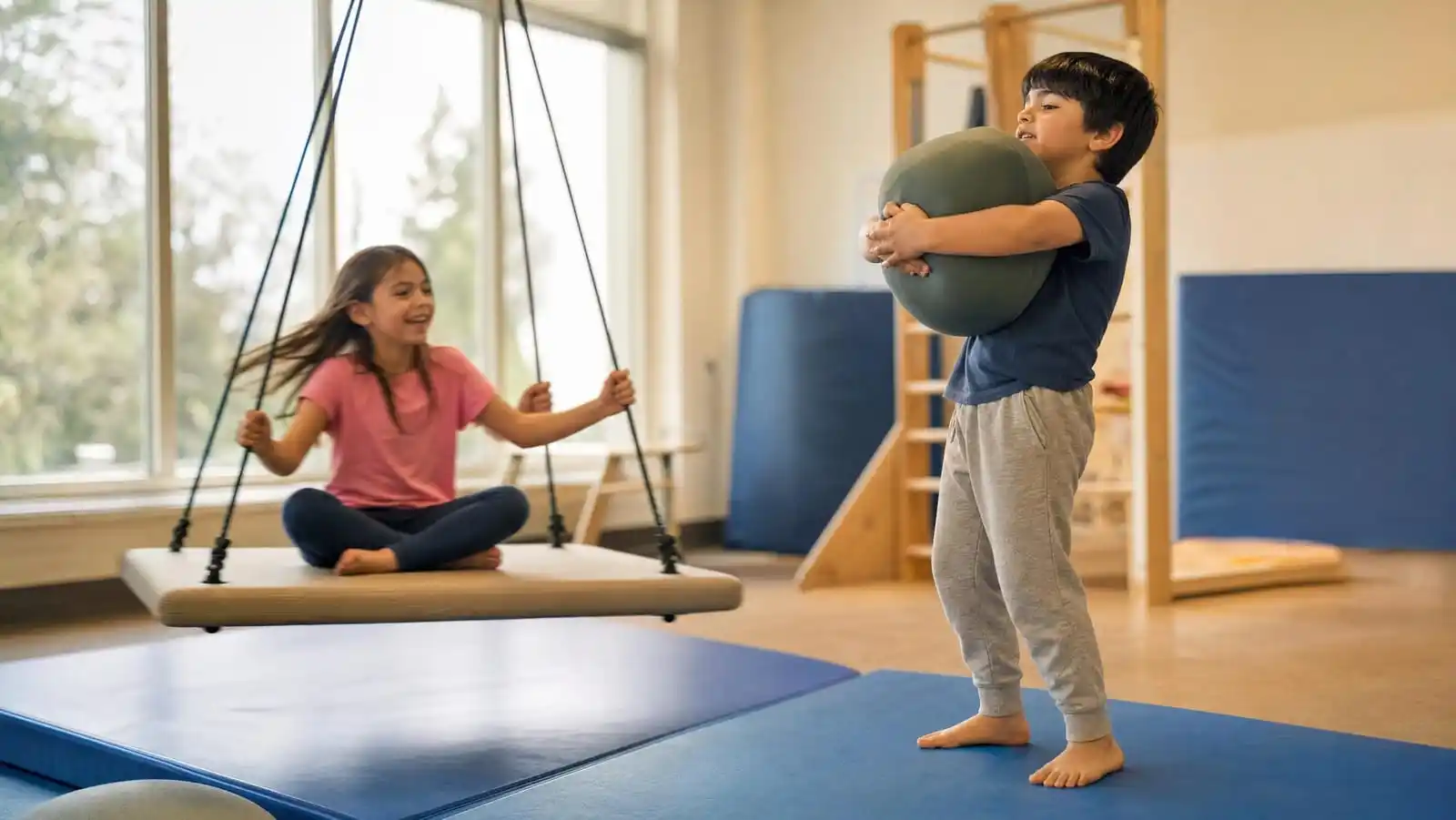
In real life you almost never get one without the other, and that is a feature rather than a complication. Picture a child on a platform swing pushing off the wall with both feet each pass: the swinging is vestibular, the push is proprioceptive, and the combination is more organizing than either alone. The same pairing shows up in a scooter board hauled hand-over-hand along a rope, in climbing a rope ladder, in hanging from monkey bars. Balance boards do it too — the wobble is vestibular, the micro-corrections in the legs and trunk are proprioceptive.
This is why "add heavy work" is such common OT advice around movement. Families use it before movement to prime an anxious child (wall push-ups, carrying something heavy to the swing), during movement by building in resistance (pushing off a wall, pulling a rope), and after movement to bring a revved-up child back down (animal walks, a chair push).
If suspended equipment is not an option at home, our roundup of vestibular activities without equipment covers rolling, rocking, and log-roll games that need nothing but floor space. Because thresholds differ so much, an OT is the right person to help you find the sequence and dose for your child.
Movement Safely: Spinning Deserves the Most Care
Spinning is the highest-risk item on this page. Heather Greutman, a certified occupational therapy assistant writing at Growing Hands-On Kids, suggests keeping spinning to no more than about 10 rotations at a time and having children spin in both directions. She notes that children with heart conditions or seizure disorders should avoid spinning unless directed by their doctor, and that overstimulation can show up as red cheeks, nausea, or feeling faint.
Watch for the signs of too much input listed by the OT Toolbox: pupil dilation, sweaty palms, changes in breathing, disorientation. The same source warns that negative reactions "may not be apparent for several hours following input" — so an unexplained meltdown at bedtime can trace back to an afternoon on the tire swing.
A short checklist we would apply in any home:
- Never spin a child who cannot ask you to stop — including babies, and any child without a reliable way to signal "enough."
- Stop the moment they want to stop, and never force movement, resistance, or pressure.
- Keep bouts short with breaks, and finish with proprioceptive input rather than more spinning.
- Check with a pediatrician or OT first if your child has low muscle tone, hypermobility, seizures, ear or balance conditions, a shunt, or any other medical condition.
- Install suspended equipment properly and supervise it. The OT Toolbox's guidance on sensory swings is blunt: follow the manufacturer's instructions, confirm the support structure can carry the load, "always supervise your child while they are using the swing," and limit rotary input to a set number of monitored minutes.
Our review of spinning toys flags which designs let a child control their own speed — a real safety advantage.
Frequently Asked Questions
Can a child seek both proprioceptive and vestibular input?
Very often, yes. The child who spins, then crashes into the beanbag, then hangs upside down is chasing both. Watch which one they return to when they are most dysregulated — that is usually the one doing the heavier lifting.
Why doesn't my child ever get dizzy?
Some children register rotary movement less strongly, so the usual dizziness signal is muted. The NAPA Center lists the ability to spin without dizziness among the signs of an under-responsive vestibular system. Mention it to your pediatrician or OT — not because it is dangerous in itself, but because your child cannot rely on dizziness to tell them they have had enough.
Which type of input is better before bedtime?
Many occupational therapists lean toward proprioceptive input in the wind-down hour: animal walks down the hallway, carrying the laundry basket, a firm bear hug. If you use movement, keep it slow, rhythmic, and linear — gentle rocking rather than spinning, which the OT Toolbox describes as intense.
Is spinning bad for my child?
No — spinning is normal, valuable play, and therapists use rotary input deliberately. The concern is dose and control: short bouts, both directions, a child who can stop it themselves, and attention to how they look afterward. Children with heart conditions, seizure disorders, or other medical concerns should check with their doctor first.
Do I need an OT to tell the difference?
Not for the basic distinction — the table above gets you most of the way. But an OT adds two things you cannot easily do at home: observing your child across settings, and calibrating dose and timing to their threshold. If sensory patterns affect safety, sleep, learning, or family life, an evaluation is worth the wait list.
The Bottom Line
Proprioception tells the brain where the body is. The vestibular sense tells the brain how the head is moving. Neither is better, and neither works alone — but they behave differently enough that knowing which one you are reaching for changes how the afternoon goes.
If you remember one thing: when in doubt, start with muscle work. Pushing, pulling, carrying, and squeezing are the most forgiving inputs, and they pair with almost any movement your child loves. Add vestibular input on purpose, watch the direction and speed, and treat it like the powerful tool it is.
For the full library of tools and age-by-age guidance on the muscle-and-joint half of this pair, start with Sensory Toy Space's proprioceptive and heavy work guide.