This article contains affiliate links. We may earn a commission if you make a purchase through our links, at no extra cost to you.
Quick Verdict
Best Overall: The Champion Sports Standard Scooter Board is our top pick for most families. It's the same durable design used in school PE classes and therapy clinics for decades—proven, affordable, and built to last.
Best Padded Option: For children who spend extended time in prone position, the Fun & Function Foam Tummy Scooter offers superior comfort with high-density foam and a contoured design that makes tummy time more enjoyable.
Best Budget Pick: The hand2mind Blue Indoor Scooter Board delivers quality construction at an unbeatable price point—perfect for families wanting to try scooter board therapy without a major investment.
Introduction: The Classic OT Tool Every Family Needs
Walk into any occupational therapy clinic, and you'll find scooter boards. These simple flat platforms on wheels have been a cornerstone of sensory therapy for decades—and for good reason. They're one of the most versatile and affordable therapy tools available, delivering powerful benefits that help children with autism, ADHD, and sensory processing disorder.
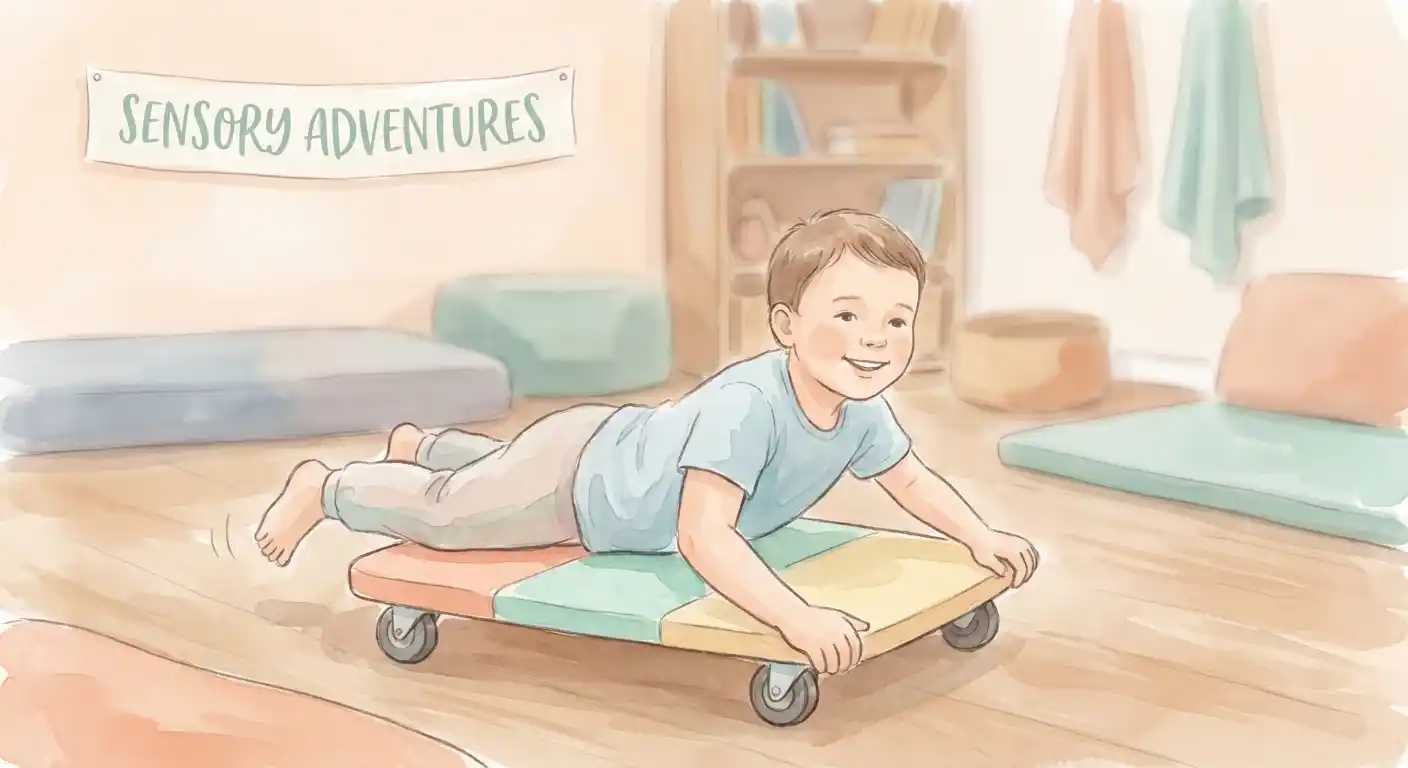
A scooter board is a flat plastic platform with four swivel casters on the bottom, typically featuring handles on the sides. Unlike standing scooters, these boards are designed for sitting, kneeling, or lying prone (on the stomach). This prone position is where the real therapeutic magic happens—children push themselves across the floor using their arms, providing intense proprioceptive and vestibular input that helps regulate their sensory systems.
For children who are sensory seekers or struggle with body awareness, scooter boards offer exactly what they need. The heavy work of pushing and pulling engages muscles and joints, while the movement stimulates the vestibular system responsible for balance and spatial orientation. Best of all, kids love them—therapy disguised as play.
Whether you're an OT looking for clinic-quality equipment, a PE teacher outfitting your gymnasium, or a parent bringing therapy tools home, we've researched the best scooter boards for sensory therapy to help you choose. For more vestibular equipment options, see our complete guide to sensory swings and vestibular toys.
Why Scooter Boards Work for Sensory Therapy
Scooter boards deliver a unique combination of sensory inputs that few other therapy tools can match. When children lie prone on a scooter board and use their arms to propel themselves forward, they receive simultaneous proprioceptive and vestibular stimulation.
Proprioceptive Input: The pushing and pulling movements create deep pressure through the joints and muscles of the arms, shoulders, and core. This "heavy work" helps children with low muscle tone build strength while also providing the calming, organizing sensory input that many autistic children crave.
Vestibular Input: Movement on wheels stimulates the vestibular system in the inner ear. Whether gliding in straight lines or spinning in circles, scooter board activities challenge the balance system and improve spatial awareness. This differs from the linear motion of sensory swings—scooter boards let children control their own speed and direction.
Motor Planning Benefits: Navigating a scooter board requires coordination and motor planning. Children must figure out how to move their arms to go forward, turn, or stop. This bilateral coordination—using both sides of the body together—strengthens neural pathways essential for daily activities.
According to occupational therapists, scooter board activities help calm and organize the nervous system. The focused physical activity can reduce feelings of stress and anxiety, decrease aggressive behaviors, and improve self-regulation. For children who struggle to sit still or focus, a few minutes on a scooter board can help them feel centered and ready to learn.
Types of Scooter Boards
Understanding the different scooter board styles helps you choose the right one for your child's needs.
Standard Plastic Square Boards: The classic design used in schools and clinics. These 12" x 12" boards are durable, easy to clean, and affordable. They work well for most children and activities.
Heavy-Duty Plastic Boards: Built with thicker plastic and reinforced construction, these boards support higher weights and withstand intense use. Ideal for therapy clinics, older children, or families wanting maximum durability.
Padded/Foam Scooter Boards: Feature cushioned tops for comfortable prone positioning. The foam surface is easier on elbows and hipbones during extended tummy time activities. Worth the investment for children who resist hard surfaces.
Contoured or Round Designs: Some scooter boards feature curved edges or round shapes that allow for easier spinning. These can provide more intense vestibular input for children who seek rotational movement.
With Handles vs. Without: Handles serve an important safety function—they keep fingers away from the rolling wheels and provide steering control. For beginners and younger children, handles are strongly recommended.
The 8 Best Scooter Boards for Sensory Therapy
1. Champion Sports Standard Scooter Board — Editor's Choice
The Champion Sports scooter board is the gold standard for a reason. Used in schools and therapy clinics nationwide, this 12" x 12" board has earned its reputation through years of dependable service.
Key Features:
- 12" x 12" sturdy plastic construction
- Contoured safety handles on all sides
- Non-marring swivel casters for smooth rolling
- Available in multiple colors
Pros:
- Proven durability used in PE classes for decades
- Affordable price point for individual or bulk purchases
- Handles keep fingers safely away from wheels
- Smooth, consistent rolling on hard surfaces
Cons:
- Hard plastic may be uncomfortable for extended prone use
- 12" size works better for younger children
Best For: Families wanting a reliable, proven scooter board at an excellent price. Schools and clinics purchasing multiple units.
"We've had ours for three years of near-daily use, and it still rolls perfectly. My son with SPD uses it every afternoon for his sensory diet."
2. hand2mind Red Heavy-Duty Scooter Board — Best Heavy Duty
Built for intensive use, the hand2mind heavy-duty model features reinforced construction that handles demanding therapy sessions and supports larger users.
Key Features:
- 16.5" x 11.25" x 3.75" dimensions
- Heavy-duty red plastic construction
- Supports up to 175 lbs
- Non-marring plastic casters
Pros:
- Larger platform accommodates older children and teens
- Reinforced design withstands intensive daily use
- Higher weight capacity than standard models
- Bright red color appeals to kids
Cons:
- Slightly higher price than basic models
- Heavier, less portable than smaller boards
Best For: Therapy clinics needing equipment that handles high-volume use. Families with older children or those wanting extra durability.
"As an OT, I've tried many scooter boards. This heavy-duty version holds up to my busiest clinic days and my patients love the larger size."
3. Fun and Function Plastic Scooter Board — Best for OT
Created by an award-winning sensory products company, the Fun and Function scooter board is designed specifically for occupational therapy use.
Key Features:
- 12" blue plastic construction
- Contoured handles for easy gripping
- 360-degree swivel casters
- Supports up to 120 lbs
Pros:
- Designed by OT specialists who understand sensory needs
- Smooth rolling for vestibular input
- Quality construction from a trusted brand
- Available in multiple colors
Cons:
- Lower weight capacity than some competitors
- Premium pricing compared to basic models
Best For: Families prioritizing products designed specifically for therapeutic use. Those who value brand expertise in sensory tools.
"The quality difference is noticeable compared to the cheap one we started with. My daughter uses it daily for her sensory breaks and it's held up beautifully."
4. Fun & Function Foam Tummy Scooter — Best Padded
For children who resist hard surfaces or need extended prone positioning, the Foam Tummy Scooter offers cushioned comfort without sacrificing functionality.
Key Features:
- 17.5" x 14" x 4.5" dimensions
- High-density foam cushioned top
- Contoured base design
- Non-marring 360-degree casters
Pros:
- Comfortable for extended tummy time activities
- Larger surface area supports full torso
- Foam resists compression over time
- Ideal for sensory integration work
Cons:
- Higher price point than plastic options
- Foam surface requires more cleaning care
- Bulkier for storage
Best For: Children who need extra comfort during prone activities. Families using scooter boards for intensive therapy sessions.
"My son has sensory aversions and wouldn't use our plastic scooter board. This foam version was a game-changer—now he asks to use it every day."
5. hand2mind Blue Indoor Scooter Board — Best Budget
Delivering quality construction at an entry-level price, the hand2mind Blue scooter board proves you don't need to overspend for effective therapy equipment.
Key Features:
- 12" x 12" plastic construction
- Safety handles on all sides
- Smooth-rolling swivel casters
- Lightweight and portable
Pros:
- Excellent value for budget-conscious families
- Same quality construction as pricier models
- Easy to clean and maintain
- Non-marring wheels safe for indoor floors
Cons:
- Standard size may be small for older children
- Basic features without extras
Best For: Families trying scooter board therapy for the first time. Those needing multiple boards without breaking the budget.
"I wasn't sure if my kids would take to scooter boards, so I started with this affordable option. They love it, and the quality is much better than the price suggests."
6. Shot Taker Co. Educational Scooter Board — Best Safety Design
Featuring redesigned safety features including wheel covers and increased board height, this scooter board prioritizes child safety without sacrificing performance.
Key Features:
- 16" x 12" x 4.5" dimensions
- Redesigned wheels with protective covers
- 4" board height for finger protection
- Supports up to 175 lbs
Pros:
- Enhanced safety features prevent finger injuries
- Larger platform fits bigger kids
- High weight capacity for growing children
- Durable construction for educational settings
Cons:
- Wheel covers may collect debris faster
- Slightly higher price for safety features
Best For: Parents prioritizing maximum safety features. Schools and daycares with strict safety requirements.
"The wheel covers give me peace of mind. My curious toddler used to try putting fingers near the wheels on our old board—this design eliminates that worry."
7. Lopxo Kids Autism Sensory Scooter Board — Best Weight Capacity
Designed specifically for children with autism, this scooter board features a higher weight capacity and sensory-friendly construction.
Key Features:
- High-strength PP material construction
- 6 mute universal casters for quiet rolling
- Supports up to 220 lbs
- Ergonomic handle design
Pros:
- Highest weight capacity in our list
- Quiet wheels won't startle sensory-sensitive children
- Explicitly designed for autism and sensory needs
- Suitable for teens and small adults
Cons:
- Newer brand with less track record
- Higher price than basic models
Best For: Older children, teens, and adults needing higher weight capacity. Families with sensory-sensitive children who need quiet equipment.
"Finally, a scooter board that holds my 12-year-old without worry! The quiet wheels are a bonus—loud rolling used to bother his sensory sensitivities."
8. GSE Games & Sports Expert 4-Pack — Best Multi-Pack
For families with multiple children, therapists building their equipment inventory, or anyone wanting variety, this four-pack delivers value and options.
Key Features:
- Set of 4 scooter boards in assorted colors
- 12" x 12" construction per board
- Includes screwdriver and casters
- Supports up to 175 lbs each
Pros:
- Excellent per-unit value buying in bulk
- Multiple colors for easy identification
- Everything needed included in pack
- Great for sibling or group activities
Cons:
- May be more than single-child families need
- Basic construction without premium features
Best For: Families with multiple children. Therapists, teachers, and daycares equipping activity spaces.
"I got these for my three kids so they could do scooter board races together. The value is unbeatable, and they've held up to some serious sibling competition."
Scooter Board Comparison Table
| Product | Best For | Weight Limit | Style | Price Range | |---------|----------|--------------|-------|-------------| | Champion Sports | Most Families | 175 lbs | Standard Plastic | $12-$18 | | hand2mind Heavy-Duty | Intensive Use | 175 lbs | Heavy-Duty Plastic | $15-$22 | | Fun and Function | OT Sessions | 120 lbs | Premium Plastic | $18-$25 | | Foam Tummy Scooter | Comfort | 150 lbs | Padded Foam | $55-$75 | | hand2mind Blue | Budget | 150 lbs | Standard Plastic | $12-$18 | | Shot Taker Co. | Safety Features | 175 lbs | Safety-Enhanced | $16-$22 | | Lopxo Sensory | Higher Capacity | 220 lbs | Autism-Focused | $25-$35 | | GSE 4-Pack | Multiple Kids | 175 lbs | Value Multi-Pack | $35-$50 |
How to Choose the Right Scooter Board
Size Matters
Standard 12" x 12" boards work well for children ages 3-8. For older children, teens, or adults, look for larger platforms (16" x 12" or bigger) that accommodate longer torsos during prone activities. A board that's too small forces awkward positioning that reduces therapeutic benefits.
Handles vs. No Handles
We strongly recommend scooter boards with handles, especially for beginners and younger children. Handles serve two critical functions: they keep fingers away from rolling wheels, and they provide steering control. Some children graduate to handleless boards as they develop skills, but safety handles are the better starting point.
Plastic vs. Padded
Standard plastic boards work fine for most children and activities. However, if your child will spend extended time in prone position or has tactile sensitivities to hard surfaces, invest in a padded foam scooter. The comfort difference makes a significant impact on how long children will engage with the activity.
Weight Capacity
Choose a scooter board rated well above your child's current weight. This ensures durability as they grow and prevents the board from flexing under use. Most quality scooter boards support 150-175 lbs, which accommodates children through their teen years.
Wheel Quality
Non-marring wheels are essential for indoor use—they won't scuff or damage hardwood, tile, or laminate floors. Look for swivel casters that roll smoothly in all directions. Quality wheels make a noticeable difference in how easily children can propel themselves.
For comparison with other vestibular tools, balance boards offer standing vestibular input while scooter boards excel at prone activities.
10 Scooter Board Activities for Sensory Therapy
1. Prone Superman Glides
Have your child lie on their stomach with arms extended forward like Superman. They push themselves across the room using only their arms, building upper body and core strength while receiving proprioceptive input.
2. Seated Spinning
Sitting cross-legged on the board, children use their hands to spin themselves in circles. This provides intense vestibular input—start slow and watch for signs of overstimulation. Some children can handle more rotation than others.
3. Obstacle Course Navigation
Set up cushions, cones, or furniture as obstacles. Children navigate the course while prone on the scooter board, developing motor planning skills and spatial awareness as they figure out how to steer around barriers.
4. Partner Pulling with Rope
Attach a rope to the scooter board handles. One person sits on the board while another pulls them across the room. The seated child receives vestibular input while the puller gets proprioceptive heavy work—double the sensory benefit.
5. Tunnel Crawling
Create tunnels using tables, chairs with blankets, or play tunnels. Children propel themselves through on their scooter boards, adding an element of adventure while developing motor planning skills.
6. Ball Target Games
While prone on the scooter board, children throw balls at targets. This challenges core stability and bilateral coordination as they must stabilize their body while also aiming and throwing.
7. Relay Races
For families with multiple children, set up relay races where kids take turns scooting across the room. The competitive element motivates participation while everyone receives sensory benefits.
8. Ramp Rolling
Create gentle inclines using foam wedges or boards propped on books. Children roll down for vestibular thrill and push themselves back up for proprioceptive work—like their own therapy roller coaster.
9. Crash Pad Landings
Position a crash pad or pile of pillows at the end of a glide path. Children propel themselves toward the crash pad for heavy work impact at the finish. Always supervise for safety.
10. Quiet Floor Time
Sometimes the best activity is gentle, slow movement. Children lie prone and slowly push themselves around while processing other sensory input—perfect for calming overstimulated nervous systems.
For children who crave more intense vestibular input, consider adding spinning toys to your therapy toolkit.
Safety Guidelines for Scooter Board Use
NEVER Stand on Scooter Boards: This is the most important rule. Scooter boards look like skateboards, and children will want to stand on them. Resist this urge—the narrow platform and swivel wheels create a serious fall hazard. Enforce a firm "no standing" rule from day one.
Always Supervise Younger Children: Children under 6 should have an adult present during all scooter board activities. Even older children benefit from supervision until they demonstrate safe, controlled use.
Use on Smooth, Hard Surfaces Only: Scooter boards work best on hardwood, tile, laminate, or smooth concrete floors. Carpet prevents proper rolling, and rough outdoor surfaces can cause sudden stops that throw children off balance.
Check Wheels Regularly: Inspect casters for debris, hair, or damage that could affect rolling. Stuck wheels can cause unexpected stops or uneven movement. Clean wheels regularly for optimal performance.
Finger Safety: Even with handled boards, teach children to keep hands on top of the handles rather than near the wheels. The handles exist to protect fingers—make sure children use them properly.
Start Slow with Vestibular-Sensitive Children: Some children are hypersensitive to vestibular input and may become dizzy, nauseous, or disoriented quickly. Begin with slow, linear movements and gradually increase intensity based on the child's tolerance.
Frequently Asked Questions
What age can kids start using scooter boards?
Most children can begin supervised scooter board activities around age 3, when they have sufficient upper body strength to push themselves while prone. Choose a smaller board with sturdy handles for beginners. Always supervise young children and start with simple, slow activities before progressing to faster or more complex movements.
Are scooter boards safe for kids with autism?
Yes, scooter boards are widely used in occupational therapy for autistic children. They provide the proprioceptive and vestibular input that many autistic children actively seek. The key is matching the activities to the child's sensory profile—some children crave intense movement while others need gentler input. Start slowly and observe your child's responses.
Can adults use therapy scooter boards?
Adults can use scooter boards, but you'll need one with appropriate weight capacity. The Lopxo model supports up to 220 lbs, making it suitable for most adults. Adults benefit from the same proprioceptive and vestibular inputs as children, making scooter boards useful for adult sensory processing support and physical therapy applications.
How do scooter boards help with sensory processing?
Scooter boards provide two types of sensory input simultaneously. The pushing and pulling movements create proprioceptive input through joints and muscles, which has a calming, organizing effect on the nervous system. The rolling movement stimulates the vestibular system responsible for balance and spatial awareness. Together, these inputs help children regulate their sensory systems, improve body awareness, and develop motor skills.
Conclusion
Scooter boards remain one of the most effective and affordable sensory therapy tools available. Used by occupational therapists for decades, these simple platforms on wheels deliver powerful proprioceptive and vestibular input that helps children with autism, ADHD, and sensory processing challenges regulate their systems and build strength.
Our Top Recommendations:
- Best Overall: Champion Sports Standard Scooter Board — Proven, durable, and affordable
- Best for Comfort: Fun & Function Foam Tummy Scooter — Cushioned for extended prone activities
- Best Budget: hand2mind Blue Indoor Scooter Board — Quality construction at an unbeatable price
Unlike sensory swings that require installation or specialized stands, scooter boards need nothing but a smooth floor. They're portable, easy to store, and provide therapy benefits that rival much more expensive equipment. Every sensory toolkit should include one.
For comprehensive guidance on building a complete vestibular therapy setup at home, explore our full vestibular toys guide covering swings, balance boards, spinning toys, and more.